ADHD Visual Cleaning Reset: Use a Four-Zone Room Map Instead of a To-Do List
Evidence ExplainerQuick picks
| Product | Key Specs |
|---|---|
| See price on Amazon |
|
| See price on Amazon |
|
Product availability, certifications, and retailer details can change; check the current Amazon page before buying.
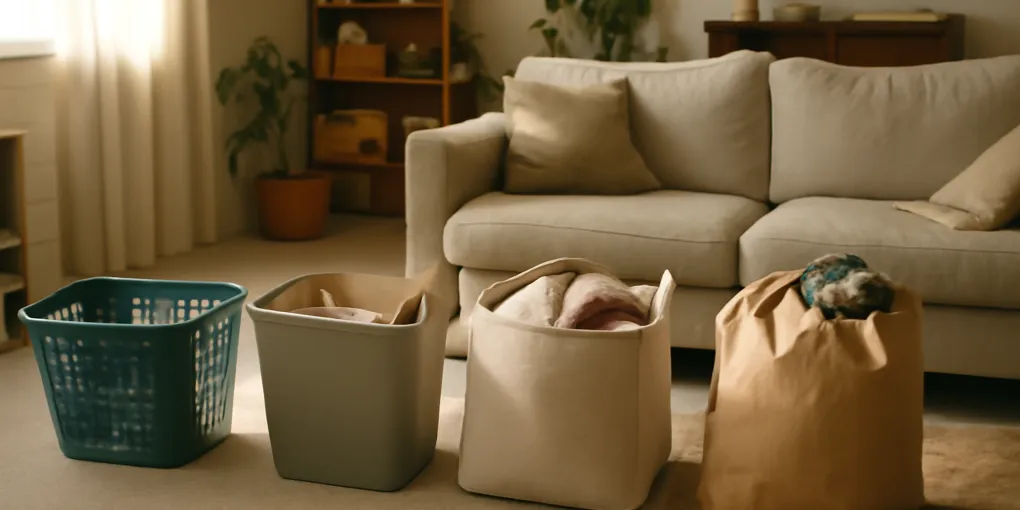
A cluttered room can look like one task, but it is usually four different tasks mixed together: trash, dishes, laundry, and belongings that migrated from another room. For an ADHD-friendly reset, separating those materials matters more than choosing the perfect organizer.
The goal for this session is concrete: clear a walking path, make one seat usable, and return the room to a state where tomorrow’s clutter is visible rather than buried. It is not a demand to deep-clean, sort keepsakes, or redesign the room.
Make four visible destinations before touching the pile
Place four open destinations where you can see them from the room’s doorway:
- A trash or recycling bag.
- A dish tub or tray for cups, plates, and bottles.
- A laundry basket.
- A “belongs elsewhere” basket.
Do not label a fifth basket “miscellaneous.” That category turns every delayed decision into a new pile. If an object needs a decision, leave it where it is until the four fast categories are out of the way.
This setup uses external cues rather than memory. The CDC describes ADHD as involving persistent patterns of inattention and/or hyperactivity-impulsivity that can interfere with daily functioning; practical supports often work better when the next action is made obvious rather than held in working memory alone (CDC ADHD overview). This is a home-management adaptation, not a treatment for ADHD.
Run the reset in material passes, not by surface
Set a timer for 12 minutes. Start at the doorway and move clockwise, but pick up only trash and recycling. Ignore laundry, papers, and items you could potentially organize. When the timer ends, take the bag out or tie it closed beside the exit.
Reset the timer for another 12 minutes and collect dishes. A dish tub is useful because it prevents the familiar detour of carrying one mug to the kitchen, noticing the counter, and abandoning the original room. Put the tub by the sink; washing can be a separate task.
The third pass is laundry. Put wearable clothes, towels, and bedding in the basket. Do not fold, match socks, or decide whether an old shirt should be donated. The fourth pass is the elsewhere basket. Carry it room by room only after the room has a clear path.
The National Institute of Mental Health notes that ADHD treatment can include behavioral interventions alongside other individualized care (NIMH ADHD information). A visual reset is not clinical care, but its narrow sequence can reduce the number of competing choices in a moment of overwhelm.
Pick a stopping point that changes how the room works
A useful stop line is not “everything put away.” Choose two physical outcomes:
- You can walk from the door to the bed, desk, or sofa without stepping around objects.
- One main working surface has room for its actual job: sleep, eating, homework, or sitting.
For a bedroom, that might be a clear strip from door to bed and an empty nightstand corner for water and medication. For a living room, it might be a clear sofa seat and coffee-table space for one tray. For a home office, it might be a clear chair and enough desk space for a laptop.
Make the stop line visible before starting. Put painter’s tape around one laptop-sized rectangle on the desk, place an empty tray on the coffee table, or set the laundry basket beside the exact floor path you want to clear. At the end of each material pass, compare that same area—not the whole room—to its starting state. If the door opens normally, the route to the main seat or bed is unobstructed, and the chosen work surface can perform its job, the reset has delivered its promised outcome.
That specificity matters because “clean the room” has no natural finish. A clear floor path and usable seat do.
Keep the next reset easier than the first
After the room is usable, look for the category that reappears in the same place. A laundry pile near the bed may need a basket within arm’s reach. Cups near the sofa may need a tray that makes a single kitchen trip possible. Mail on a desk may need a separate paper inbox, not another decorative catchall.
Do not buy containers for every category after one reset. Test the location for a week. If the same items land there again, give that category an open, low-lid home. If they do not, the pile may have been a one-time backlog.
Optional containers after the route works
Buy a container only for a category and location the reset has already revealed. ClearSpace Clear Plastic Storage Bins can keep a recurring category visible on a shelf; measure the shelf and see price on Amazon only if an open clear bin matches the tested landing place. Do not use a large bin as a new miscellaneous pile.
For infrequent or emotionally loaded items that need a dated review rather than daily access, IRIS USA 21 Qt Stackable Bins with Lids provide a different boundary; confirm the quantity and dimensions, then see price on Amazon. A lidded multipack is excessive for one small decision box, so skip it unless several defined categories already need the same format.
When to pause and get support
Stop the reset if you uncover spoiled food, broken glass, pests, medication concerns, or blocked exits that need a different response. Ask another person to help with heavy lifting, sharp objects, or tasks that feel emotionally loaded. If ADHD symptoms are making routine care consistently difficult, a clinician can help assess supports and treatment options; organization content cannot replace that conversation.
ADHD visual cleaning reset FAQ
What if I keep moving objects from one pile to another?
Return to the four materials. Trash goes out, dishes go to the tub, laundry goes to the basket, and elsewhere items go to one carry basket. Do not create a sorting project until the floor path is clear.
Can I use a timer if it makes me anxious?
Yes, but make it an end signal rather than a pressure signal. Set 10 or 12 minutes and stop when it rings. You can choose a second round later; the timer’s job is to limit the task, not force completion.
What should I do with sentimental clutter during a reset?
Leave it for a planned session. Sentimental decisions are slower and can derail a room reset. Put the object in one clearly marked temporary box only if it blocks the path.
Sources
- Centers for Disease Control and Prevention, About ADHD: https://www.cdc.gov/adhd/about/index.html
- National Institute of Mental Health, Attention-Deficit/Hyperactivity Disorder: https://www.nimh.nih.gov/health/topics/attention-deficit-hyperactivity-disorder-adhd
Frequently Asked Questions
- Use visible zones and handle only one material at a time: trash, dishes, laundry, and items that belong elsewhere. Stop after the floor path and main seat are usable.
- Usually no. Make the room usable first. Buy a container only when the same category repeatedly has no nearby home after several resets.
- A broad list asks you to choose among many tasks at once. A visible four-zone reset narrows the next action and gives each item an immediate destination.