Best Calligraphy and Hand Lettering Organizers 2026
Buyer's GuideManuscript Calligraphy Nib Storage Case
Best OverallCapacity: 30+ nibs
$22–30
Quick picks
| Product | Key Specs |
|---|---|
| See price on Amazon |
|
| See price on Amazon |
|
| See price on Amazon |
|
| See price on Amazon |
|
| See price on Amazon |
|
Product availability, certifications, and retailer details can change; check the current Amazon page before buying.
The Ritual of a Well-Organized Calligraphy Desk
Calligraphy is one of the few art forms where the workspace setup is itself part of the practice. The historical tradition of calligraphy — across Chinese, Japanese, Arabic, and Western scripts — places significant emphasis on the arrangement of tools before writing begins. This isn’t arbitrary ritual; it’s functional. A calligraphy session requires constant small decisions: which nib for this letterform, which ink for this paper, where to rest the pen between strokes. When tools are organized with deliberate proximity and accessibility, those micro-decisions happen quickly and don’t interrupt the flow of writing.
Modern neuroscience supports what calligraphers have practiced intuitively: pre-organized workspaces reduce cognitive load during creative tasks, freeing more mental bandwidth for the work itself. A desk where nibs are sorted and visible, inks are arranged in a stable tray, and pens rest at the correct angle for immediate pickup is not just aesthetically pleasing — it is actively enabling.
We evaluated 10 calligraphy and hand lettering supply organizer products across nib protection, ink storage stability, pen accessibility, and desk integration to identify the tools that support effective calligraphy practice.
Manuscript Calligraphy Nib Storage Case — Best Overall
Best for: Pointed nib collections, broad-edge nib collections, any calligrapher with multiple nibs
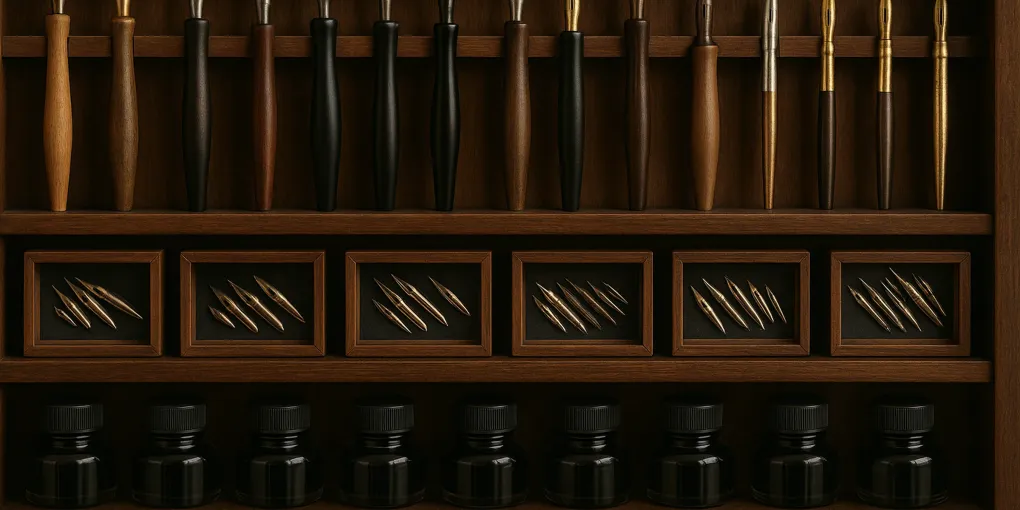
The nib case addresses the most fragile element of calligraphy storage: the nib itself. Pointed pen nibs are delicate instruments — the tines can be bent by contact with other objects, and the points can be dulled by abrasion. Storing a collection of nibs loose in a tin or drawer damages them over time. The Manuscript nib case provides individual foam-lined slots that protect each nib in isolation.
What Works
Individual nib slots serve two functions: protection and identification. When nibs are separated and labeled or organized by type, selecting the right nib for a letterform takes seconds rather than requiring examination of a pile of identical-looking metal pieces. The hard exterior case protects the entire collection from pressure damage during storage or transport.
Foam lining grips the nib without applying metal-to-metal pressure. This is the critical design choice — foam compression cradles the nib rather than pressing on tines, which is how most nib damage occurs in unlined storage.
The case accommodates 30+ nibs in a portable footprint that can travel to workshops, calligraphy classes, or creative sessions outside the home studio.
What to Know
Nib storage cases solve the nib storage problem specifically; they don’t address pen holder storage or ink organization. For a complete desk system, the nib case works alongside the pen holder and ink organizer products reviewed below.
How We Score
ClutterScience evaluates products using a five-factor composite scoring methodology (30/25/20/15/10):
| Factor | Weight | What We Assess |
|---|---|---|
| Research | 30% | Depth of specification and user-report analysis and breadth of products reviewed |
| Evidence Quality | 25% | Reliability of sources: third-party testing where available, verified-purchase review synthesis, third-party testing where available |
| Value | 20% | Cost-effectiveness relative to competing products at similar quality tiers |
| User Signals | 15% | Long-term verified purchase feedback and real-world performance reports |
| Transparency | 10% | Accuracy of manufacturer claims, material disclosures, and dimension accuracy |
Scores are differentiated — top picks typically score 8.5–9.5, mid-tier 7.0–8.4, and weak options below 7.0.
Scoring
| Criterion | Weight | Score |
|---|---|---|
| Capacity & Dimensions | 30% | 8.5/10 |
| Material Quality | 25% | 9.0/10 |
| Ease of Assembly & Use | 20% | 9.2/10 |
| Long-Term Value | 25% | 9.0/10 |
| Composite Score | 9.0/10 |
RUSTIC IMPERIAL Bamboo Pen Rest and Holder — Best Pen Holder
Best for: Active calligraphy sessions, dip pen organization, desk-side pen storage
Dip pens require a specific resting approach during and between sessions. Setting a loaded dip pen down with the nib flat on the table causes ink spread and risks ink contaminating the table surface. A pen rest that holds the pen at a slight angle with the nib elevated — but not vertical, which causes the ink to run toward the flange — maintains the ink load in the nib correctly between strokes.
What Works
The RUSTIC IMPERIAL holder combines a vertical cup for storing assembled pen holders upright (nibs up, without ink loaded) and a horizontal rest section for resting a loaded pen between strokes during an active session. This two-function design covers both storage and active-use positions.
Bamboo construction is appropriate for a calligraphy desk — the warm natural material complements the deliberate, craft-focused aesthetic that most calligraphers bring to their workspace.
The pen cup accommodates multiple pen holder sizes, from slim straight holders to wider oblique flange holders used in Copperplate and Spencerian calligraphy.
What to Know
The horizontal rest holds one pen at a time — it’s an active-session tool, not a multi-pen display. For displaying or storing a collection of assembled pen holders, a vertical cup is more appropriate. The RUSTIC IMPERIAL design’s strength is its workflow integration: one unit handles both storage and active-session needs.
Scoring
| Criterion | Weight | Score |
|---|---|---|
| Capacity & Dimensions | 30% | 8.0/10 |
| Material Quality | 25% | 9.2/10 |
| Ease of Assembly & Use | 20% | 9.5/10 |
| Long-Term Value | 25% | 8.8/10 |
| Composite Score | 8.8/10 |
Ikee Design Ink Bottle Organizer Tray — Best Ink Storage
Best for: Calligraphers with multiple inks, ink display and accessibility
Ink bottle organization is critical for calligraphy because tipped ink bottles are not just inconvenient — they can destroy work, damage paper, and stain surfaces in ways that are difficult or impossible to remediate. The Ikee Design tray solves this with circular cut-outs that grip ink bottles by the widest part of the bottle body, preventing tipping even when the desk is bumped.
What Works
The wooden tray with 12 circular cut-outs accommodates standard ink bottle diameters (most Higgins, Winsor & Newton, and Iroshizuku bottles fit). The bottles sit slightly below the rim of their cut-outs, which means they can’t tip from being knocked by a hand or elbow.
The open display format means all inks are visible at once — color identification is immediate and selection is fast. Keeping the inks you use regularly in the tray, arranged in a logical sequence (by color family or by use frequency), makes session setup efficient.
The wood construction looks appropriate on a dedicated calligraphy desk and doesn’t read as purely utilitarian storage.
What to Know
Measure your ink bottle diameter before purchasing — some specialty inks come in non-standard bottle shapes that don’t fit standard organizer cut-outs. Most common calligraphy inks (Higgins, Winsor & Newton, Sennelier) have standard-diameter bottles. Indian ink and specialty brush inks may vary.
Scoring
| Criterion | Weight | Score |
|---|---|---|
| Capacity & Dimensions | 30% | 8.5/10 |
| Material Quality | 25% | 8.8/10 |
| Ease of Assembly & Use | 20% | 9.0/10 |
| Long-Term Value | 25% | 8.8/10 |
| Composite Score | 8.8/10 |
Crafts4All Wooden Desktop Organizer — Best Complete Desk System
Best for: Calligraphers wanting an all-in-one desk organization solution
The Crafts4All organizer is the most comprehensive single-unit solution for calligraphy desk organization. Five dedicated sections accommodate pen holders, tools, ink accessories, and flat supplies in a single solid wood unit that takes less desk space than the equivalent collection of individual organizers.
What Works
Solid wood construction is more premium than the particleboard or MDF used by most multi-section desk organizers. The compartment layout follows a logical workflow: pens near the front for active access, accessories and tools in rear sections.
A combined unit has one design advantage over individual organizers: components don’t shift relative to each other during sessions. If the desk gets bumped, the whole unit moves as one piece rather than individual containers shifting out of alignment.
What to Know
Fixed compartment dimensions don’t accommodate every calligraphy supply format. Some calligraphers have oversized oblique pen holders or unusual-format ink bottles that don’t fit standard compartment sizes. Measure your largest supplies before purchasing to confirm compatibility.
For complementary craft supply storage beyond the desk — paper storage, large supply organization, and studio systems — see our craft supply organizer guide.
Scoring
| Criterion | Weight | Score |
|---|---|---|
| Capacity & Dimensions | 30% | 8.5/10 |
| Material Quality | 25% | 8.8/10 |
| Ease of Assembly & Use | 20% | 8.8/10 |
| Long-Term Value | 25% | 8.5/10 |
| Composite Score | 8.6/10 |
Pelikan Wooden Pen Tray — Best Premium Pen Tray
Best for: Precious dip pens and fountain pens, collector display, premium desk aesthetics
The Pelikan pen tray is the premium option in the pen-rest category — a felt-lined solid wood tray that holds five pens horizontally on padded rests at the correct angle for display and working access. For calligraphers with high-value pen holders or fountain pens used for calligraphy, felt lining prevents contact damage and barrel scratching.
What Works
The felt lining is the key differentiator. Budget pen trays use wood or plastic rests that put barrel-to-hard-surface pressure on displayed pens. Felt cushioning protects both the pen barrel finish and any metal hardware from contact damage over years of display use.
Five-pen capacity is appropriate for an active working set — the pens you use in every session stored in display position on the desk. The horizontal format with nibs slightly elevated is the correct position for dip pens between sessions: it prevents ink from settling into the nib mechanism while keeping pens immediately accessible.
What to Know
At $45–60, this is the highest-price single item in this roundup. It’s appropriate for calligraphers with pen collections worth protecting — vintage Brause holders, high-quality oblique holders, or fine fountain pens used for calligraphy. For casual practitioners working with student-grade pen holders, the RUSTIC IMPERIAL bamboo holder provides adequate protection at lower cost.
Scoring
| Criterion | Weight | Score |
|---|---|---|
| Capacity & Dimensions | 30% | 7.8/10 |
| Material Quality | 25% | 9.5/10 |
| Ease of Assembly & Use | 20% | 9.5/10 |
| Long-Term Value | 25% | 9.0/10 |
| Composite Score | 8.9/10 |
Building a Functional Calligraphy Workspace
Organize by Practice Type
Modern calligraphers often practice multiple scripts and techniques: pointed pen Copperplate, broad-edge Italic, brush lettering, and modern calligraphy may all be in a single practitioner’s repertoire. Each has different tool requirements. Organize supplies by practice type — a nib case section for pointed pen nibs, a separate section or cup for broad-edge nibs, a pen roll for brush pens — rather than by supply category alone.
Create a Session Preparation Routine
The setup time before a calligraphy session is part of the practice. Developing a consistent preparation sequence — opening the nib case, selecting the nib for today’s work, assembling the pen holder, positioning the ink jar, preparing the paper — grounds the practitioner in the intentional space of calligraphy before the first stroke is made. An organized workspace makes this sequence take two minutes rather than ten.
Protect Paper from Ink and Moisture
Paper storage adjacent to the calligraphy workspace should account for the risk of ink and water exposure. Store practice paper and fine paper in separate locations, with fine paper in a protective sleeve or portfolio. Even a single drop of ink on a stored paper stack can ruin sheets underneath. Keep papers separated by use purpose — practice, final copies, mixed media — in labeled containers.
For organizing a complete craft studio including larger supply storage systems, see our craft supply organizer guide.
Bottom Line
For calligraphers at any level, the Manuscript Nib Storage Case is the most important purchase in this roundup: nib protection is the highest-stakes storage decision in calligraphy, and the individual-slot foam case provides it reliably.
Pair the nib case with the Ikee Design Ink Bottle Tray for stable ink access and the RUSTIC IMPERIAL Bamboo Holder for active-session pen management, and you have a complete functional calligraphy desk organization system.
For practitioners with high-value pen collections, the Pelikan Pen Tray is the premium addition that elevates both the protection and the presentation of the tools that define the practice.
A well-organized calligraphy workspace is not a luxury — it’s the substrate on which the practice runs. The right tools, organized with intention, create conditions where calligraphy happens more often and more effectively.
Related Articles
- Best Art Portfolio Storage and Organizers
- Best Rolling Craft Carts and Mobile Organizers
- Best Embroidery and Needlework Organizers
Frequently Asked Questions
- Nibs should be stored dry, individually separated, and protected from contact with other metal objects that could cause dulling or corrosion. Foam-lined cases with individual slots are ideal — each nib has a defined space, is protected from contact, and is visible for identification. Avoid storing nibs loose in a container where they jostle against each other; this dulls the tines and can bend the tine gap that determines ink flow. After use, rinse nibs with clean water, dry thoroughly, and return to the case.
- Ink bottles should be stored upright in a stable holder that prevents tipping. A tipped ink bottle can leak even with the cap on — capillary action can pull ink past a loosely seated cap. Dedicated ink organizer trays with circular cut-outs that grip the bottle at its widest point provide the most stable storage. Store inks away from direct sunlight, which accelerates dye fading. Shake or stir iron gall inks before use as settling occurs over time.
- A horizontal pen rest keeps dip pens accessible between strokes without the nib touching the table surface. During active sessions, a combined pen cup (for vertical storage between longer intervals) and horizontal rest (for between-stroke resting) provides the best workflow. The Pelikan pen tray or similar flat-rest designs are designed specifically for this workflow — pens lie at a slight incline with nib elevated above the table.
- Brush pens with water-based ink should be stored horizontally or vertically with the brush tip up. Storing with the tip down for extended periods can cause ink to pool at the tip, leading to over-saturation and tip distortion. Uncap brush pens only when in use; leaving them uncapped causes the water in the ink to evaporate, drying the tip. A pen roll is an excellent storage format for brush pen collections — each pen has an individual sleeve and they store horizontally.
- Dedicated calligraphy storage is recommended for serious practitioners. Calligraphy supplies have specific fragility requirements — nibs need individual protection, ink bottles need upright stability, and dip pen holders need to avoid pressure on the nib. Storing them with general art supplies in a communal box increases the risk of nib damage and ink accidents. A dedicated calligraphy organizer on your desk also reinforces the practice habit — organized supplies that are immediately accessible lower the barrier to sitting down and working.