Best Clear Stackable Sweater Bins for Closet Shelves: What Actually Stays Reachable
Buyer's GuideDrop-Front Clear Stackable Sweater Boxes
Best overall reachBest For: Weekly sweaters on eye-level shelves
$45-90 per multi-pack
Quick picks
| Product | Key Specs |
|---|---|
| See price on Amazon |
|
| See price on Amazon |
|
| See price on Amazon |
|
Product availability, certifications, and retailer details can change; check the current Amazon page before buying.
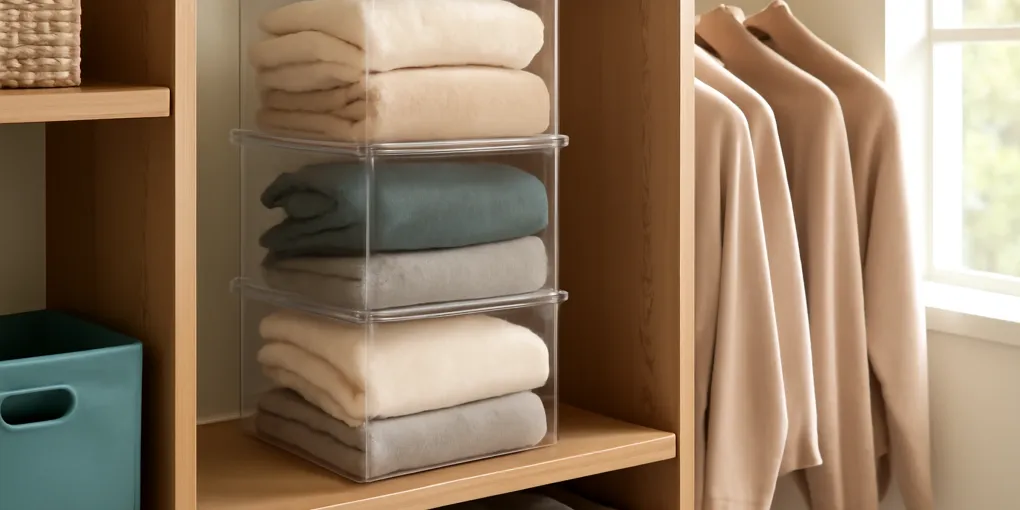
Clear stackable sweater bins solve a specific closet problem: folded sweaters are bulky enough to topple, soft enough to slump, and often stored on shelves that are just a little too high or deep for easy access. The best bin is not simply the clearest or the largest. It is the one that lets you see the sweater, reach it without unloading the shelf, and return it without rebuilding a folded tower.
For most closet shelves, the safest first choice is a drop-front clear stackable sweater box. It keeps the visibility advantage of a clear bin while removing the main failure point of stacked lidded boxes: needing to lift the top box every time you want something from the lower one. If the sweaters are seasonal or rarely used, a clear lidded sweater bin can be a better value. If your closet shelves are deep and hard to reach, a clear drawer-style bin may be worth the extra footprint.
This guide assumes a normal bedroom closet shelf rather than a garage tote system. The goal is reachable clothing, not archive storage. If you are rotating wool, cashmere, and winter layers between seasons, pair the bin choice with our guide to how to rotate a seasonal wardrobe. If the closet feels busy even when everything is technically sorted, read low-visual-noise storage before buying more containers.
Quick picks for clear sweater bins
- Best overall reach: Search Amazon for drop-front sweater boxes. Choose these for eye-level or chest-level shelves where sweaters are used weekly.
- Best budget stack: Search Amazon for clear lidded sweater bins. Choose these for out-of-season sweaters or upper shelves where access is occasional.
- Best deep-shelf option: Search Amazon for clear sweater drawer bins. Choose these when the back half of the shelf is where sweaters disappear.
The important rule is simple: do not stack a bin higher than you are willing to access on a normal weekday. A system that requires both hands, a step stool, and a rebuilt pile will work only during the first week after organizing.
What actually stays reachable?
Reachability depends on shelf height, stack height, opening style, and sweater thickness. A clear bin can look perfect in a product photo and still fail if it sits above shoulder height with a tight snap lid. Visibility gets you only halfway. The bin also has to open in the direction your body can comfortably use.
For shelves between waist and eye level, drop-front boxes are the strongest choice. You can open the front, pull one folded sweater, and close the door while the stack remains in place. For shelves above eye level, any heavy clear box becomes less convenient. A lidded bin may still be acceptable there, but only for categories you touch monthly or seasonally.
Depth is the second hidden issue. Many closet shelves are 12 to 16 inches deep, but some built-in systems run deeper. A 14-inch-deep bin on a 16-inch shelf is usually fine. A 20-inch-deep bin may store more sweaters but push the back row into a place you cannot see or reach. If you need a deep bin, drawer-style access becomes more important because it brings the contents forward.
Drop-front clear stackable sweater boxes
Drop-front sweater boxes are the best overall category for everyday closet shelves because they preserve access after stacking. The front panel opens like a small door, so the lower box in a two-high stack remains useful. That single feature matters more than almost any decorative detail.
Look for boxes with a rigid frame, a door that opens wide enough for both hands, and a flat top that supports another box without bowing. Some cheap clear boxes are technically stackable only when empty or lightly loaded. Sweaters are not extremely heavy, but several cotton knits can still make a flimsy lid sag. If the top bows, the door below may scrape or stick.
The best fit is a shelf at waist, chest, or eye height with enough front clearance to open the door fully. This format is especially good for work sweaters, cardigans, school uniform layers, and anything that leaves the closet more than once a week. Shopping option: Search Amazon for drop-front clear stackable sweater boxes.
Clear lidded sweater storage bins
Clear lidded sweater bins are the value choice when access frequency is low. They protect folded knits from dust, keep categories together, and cost less per bin than many drawer or drop-front systems. For off-season storage on an upper shelf, that is often enough.
Use lidded bins for sweaters you retrieve in batches: winter wool moved out in spring, holiday layers, ski-base layers, or rarely worn formal cardigans. Do not use them as the primary home for the sweater you grab twice a week unless the bin sits alone at an easy height. Once lidded bins are stacked, the lower bins become less reachable because the top bin has to move first.
Shopping option: Search Amazon for clear lidded sweater storage bins.
Clear stackable sweater drawer bins
Drawer-style sweater bins are useful when the shelf is deep or when the closet has a built-in tower where the back of each shelf disappears. Instead of opening a front door and reaching into the box, the drawer pulls forward. That motion makes the back half of the bin more usable.
This format works best on sturdy shelves at waist to chest height. It is not ideal for very high shelves because pulling a loaded drawer toward your face is awkward. It also needs enough shelf depth for the frame and enough front clearance for the drawer to extend. Measure the shelf depth, then check the product depth with the drawer open if the listing provides it.
Shopping option: Search Amazon for clear stackable sweater drawer bins.
Fit checks that matter
Choose the bin style by shelf clearance, access direction, sweater thickness, stack stability, and how often the clothes move in and out of rotation.
| Fit check | What to verify |
|---|---|
| Fit and safety | Comparison across access styles, shelf layouts, sweater thickness, and seasonal versus daily storage use. |
| Verifiable details | Observable traits such as dimensions, door style, stack stability, wall thickness, lid rigidity, and drawer-slide behavior. |
| Value and capacity | Capacity and durability relative to price, including whether the bin prevents re-folding and closet-floor overflow. |
| Daily friction | Patterns around doors popping open, lids cracking, drawers sticking, stacks bowing, and bins becoming too heavy to retrieve. |
| Listing clarity | Clear dimensions, realistic product photos, material details, load guidance, and return-policy confidence. |
For sweaters used often, drop-front boxes are usually the easiest stack because access remains good after stacking. Lidded bins can be economical for off-season pieces, but they are frustrating when stacked for daily use. Drawer-style bins can be the best fit for deep shelves, but only when the frame is stable, the drawer opens fully, and the shelf height makes pull-out access comfortable without lifting a heavy stack.
Setup rules before you buy
Measure the shelf opening, not just the shelf board. Closet rods, shelf pins, door tracks, trim, and side returns can reduce the usable opening. Write down width, depth, and vertical clearance. Then decide whether the bin will sit alone, stack two high, or stack three high. For sweaters, two high is usually the practical maximum for everyday access.
Start by editing the sweater category before adding bins. Remove pieces that need repair, cleaning, donation, or off-season storage. Clear bins make inventory visible, but they should not preserve sweaters you already know you do not wear.
Next, fold by thickness. Put bulky knits together, lightweight cardigans together, and delicate materials together. Mixing thick and thin items in the same bin causes the stack to lean. If a delicate sweater has buttons, beads, or open knitwork, avoid burying it under heavier cotton or fleece.
Finally, test the laundry return. Put one clean sweater back into each bin as if you were tired and in a hurry. If the door catches, the lid needs two hands, or the drawer has to be braced with your knee, the bin is too full or the access style is wrong for daily use. The right sweater bin should make the second week easier than the first week, not just make the closet look clearer on setup day.
Leave enough clearance to open the selected door or drawer without scraping the shelf above. That small gap also makes it easier to notice a leaning stack before it becomes unstable.
Sources
- ADA.gov. 2010 ADA Standards, Reach Ranges: https://www.ada.gov/law-and-regs/design-standards/2010-stds/#308-reach-ranges.
- Safe Kids Worldwide. Tip-over prevention guidance for anchoring furniture and televisions: https://www.safekids.org/safetytips/field_risks/tip-overs.
- EPA. A Brief Guide to Mold, Moisture and Your Home: https://www.epa.gov/mold/brief-guide-mold-moisture-and-your-home.
Frequently Asked Questions
- A drop-front box is usually best because it opens while stacked. Use lidded bins for seasonal sweaters and drawer bins only when deep shelves are the main problem.
- Most folded sweaters fit best in bins around 7 to 10 inches tall. Very short bins compress bulky knits; very tall bins invite unstable piles.
- Yes. Clear bins work best when each bin holds one visible clothing category, such as cardigans or bulky pullovers, rather than mixed accessories and packaging.
- Four to eight sweaters is a practical range depending on thickness. If one sweater pulls the whole stack forward, the bin is overfilled.