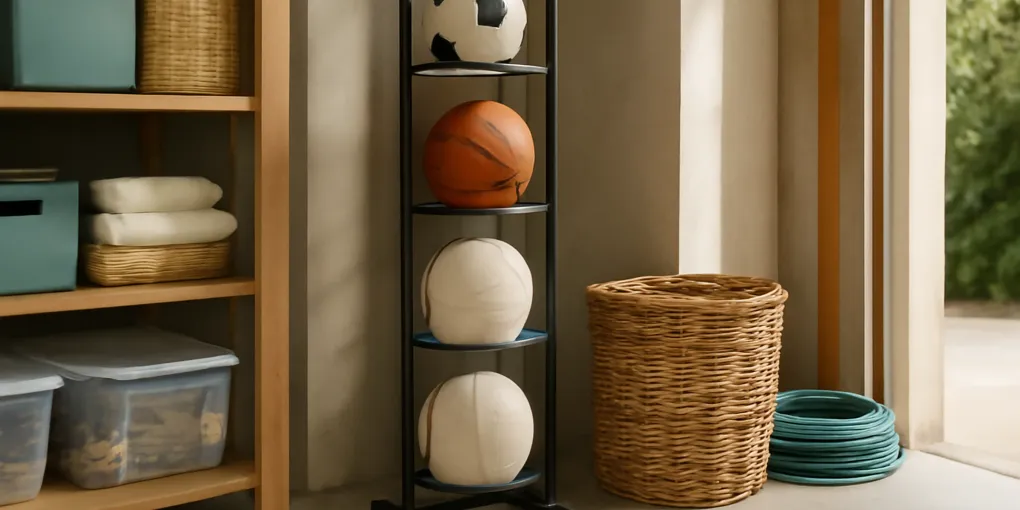
Best Garage Ball Storage Racks for Family Sports Gear
Buyer's GuideWall-mounted ball rack with bungee front
Best for garage floor clearanceBest For: Basketballs, soccer balls, volleyballs, and families that need the floor clear
$25-60
Quick picks
| Product | Key Specs |
|---|---|
| See price on Amazon |
|
| See price on Amazon |
|
| See price on Amazon |
|
Product availability, certifications, and retailer details can change; check the current Amazon page before buying.
Loose sports balls fail faster than most garage organizers because the objects are round, shared by multiple people, and used outside the house. A basketball left by the car tire, a soccer ball under a bike pedal, and a tennis-ball bag on the steps are not just visual clutter. They change how safely people walk through the garage.
The best garage ball storage rack is the one that matches two facts: where balls are grabbed from, and whether the rack can be secured without blocking the route from house to car safely. If the family plays in the driveway, a rolling cart near the garage door may beat a beautiful wall rack in the back corner. If the garage already has bikes, bins, and tools on the floor, a wall-mounted bungee rack usually earns its space.
This guide pairs well with our garage bike storage guide when the real problem is a shared wall where bikes, balls, helmets, and scooters all compete for the same path.
Quick picks
- Best floor-clearing fix: Search Amazon for wall-mounted ball racks if you can anchor the rack into studs or masonry.
- Best renter-friendly option: Search Amazon for rolling sports ball carts when drilling is not allowed or balls move to the driveway daily.
- Best full sports station: Search Amazon for sports gear organizer towers if helmets, cones, pumps, gloves, and pads need one home.
Do not buy the tallest organizer first. Count the active balls, measure the route people walk through, and decide whether the organizer should stay fixed or roll.
The safety test before buying
Start with the walkway, not the product photo. The CDC’s fall-prevention guidance emphasizes removing trip hazards and keeping pathways clear, which applies directly to garage storage where round objects can roll underfoot (CDC falls prevention). A good ball rack should make the walking path cleaner the same day it arrives.
Stand where people enter the garage from the house. Walk to the car, trash bins, freezer, bikes, and garage door button. Any rack that narrows those routes is a poor fit, even if it holds more balls. The best location is usually a side wall, a corner outside the car-door swing, or a zone beside other sports gear.
Wall-mounted ball racks
A wall-mounted bungee rack is the strongest choice when garage floor space is scarce. The bungee front lets kids pull one ball out without unloading a whole shelf. It also makes the inventory visible: if the basketball lane is full, another basketball probably does not need to come home.
The catch is installation. A rack full of balls is lighter than a shelf full of paint cans, but it still gets tugged repeatedly. Anchor it into studs, blocking, masonry, or the manufacturer’s recommended surface. Skip adhesive-only mounting for a rack children will pull on. Place the bottom low enough for kids to return balls without climbing, but high enough that balls do not spill into the traffic lane.
Choose this style for basketballs, soccer balls, volleyballs, playground balls, and foam balls. It is less useful for bats, skates, helmets, or racquets unless the rack includes side hooks or shelves.
Rolling carts
A rolling cart is best when balls need to move. Driveway basketball, backyard soccer, and neighborhood play often work better with a cart that rolls to the garage threshold. It is also the easiest option for renters because it does not require wall holes.
The failure mode is drift. A cart parked in the middle of the garage becomes a moving obstacle. Choose locking casters, a narrow footprint, and a parking spot marked by the wall. If the cart is wider than the gap between the parked car and storage shelves, it will migrate to the path.
Rolling carts are also useful for mixed ages. Younger kids can return balls without reaching a wall rack, while older kids can roll the whole cart out for practice. Put the heaviest balls low so the cart does not tip when someone grabs from the top.
Sports gear towers
A sports gear tower makes sense when balls are only one part of the mess. Families with helmets, cleats, cones, gloves, jump ropes, pumps, and pads need more than a ball corral. A tower with shelves and hooks can keep sport categories together instead of spreading them across bins.
Buy the tower only if it has a clear job. One shelf for helmets, one bin for small balls, one hook rail for bags, and one lower ball corral is useful. A tower with many open shelves can become another garage dumping ground if every item is allowed in.
For top-heavy towers, check stability and wall-strap options. Safe Kids’ furniture tip-over guidance is written for furniture, but the principle transfers to tall storage: secure tall units that children may climb, pull, or lean on (Safe Kids furniture tip-overs).
Fit matrix
| Garage condition | Best storage choice | Avoid |
|---|---|---|
| Narrow walking path beside car | Wall-mounted bungee rack | Rolling cart parked in the lane |
| Rental garage or unfinished wall | Rolling ball cart | Permanent anchors without permission |
| Balls plus helmets and cones | Sports gear tower | Ball-only rack that leaves accessories loose |
| Young kids return gear | Low bungee rack or low cart | High shelves that require climbing |
| Seasonal sport overflow | Active rack plus labeled backstock bin | Buying a rack for every rarely used ball |
How to keep the rack from becoming overflow storage
Set a capacity rule. If the rack holds eight active balls, the ninth ball must replace one, move to seasonal storage, or be donated. Without a capacity rule, the rack only makes the growing pile look organized.
Add a small pump zone if inflatable balls are common. A ball pump, needles, and pressure gauge belong in a lidded pouch or small bin attached to the sports station. Otherwise flat balls stay in the rack forever because the fix is in another room.
Keep muddy or wet gear out of closed bins until dry. Balls can sit in an open rack, but gloves, pads, and shoes may need airflow. If the garage is damp, avoid fabric bins for wet outdoor gear.
Installation details that matter
For wall racks, the mounting surface is part of the product. A rack screwed only into drywall can loosen when kids pull balls through the bungee front. Use studs, masonry anchors, or the hardware specified by the manufacturer. If you are unsure what is behind the wall, choose a freestanding cart instead of guessing.
Place the rack where the ball can be returned with one hand. If a child has to move a bike, step over a scooter, or open a cabinet door before returning the ball, the ball will land on the floor. The return path should be easier than dropping the ball by the garage door.
For rolling carts, test the parked footprint with painter’s tape before ordering. Mark the cart width and depth on the floor, then open the car door, move the trash bin, and walk from the house door to the driveway. If the tape outline feels annoying, the real cart will be worse.
Sport-by-sport storage notes
Basketballs and soccer balls are the best match for bungee-front racks because they are large, round, and frequently used. Keep the most-used ball at chest or waist height so it does not have to be pulled from the bottom of a compressed pile.
Baseballs, tennis balls, pickleballs, and golf practice balls need a different container. Put small balls in a lidded bin, mesh pouch, or drawer on the sports tower. If they share the large-ball rack, they fall through gaps and become floor clutter again.
Bats, sticks, racquets, and jump ropes need vertical hooks or side slots. Do not wedge long gear through a ball rack unless the rack is designed for it. Long gear sticking out into the garage path creates the same trip and snag problem the rack was supposed to solve.
Garage ball storage FAQ
Is a wall rack better than a ball bag?
For garages, usually yes. A wall rack keeps each ball visible and prevents the bag from becoming a heavy mixed sack. A mesh ball bag is better for teams, car transport, or seasonal storage.
Can balls go on overhead garage shelves?
Only for inactive seasonal items. Active balls stored overhead do not get returned consistently, and reaching for them near a car or step ladder creates a worse system than floor clutter.
What should I measure before ordering?
Measure wall width, rack depth, car-door swing, and the height children can reach safely. For rolling carts, measure the parked location plus the route the cart must travel.
Reader test
A reader can choose today: wall rack for anchored floor clearance, rolling cart for driveway use or renters, and gear tower for mixed sports equipment. The article is specific to round sports balls because it addresses rolling trip hazards, bungee fronts, ball pumps, car-door clearance, and active-versus-seasonal ball capacity.
Frequently Asked Questions
- For most garages, a wall-mounted bungee rack is best when it can be anchored securely and does not block a car door path. Rolling carts work better for renters or driveway play.
- Not in a traffic lane. Loose balls on the garage floor create trip and roll hazards, especially near steps, bikes, tools, and parked cars.
- Buy for the number of balls used weekly, not every seasonal item. Overflow balls should be donated, deflated for storage, or moved to a labeled backstock bin.