Best Kitchen Appliance Storage 2026
Buyer's GuideSimple Houseware Sliding Cabinet Organizer
Best Sliding TrayType: Sliding cabinet pull-out tray
$22–32
Quick picks
| Product | Key Specs |
|---|---|
| See price on Amazon |
|
| See price on Amazon |
|
| See price on Amazon |
|
Product availability, certifications, and retailer details can change; check the current Amazon page before buying.
Best Kitchen Appliance Storage 2026
Small kitchen appliances are among the most space-consuming items in home kitchens. A countertop cluttered with a blender, air fryer, stand mixer, toaster, and food processor is a kitchen where counter space doesn’t exist for actual food preparation. Yet the alternative — burying appliances in deep cabinets where they’re inconvenient to retrieve — means they stop being used. Effective appliance storage balances accessibility with counter-space conservation.
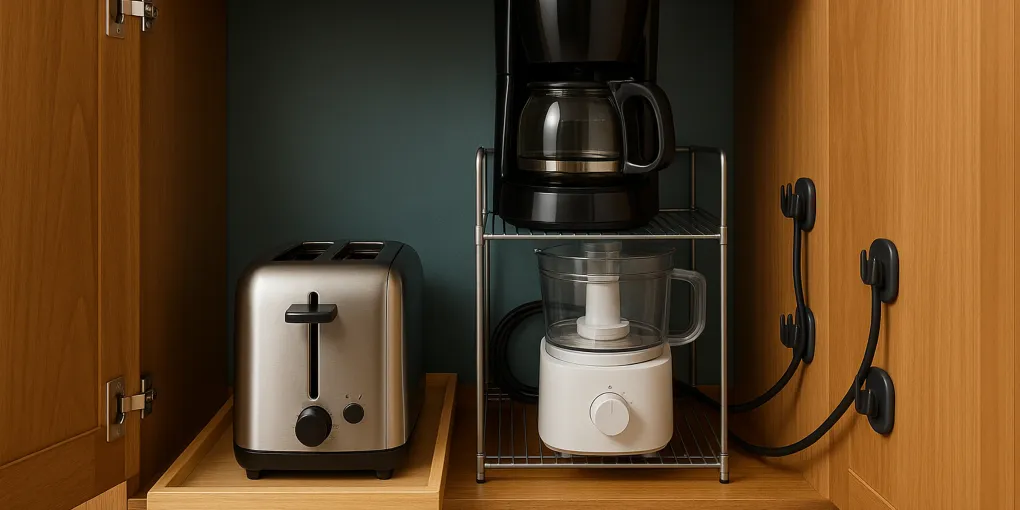
The right storage solution depends on the appliance type (height, weight, frequency of use) and the cabinet configuration available. This guide covers three organizer approaches that collectively address the most common appliance storage scenarios: a sliding pull-out tray for deep lower cabinet access, a vertical divider system for flat-profile appliances and bakeware, and a wire shelf for general cabinet tier separation.
Simple Houseware Sliding Cabinet Organizer — Best Sliding Tray
Best for: Lower cabinets where appliances are stored in the back and require full removal of front items to access
The Simple Houseware Sliding Cabinet Organizer converts a static lower cabinet shelf into a sliding pull-out tray. Instead of reaching to the back of the cabinet and removing everything in front, the tray slides out fully, bringing whatever is at the back to the front. For appliance storage, this is transformative — a slow cooker, a rice cooker, or an instant pot stored at the rear of a lower cabinet becomes immediately accessible without cabinet archaeology.
The steel construction with a protective coating handles appliance weights comfortably — most small appliances fall within the 5–15 pound range that the sliding mechanism is designed for. The non-skid surface prevents appliances from sliding on the tray as it moves in and out. Amazon verified purchaser reports consistently describe this as one of the higher-impact organization purchases for lower cabinet storage, specifically because it changes the usability of rear-cabinet space rather than just adding another shelf. User community synthesis suggests the tray is most impactful in cabinets with 18–24 inches of depth where rear items are genuinely inaccessible.
What Works
- Full slide-out access brings rear-cabinet appliances to the user rather than requiring arm extension
- Steel construction with non-skid surface handles heavy small appliances securely
- No installation required — the tray sits on the existing cabinet shelf
Trade-offs
The tray reduces the vertical clearance in the cabinet below the shelf above — ensure the appliances being stored fit within the available height. Not suitable for very large or extra-heavy appliances (stand mixers over 25 lbs can stress the sliding mechanism). Works best in lower cabinets with smooth, level shelving.
Scoring
How We Score
ClutterScience evaluates products using a five-factor composite scoring methodology (30/25/20/15/10):
| Factor | Weight | What We Assess |
|---|---|---|
| Research | 30% | Depth of specification and user-report analysis and breadth of products reviewed |
| Evidence Quality | 25% | Reliability of sources: third-party testing where available, verified-purchase review synthesis, third-party testing where available |
| Value | 20% | Cost-effectiveness relative to competing products at similar quality tiers |
| User Signals | 15% | Long-term verified purchase feedback and real-world performance reports |
| Transparency | 10% | Accuracy of manufacturer claims, material disclosures, and dimension accuracy |
Scores are differentiated — top picks typically score 8.5–9.5, mid-tier 7.0–8.4, and weak options below 7.0.
| Criterion | Weight | Score |
|---|---|---|
| Capacity & Dimensions | 30% | 9.0/10 |
| Material Quality | 25% | 8.5/10 |
| Ease of Assembly & Use | 20% | 9.2/10 |
| Long-Term Value | 25% | 8.8/10 |
| Composite Score | 8.9/10 |
Pricing
$22–32. Strong value for the access improvement it creates in lower cabinet appliance storage.
Copco Non-Skid Bakeware Organizer — Best for Bakeware/Appliances
Best for: Flat-profile appliances (waffle makers, griddles, electric skillet lids) and bakeware stored vertically in a lower cabinet
The Copco Non-Skid Bakeware Organizer uses the vertical file-folder principle for flat kitchen items. Baking sheets, cutting boards, muffin tins, lids, and flat-profile appliances stand on edge in individual vertical slots, making each item independently accessible. The non-skid lining on each divider prevents slipping and scratching. Amazon verified purchaser reports highlight how much space this saves compared to horizontal stacking — a stack of five baking sheets horizontally requires significant height clearance; the same five sheets stored vertically use only the sheet width in height.
For appliance storage specifically, the Copco works well for items like electric skillet lids, waffle maker plates, and similar flat accessories that don’t have a natural home in standard appliance cabinets. The vertical format also works for cutting boards and cooling racks that are thin enough to stand stably on edge. User community synthesis notes the non-skid coating is genuinely effective — items don’t slide down the dividers under their own weight, even for heavier stoneware.
What Works
- Vertical slot format makes each baking sheet or flat item independently accessible
- Non-skid coating prevents sliding and scratching of pan surfaces
- Slots accommodate various widths, from thin baking sheets to thicker cutting boards
Trade-offs
Only effective for flat-profile items — round or bulky appliances don’t work in vertical slots. Slot spacing may not accommodate every size of baking pan (very large half-sheet pans may not fit in narrower slots). Position in a lower base cabinet is most ergonomic; harder to use in upper cabinets.
Scoring
| Criterion | Weight | Score |
|---|---|---|
| Capacity & Dimensions | 30% | 8.5/10 |
| Material Quality | 25% | 8.0/10 |
| Ease of Assembly & Use | 20% | 9.0/10 |
| Long-Term Value | 25% | 8.2/10 |
| Composite Score | 8.4/10 |
Pricing
$18–28. Well-priced for the bakeware and flat-item organization problem it solves.
mDesign Wire Kitchen Cabinet Organizer — Best Wire Shelf
Best for: Adding a tier inside a tall cabinet to create two levels of appliance or general kitchen storage
The mDesign Wire Cabinet Organizer is a freestanding wire shelf that sits inside a cabinet and creates a second tier of storage underneath it. For tall cabinets or cabinets with excess vertical clearance, this converts one storage level into two without installation. The wire construction allows items on the lower level to remain visible, and the shelf above holds a second layer of smaller appliances or accessories. Amazon purchaser reports describe this as a simple, effective addition to any cabinet with unused vertical space between shelves.
The open wire format is specifically useful for appliance storage because it doesn’t trap heat or moisture — important for appliances with vents or for storing items that need air circulation. The mDesign’s adjustable width variants fit different cabinet widths, and the tool-free setup means repositioning is easy if the cabinet configuration changes. User community synthesis suggests the wire shelf works best in combination with a sliding tray or vertical divider — adding vertical tiers to an already-organized cabinet rather than as a standalone solution.
What Works
- Creates a second storage level in cabinets with excess vertical clearance
- Open wire construction allows visibility of lower items and air circulation
- Tool-free setup and repositionable for changing storage configurations
Trade-offs
Works best in cabinets with specific vertical clearance — cabinets with tightly packed shelves don’t benefit. Items on the wire shelf need to be small enough to maintain stability (rounded or bottom-heavy appliances may not sit stably on wire). Not a standalone solution for appliances that need pull-out or vertical access.
Scoring
| Criterion | Weight | Score |
|---|---|---|
| Capacity & Dimensions | 30% | 7.8/10 |
| Material Quality | 25% | 7.5/10 |
| Ease of Assembly & Use | 20% | 9.5/10 |
| Long-Term Value | 25% | 7.8/10 |
| Composite Score | 8.0/10 |
Pricing
$15–22. Budget-appropriate for a simple tiering solution; strongest value when combined with other cabinet organization approaches.
Head-to-Head Comparison
| Feature | Simple Houseware Sliding | Copco Bakeware | mDesign Wire Shelf |
|---|---|---|---|
| Best for | Deep cabinet pull-out access | Vertical flat-item storage | Tier creation in tall cabinets |
| Installation | Tool-free, sits on shelf | Tool-free, sits on shelf | Tool-free, sits on shelf |
| Solves | Rear-cabinet inaccessibility | Horizontal bakeware stacking | Unused vertical clearance |
| Price | $22–32 | $18–28 | $15–22 |
| Composite score | 8.9/10 | 8.4/10 | 8.0/10 |
Who Should Choose Which
Choose the Simple Houseware Sliding Tray if your primary appliance storage problem is rear-cabinet inaccessibility. The slide-out format fundamentally changes how a lower cabinet functions — rear items become as accessible as front items.
Choose the Copco Bakeware Organizer if flat-profile items (baking sheets, cutting boards, flat appliance accessories) are the primary storage problem. Vertical storage is dramatically more space-efficient and accessible than horizontal stacking for these items.
Choose the mDesign Wire Shelf if you have a cabinet with excess vertical clearance and want to add a storage tier without installation. It’s most impactful as a complement to other organizers rather than a standalone solution.
How to Plan Small Appliance Storage by Use Frequency
The most important principle for appliance storage planning is use frequency. Every appliance falls into one of three categories: daily use (on the counter), several-times-weekly use (accessible lower cabinet), and occasional use (deep cabinet or pantry).
Daily appliances are the coffee maker, toaster, and perhaps an air fryer for households that use it every day. These earn their counter space because the daily access makes the footprint worthwhile. Storing a daily-use appliance in a cabinet creates friction that compounds across hundreds of morning routines.
Several-times-weekly appliances — a blender for smoothies three mornings a week, a rice cooker used on cooking nights — should be in the most accessible lower cabinet storage, ideally on a sliding pull-out tray. The tray means retrieval takes five seconds rather than thirty, which makes the difference between an appliance that gets used and one that stays in the cabinet.
Occasional appliances — the slow cooker used for weekend meals, the waffle maker for weekend mornings, the food processor for quarterly projects — can be stored in less accessible positions. Dedicated shelf space in a pantry or a high cabinet is appropriate. These items don’t need daily-access positioning.
Research on environmental design indicates that the accessibility of objects in the home predicts their frequency of use. Studies on habit formation suggest that reducing retrieval effort by even a few seconds significantly increases the likelihood of an appliance being used in a routine. A sliding tray that brings a blender to the counter in one motion changes the behavioral math for morning smoothie preparation compared to lifting the blender out of a deep cabinet.
For the bakeware and cooking supply side of kitchen appliance storage, our guide to best baking supply organizers covers the organization of pans, molds, and baking accessories that often share cabinet space with appliances.
Frequently Asked Questions
What is the best way to store small kitchen appliances?
Small appliances used daily belong on the counter; daily access makes the counter footprint worthwhile. Small appliances used several times a week work well in an accessible lower cabinet on a sliding pull-out tray. Appliances used occasionally can be stored in a less accessible cabinet or pantry shelf. The organizing principle is access frequency — storage location should match how often the appliance is actually used.
Should I store appliances in upper or lower cabinets?
Small appliances generally belong in lower base cabinets. Heavy appliances are awkward to lift down from upper cabinets and create safety issues. Even mid-weight appliances (blenders, air fryers at 10–15 lbs) are safer and easier to access from lower cabinets. Upper cabinets work better for lighter items (small appliance accessories, extra parts) rather than the appliances themselves.
How do I maximize space in a small appliance cabinet?
Layer by height using tiered shelves or wire shelf risers to create two storage levels in a single cabinet. Pull-out trays allow rear-cabinet appliances to come forward for access. Vertical dividers help for flat-profile items like baking sheets and cutting boards. Combining two or three of these approaches in a single lower cabinet typically doubles usable appliance storage capacity.
What size sliding tray do I need for a standard cabinet?
Standard base cabinets are 24 inches deep. Most sliding cabinet organizers are 16–22 inches deep to fit inside the cabinet with the door closing. Width depends on the cabinet section width — most base cabinet sections are 12–24 inches wide. Measure interior cabinet width and depth, then choose a sliding tray at least 2 inches narrower than the interior width and shorter than the interior depth.
Bottom Line
For lower cabinet appliance access, the Simple Houseware Sliding Cabinet Organizer is the highest-impact single purchase — it transforms the usability of a deep lower cabinet by making rear storage as accessible as front storage. It earns the top score in the category.
The Copco Non-Skid Bakeware Organizer solves the specific problem of flat-item stacking with a vertical format that’s dramatically more space-efficient. For kitchens with significant bakeware, it’s a meaningful upgrade.
The mDesign Wire Shelf serves best as a complementary addition to an already-organized cabinet, creating vertical tier separation where headroom exists.
For a complete kitchen storage overhaul, our guide to best kitchen cabinet organizers covers the full range of cabinet organization solutions that support appliance storage.