Best Water Bottle Drying Racks for Crowded Kitchen Counters
Buyer's GuideOXO Good Grips Bottle Drying Rack Style
Best compact counter rackBest For: Two to six daily bottles near the sink
$15-30
Quick picks
| Product | Key Specs |
|---|---|
| See price on Amazon |
|
| See price on Amazon |
|
| See price on Amazon |
|
Product availability, certifications, and retailer details can change; check the current Amazon page before buying.
Reusable bottles save money and reduce single-use waste, but they create a specific kitchen clutter problem: tall cylinders, loose lids, straws, bite valves, and brushes all need to dry before they go back into a cabinet or bag. A dish towel pile beside the sink does not solve that job. It hides wet parts, steals counter space, and makes people avoid washing the bottle until the next refill.
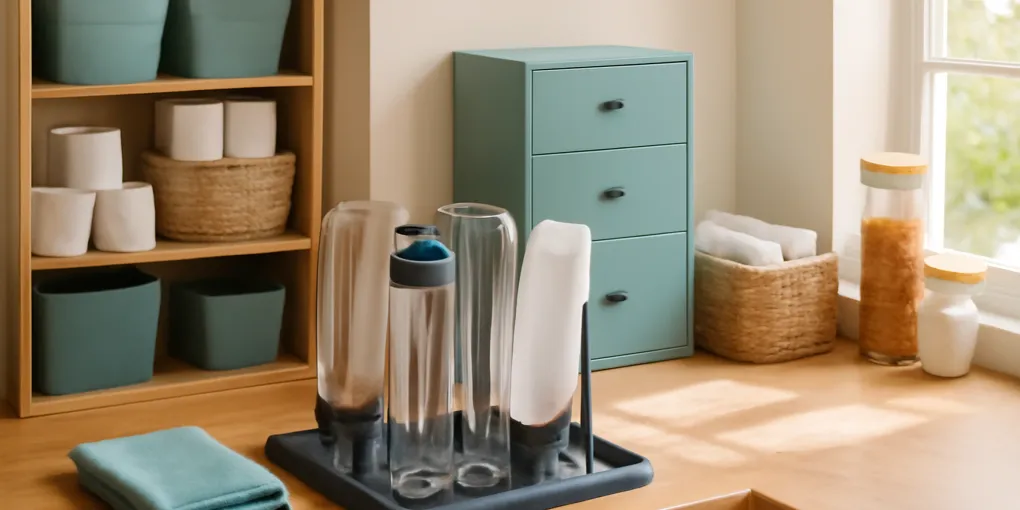
The best water bottle drying rack is the one that makes a complete bottle visible: body upright, lid separated, straw drained, and brush nearby. This guide focuses on racks and small accessories that solve that exact problem without turning the counter into a permanent bottle parking lot.
For a broader dish zone, see our nightly kitchen counter reset. Bottle racks work best when they occupy a defined lane inside that reset, not the whole sink area.
Quick picks for different bottle piles
- Most kitchens: Search Amazon for OXO bottle drying racks. Pick a low rack with raised channels if two to six bottles rotate daily.
- Large family stack: Search Amazon for bottle tree drying racks. Use vertical arms when several school, gym, and work bottles wash at once.
- Tiny counter: Search Amazon for silicone drying mats with brush holders. A mat plus upright brush cup is easier to move than a big rack.
- Lid chaos: Search Amazon for small parts drying racks. Look for pegs or a basket that keeps caps and straws separated.
Why bottle drying needs its own station
The FDA safe food handling guidance emphasizes clean hands, clean surfaces, and avoiding cross-contamination during food preparation (FDA safe food handling). A reusable bottle is not a cutting board, but the same practical lesson applies in the kitchen: wet food-contact items need a clean surface, airflow, and a clear end point before storage.
The CDC also gives household cleaning guidance for surfaces and bleach safety, including proper ventilation and following label directions (CDC cleaning and disinfecting with bleach). For bottle clutter, that means the drying station should not sit inside a dirty sink splash zone or beside open cleaning products.
A good rack reduces three failure points: bottles lying sideways with trapped water, lids stacked in a damp cup, and bottle brushes stored wet against other dishes.
What to measure before buying
Measure the height under the cabinet, the width of the sink-side counter lane, and the diameter of your tallest bottle. Many bottle racks look small online but become awkward when a 32-ounce insulated bottle leans sideways under a wall cabinet.
Count the real daily rotation too. If one person owns one bottle, a silicone mat may be enough. If the family has school bottles, sports bottles, coffee tumblers, and straw lids, you need separated vertical capacity. Do not buy for the fantasy of every bottle in the house. Buy for the number that must dry on an ordinary evening.
Compact rack: best for most sinks
A compact bottle rack is the safest first purchase for apartments, small kitchens, and households with a predictable bottle count. Look for raised ribs or pegs that lift the bottle mouth off the surface. A flat tray that simply collects water under the bottle is just a nicer puddle.
The best compact racks also have a removable drain tray or a tilted base. If the tray cannot be rinsed easily, mineral spots and residue will build up. If the rack has a lid cup, make sure the cup has holes or slots. A sealed cup defeats the purpose.
Bottle tree: best for high volume
A bottle tree uses vertical arms to hold several bottles and lids at once. It is useful when the counter pile is tall because it trades width for height. The risk is stability. Wide insulated bottles are heavier than baby bottles or light plastic sports bottles, so the base matters.
Choose a bottle tree only if it can live where elbows and backpacks will not hit it. A tall rack at the edge of a counter can become a daily annoyance. Put the tallest bottles on lower arms when possible and reserve upper arms for lids or lightweight bottles.
Silicone mat plus brush holder: best low-commitment setup
A silicone drying mat is not as structured as a rack, but it can work in a small kitchen when paired with a brush holder and a rule: bottles stand open, lids spread out, and everything leaves the mat when dry. The mat should have a raised texture so water can move away from the bottle mouth.
This setup is also useful if you are not sure how many bottles actually need daily drying. Test the mat for two weeks before buying a larger rack. If the mat is overloaded every night, upgrade to a rack. If it stays mostly clear, keep the flexible system.
Brush and lid storage matter as much as the rack
Many bottle stations fail because the bottle bodies look neat while lids, gaskets, and straws remain in a wet cluster. Choose a rack with small-part lanes or add a separate mini rack. Straw lids should dry open when the design allows it. Removable gaskets should not be pressed into a damp pile where nobody can see whether they are clean.
The bottle brush needs airflow too. Do not leave it head-down in a bottle. Use an upright brush cup or holder that drains. If several specialty brushes are needed, keep only the ones used weekly near the sink and move extras to a labeled utility drawer.
What makes a bottle rack useful after dinner
| Buying factor | What to look for |
|---|---|
| Airflow and separation | Bottles stand open, lids have their own lane, and straw parts are not trapped in a damp pile. |
| Realistic hygiene claims | The rack supports drying after washing; it should not be treated as a sterilizer. |
| Counter-space value | The setup reduces duplicate bottle buying without claiming a huge permanent footprint beside the sink. |
| Easy unloading | Kids, guests, or tired adults can see where dry bottles and lids go next. |
| Care limits | The product copy and household routine still defer to bottle-specific cleaning instructions. |
Buying mistakes to avoid
Do not buy a rack that only fits one bottle style if your household uses insulated bottles, straw cups, and coffee tumblers. Do not buy a tall tree if it will live under a low cabinet. Do not buy a covered bin for drying. Covered storage is for clean, dry bottles, not damp bottle parts.
Also avoid storing the drying rack permanently full. A rack is a transition zone, not a display shelf. If dry bottles never leave it, the next wet bottle has nowhere to go and the counter pile returns.
Setup details that prevent the pile from coming back
Put the rack where the person washing bottles already stands, not across the kitchen. Distance matters because wet bottle parts drip and people will choose the closest towel when the rack is inconvenient. If the sink has a disposal switch, soap pump, or cutting-board slot nearby, leave hand clearance so the drying station does not interfere with normal cleanup.
Give lids a front-row position. Lids are the part people need to reassemble the bottle, and they are also the part most likely to trap moisture. A shallow small-parts cup, ridged silicone corner, or mini drying basket is worth more than extra bottle slots if your household uses straw lids. If the rack has no lid area, add a small ventilated dish that can be lifted and rinsed.
Create an exit rule too. Dry bottles should move to a cabinet shelf, school-bag station, gym bag, or fridge fill spot before the next wash cycle. Without that exit, the rack becomes the new bottle cabinet and the counter problem returns with better posture.
Water Bottle Drying Rack FAQ
Can I use a regular dish rack for water bottles?
Yes, if the bottles can stand open and lids can dry separately. A dedicated bottle rack is better when tall bottles fall over or small parts disappear in the dish rack.
How many bottle slots do I need?
Count the bottles washed on a normal night, then add one extra slot for a guest bottle or coffee tumbler. More capacity than that often becomes storage clutter.
Is bamboo a good material for bottle drying?
Bamboo can look good, but check whether it dries between uses and whether the manufacturer allows wet kitchen use. Plastic, stainless, and silicone are often easier to rinse and inspect.
Should the rack stay beside the sink all the time?
Only if bottles are washed daily. If bottle washing is occasional, use a silicone mat or collapsible rack that can leave the counter when dry.
Bottom line
Buy a water bottle drying rack only after you know how many bottles dry on an ordinary day. Most homes should start with a compact rack that holds bottles upright and gives lids their own airflow. Larger families may need a stable bottle tree. Small kitchens can use a silicone mat plus a brush holder if the mat is cleared after each drying cycle.
Frequently Asked Questions
- Choose a rack that holds bottles upright, separates lids, and drains fully. A compact rack works for small households, while a bottle tree is better for several tall bottles.
- Yes. Store bottles only after the interior, lid gasket, straw, and mouthpiece are dry enough that water is not trapped in closed parts.
- Keep the brush upright in a ventilated holder near the drying station, not wet inside the bottle or loose in a sink caddy.
- Yes, if the rack has small parts space. Lids, straws, and gaskets need airflow, so do not stack them in a damp cup.