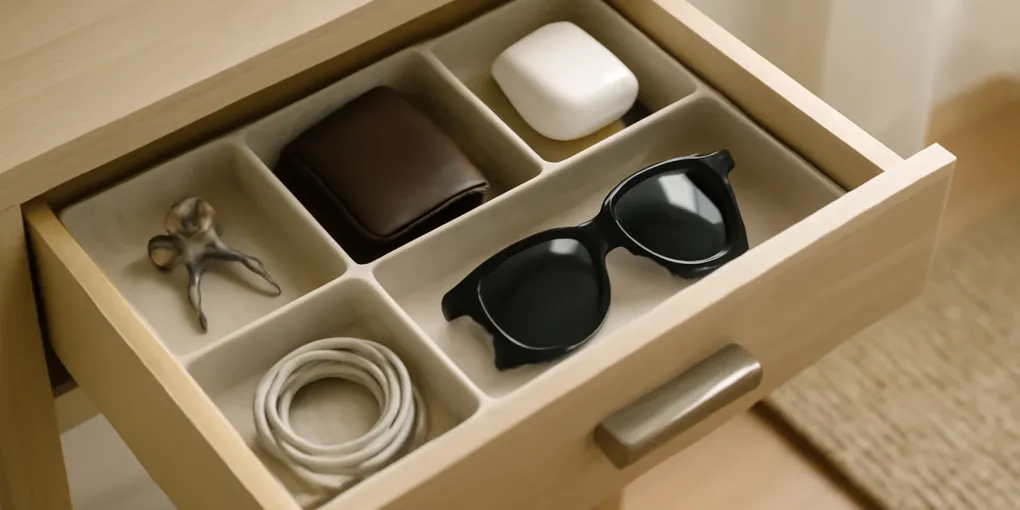
Everyday Carry Drawer Drop Zone: A 20-Minute Reset for Keys, Wallets, and Chargers
ProtocolQuick picks
Shallow Drawer Organizer Trays
★ Top pick Best first buy- Best For: Keys, wallets, earbuds, badges, and lip balm
- Caveat: Measure drawer height before buying stacked trays
Small Cable Clips or Cord Ties
Best add-on- Best For: Keeping one charging cable from tangling with pocket items
- Caveat: Adhesive clips need a clean, dry drawer surface
An everyday carry drawer is a small home base for the things that leave with you: keys, wallet, earbuds, badge, transit card, sunglasses, and one charging cable. It is not a junk drawer with better branding. It is a return point for items that otherwise spread across the counter, couch, nightstand, and car.
The best version uses one shallow drawer near the exit or charging area, divided into a few visible cells. Start with drawer organizer trays before buying a dedicated valet station. Trays are cheaper, adjustable, and easier to clean when the drawer contains coins, lip balm, dust, or a loose cough drop.
If your entryway already has shoes and bags piling up, combine this drawer with a larger entryway drop zone system. The drawer handles pocket items; hooks, shelves, or a bench handle the bulky categories.
Quick picks for the drop zone drawer
- Best first buy: Search Amazon for shallow drawer organizer trays. Choose modular trays that fit the real drawer width and leave a lane for keys.
- Best cable add-on: Search Amazon for small cable clips or cord ties. Use one clip or tie for the charger that actually belongs in this drawer.
- Optional upgrade: Search Amazon for wood valet tray drawer organizer. Choose this only if the drawer is already stable and you want a more finished look.
Do not put every small household item in this drawer. The drawer should answer one question: what do I need before leaving or settling in for the night?
The 20-minute everyday carry drawer protocol
Step 1: Empty the candidate drawer
Choose the drawer closest to the real drop point. That might be an entry console, kitchen command-center drawer, bedside drawer, or home-office drawer near the charging cable. Empty it completely. Wipe out crumbs and dust. Remove old receipts, loose hardware, batteries, pens that do not work, packaging, and duplicate cables.
This reset is easier if you do not sort the entire house. Stay inside one drawer and one nearby surface.
Step 2: Name the daily-carry items
Put only current daily-carry items on the counter. Good candidates include:
- Keys or key fob.
- Wallet or card case.
- Work badge or transit card.
- Earbuds.
- Sunglasses.
- Watch or ring dish.
- One lip balm or hand cream.
- One charging cable.
- A small medication case if it leaves the house with you.
If an item is not used at least weekly, it does not belong in the everyday carry drawer. Store backup keys, old gift cards, spare cables, and travel adapters somewhere else.
Step 3: Build lanes, not a pile
Use shallow trays to create lanes. Keys need a landing zone that can tolerate noise and scratches. Earbuds need a small cell where the case cannot hide under papers. A badge or transit card needs a flat lane so it can be grabbed without unfolding a stack.
Do not over-divide. If every object has a tiny custom slot, the drawer becomes hard to reset. A practical layout is three to five zones: keys, wallet/cards, tech, personal smalls, and outgoing reminders.
Step 4: Handle charging deliberately
Charging is where many drop zones fail. A cable in the drawer can help earbuds or a watch charge overnight, but a tangle of old cords turns the drawer into a tech graveyard. Keep one active cable in the drawer and route it so the connector lands in the tech tray.
If the drawer is not near an outlet, do not force charging. Use the drawer for storage and keep charging at a different station. A drawer that needs an extension cord crossing a walkway is solving the wrong problem.
Step 5: Add a weekly eviction rule
Once a week, remove items that do not leave the house or return to the drawer intentionally. Typical evictions include receipts, coins beyond a small amount, random screws, old masks, gum wrappers, extra pens, and mystery cables.
The rule is simple: if it cannot answer why it belongs in the daily-carry lane, it leaves.
Why the drawer works
A drawer drop zone reduces visual clutter while preserving retrieval. Open bowls can work for keys, but they mix categories together. A drawer with trays keeps each category visible when the drawer opens and invisible when it closes.
This matters because clutter is partly an attention problem. Multiple objects compete for visual attention in crowded scenes, as described by McMains and Kastner (2011, DOI: 10.1523/JNEUROSCI.3766-10.2011). A tray system reduces competition by grouping items into expected locations. You do not search the whole counter; you open one drawer and check the key lane.
The protocol also uses habit design. Wood and Neal (2007, DOI: 10.1146/annurev.psych.58.110405.085617) describe habits as context-response patterns. The drawer creates a stable context: enter, empty pockets into the same cells, leave from the same cells.
Fit checks that matter
ClutterScience uses a reader-fit fit signal for protocols and supporting products: fit, evidence, value, owner friction, and clear product limits.
For an everyday carry drawer, Research favors low-friction behavior design over elaborate storage furniture. Evidence Quality focuses on observable mechanics: proximity to the exit, visible tray cells, cable routing, and whether the drawer is shallow enough to prevent stacking. Value rewards inexpensive trays because most households can test the system before buying a dedicated valet. User Signals include whether keys, earbuds, and badges return without reminders. Transparency means the system makes its limits obvious: this drawer is for current daily-carry items, not every small thing.
Common failure points
The drawer is too far from the real drop point
If everyone drops keys on the kitchen counter, a bedroom valet tray will not fix the pattern. Move the drawer system closer to the drop point before blaming the household.
The drawer is too deep
Deep drawers invite layering. If the drawer is deeper than about six inches, use taller bins or choose a shallower drawer. Pocket items should not disappear under scarves, manuals, or spare electronics.
Too many cables are allowed
One active cable is useful. Five mystery cables are clutter. Label the active cable by device if needed and move backups to a separate tech bin.
Receipts enter without a rule
Receipts need a next action: scan, reimburse, return, or discard. If they sit in the daily-carry drawer, they hide the items the drawer is supposed to protect.
Household variations
A solo apartment drawer can be extremely small: keys, wallet, earbuds, and one cable. The danger is not sharing; it is letting receipts and spare tech creep into the lane. Use one tray with three compartments and keep the rest of the drawer empty enough to see the bottom.
A family drawer needs separation by person or by action. If two adults and a teenager share the same drawer, assign a left-to-right order and keep one shared outgoing lane for mail, returns, or school forms that must leave the house. Do not mix personal keys with shared paperwork; the first person leaving should not have to disturb everyone else’s items.
A work-from-home drawer may belong near the desk rather than the door. In that case, the category changes slightly: badge, earbuds, glasses, laptop adapter, and notebook pen. The same rule still applies. Current daily tools stay; backups and rarely used adapters move to a tech bin.
Everyday-carry drawer questions
Can an everyday carry drawer replace a junk drawer?
No. It should be smaller and stricter than a junk drawer. A junk drawer stores miscellaneous household tools. An everyday carry drawer stores items that leave with you or need to be recovered at the door.
What if two people share the same drawer?
Create left and right zones or use two color-coded trays. Shared drawers fail when one person’s keys bury the other person’s badge or earbuds.
Should keys go in a drawer if I need them quickly?
Yes, if the drawer is shallow and consistent. If emergency access is a concern, use a hook inside the drawer area or a visible dish near the exit instead.
What is the cheapest way to test the system?
Use small boxes or food-storage lids as temporary trays for one week. If the lanes work, replace them with washable shallow organizers that fit the drawer.
Sources
- Wood, W., and Neal, D. T. (2007). A new look at habits and the habit-goal interface. DOI: 10.1146/annurev.psych.58.110405.085617.
- McMains, S. A., and Kastner, S. (2011). Interactions of top-down and bottom-up mechanisms in human visual cortex. DOI: 10.1523/JNEUROSCI.3766-10.2011.
- Electrical Safety Foundation International. Home electrical safety: https://www.esfi.org/home-electrical-safety/. Keep charging cables visible, unpinched, and away from overloaded extension chains.
Frequently Asked Questions
- Keys, wallet, sunglasses, earbuds, ID badge, transit card, lip balm, small medication case, and one charging cable are good candidates. It should not become a junk drawer.
- A drawer is better when visual clutter is the problem or when small items need separate lanes. A bowl works only if the category is small and obvious.
- Give every high-frequency item a tray cell, limit the drawer to current everyday-carry items, and remove receipts, packaging, and random hardware during a weekly reset.