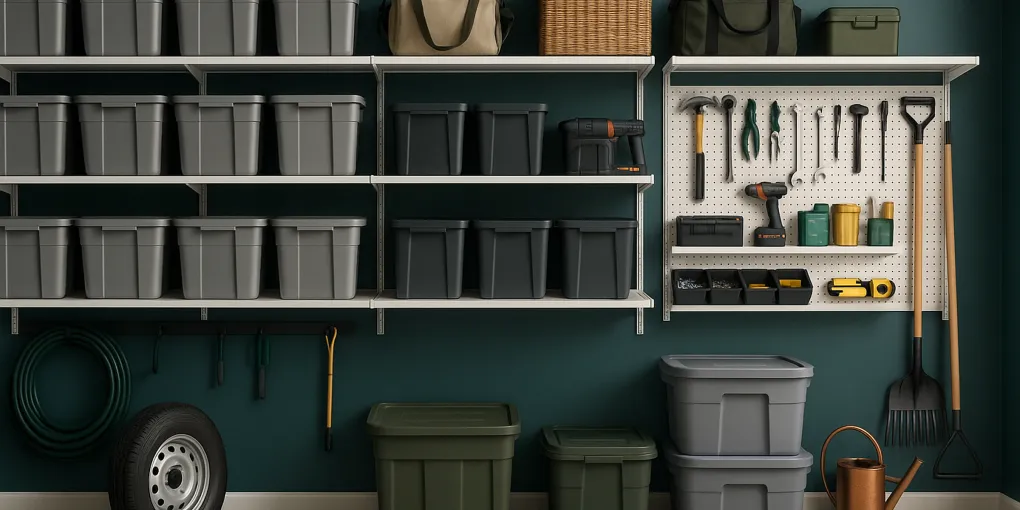
How to Declutter and Organize Your Garage 2026
Buyer's GuideQuick picks
Gladiator Premier Series Steel Wall Cabinet (2-Door)
Rubbermaid FastTrack Garage Storage System Starter Kit
Homz Durable Storage Tote with Secure Lid (18-Gallon, 4-Pack)
Why the Garage Is the Final Clutter Frontier
Quick picks
These are the products referenced in the guide; check dimensions, material, and installation limits before ordering.
- Gladiator Premier Series Steel Wall Cabinet (2-Door): See current price on Amazon
- Rubbermaid FastTrack Garage Storage System Starter Kit: See current price on Amazon
- Homz Durable Storage Tote with Secure Lid (18-Gallon, 4-Pack): See current price on Amazon The garage is, statistically, the room with the highest density of accumulated household clutter. In a 2023 survey, over 50% of American homeowners reported that their garage was too cluttered to park a car — despite this being the garage’s primary intended function. The garage has become the home’s default “figure it out later” zone, accumulating items from every other room that didn’t have a designated place.
The garage is challenging to declutter for specific reasons that behavioral science helps explain. Research on loss aversion (Kahneman & Tversky, 1979) demonstrates that people weight potential losses more heavily than equivalent gains — which in organizational terms means that keeping an item (avoiding the “loss” of discarding it) consistently feels safer than releasing it. In the garage, where items are already “stored” and invisible, the perceived risk of discarding is highest and the cost of keeping seems lowest. This dynamic drives accumulation.
Overcoming garage accumulation requires a systematic approach that reduces the in-the-moment decision load — working through categories rather than individual items, and establishing simple decision rules in advance.
This guide provides that system for 2026.
Planning the Garage Declutter
A large garage cleanout is a significant project — typically one to two full days for an average two-car garage with several years of accumulation. Planning it as a project, rather than approaching it when you happen to think of it, significantly increases completion rates.
What to prepare:
- Large trash bags (heavy-duty): For actual garbage and hazardous materials
- Donation boxes or bags: For items going to charity
- A staging area: Clear as much driveway space as possible — you’ll be pulling everything out
- Markers and tape: For temporarily labeling boxes during sorting
- Water and food: Garage cleanouts are physical, multi-hour projects
- A truck or large vehicle (or scheduled donation pickup): For same-day removal of donations — items that sit in “donate” boxes for weeks often migrate back
The commitment: Schedule the garage cleanout as a full-day commitment, not a spare-hour project. The inability to complete a garage cleanout in available time is one of the primary reasons people start and stop, leaving the garage in a worse state than they found it (partially sorted, items everywhere). A single committed day produces a completed result.
Step 1: Pull Everything Out
The single most important step in a garage cleanout is also the most daunting: remove everything from the garage and stage it in the driveway. This sounds extreme, but it’s functionally necessary for two reasons.
First, it allows you to see the full volume of what you own — which resets your sense of “normal” and provides the motivational clarity that makes donation decisions easier.
Second, it allows you to clean the garage floor, walls, and shelving before returning only the items you’re keeping. A freshly cleaned space is significantly more motivating to organize well.
Pull everything out by category to the extent possible: all sporting equipment in one area, all tools in another, all holiday decorations together. The driveway staging becomes a temporary organizational map.
Step 2: Sort by Category with Decision Rules
Working through the staged items by category, apply clear decision rules to each:
Tools (hand tools, power tools):
- Keep: Tools you’ve used in the past two to three years that are in working condition
- Donate: Duplicates of tools you already have a better version of; tools in working condition you haven’t used in years
- Discard: Broken tools that cannot be repaired cost-effectively
Sporting and recreational equipment:
- Keep: Equipment for activities you participate in actively
- Donate: Equipment from activities you’ve abandoned (the rowing machine from 2018, the golf clubs from a phase that passed), equipment your children have outgrown
- Discard: Damaged or worn-out equipment
Holiday and seasonal decor:
- Keep: Decorations you actively use and display each year
- Donate: Decorations you skip every year, duplicates, items from holidays or traditions no longer observed
- Discard: Broken lights, damaged ornaments, unusable items
Automotive supplies:
- Keep: Products you actively use for your current vehicle(s)
- Dispose properly: Old motor oil (HHW collection), expired fire extinguishers (local fire station), old batteries (retailer take-back programs)
- Discard: Parts for vehicles you no longer own, expired automotive chemicals
Gardening supplies:
- Keep: Tools in working condition for your current gardening practice
- Donate: Duplicate tools, items for garden styles you’ve moved away from (if you converted your garden beds, the related supplies may be obsolete)
- Dispose properly: Expired pesticides and herbicides (HHW collection)
The “mystery box” category: Almost every garage contains boxes that haven’t been opened in years. These boxes require opening and evaluating each item individually. The rule: if you didn’t know what was in the box without opening it, the items inside are candidates for donation or disposal by default. Items you actively missed and searched for in the years since the box was closed are keepers; items you had forgotten entirely rarely justify the storage space.
Step 3: Clean the Empty Garage
Before returning any items, clean the garage thoroughly:
- Sweep the floor completely
- Address any oil stains on the floor (degreaser and scrubbing, or floor paint/epoxy for a permanent solution)
- Wipe down shelving units and storage surfaces
- Identify any moisture issues, wall cracks, or pest evidence that should be addressed before adding storage
- Evaluate current shelving — is it the right height, in the right positions, and in good structural condition?
The clean, empty garage is the best moment to redesign the organization system before items return.
Step 4: Design the Zone System
The most effective garage organization is zone-based: designated areas of the garage for specific categories of use. Items return to their category zone, not to wherever space happens to be available. See our complete guide to how to organize your garage by zone for full zone design guidance.
Typical garage zones:
- Automotive zone: Near the garage door, floor-level access for car care supplies
- Garden and yard zone: Near the door to the yard; wall-mounted tools, rolling cart for soil and supplies
- Workshop/tool zone: Workbench area with wall-mounted tool storage and pegboard
- Sports and recreation zone: Rack or bin system for balls, rackets, helmets, seasonal gear
- Holiday/seasonal storage zone: Upper shelving, clearly labeled bins by holiday/season
- Household overflow zone: Shelving for pantry overflow, cleaning supplies, and household bulk items
How We Score
ClutterScience evaluates products using a five-factor composite scoring methodology (30/25/20/15/10):
| Factor | Weight | What We Assess |
|---|---|---|
| Research | 30% | Depth of specification and user-report analysis and breadth of products reviewed |
| Evidence Quality | 25% | Reliability of sources: third-party testing where available, verified-purchase review synthesis, third-party testing where available |
| Value | 20% | Cost-effectiveness relative to competing products at similar quality tiers |
| User Signals | 15% | Long-term verified purchase feedback and real-world performance reports |
| Transparency | 10% | Accuracy of manufacturer claims, material disclosures, and dimension accuracy |
Scores are differentiated — top picks typically score 8.5–9.5, mid-tier 7.0–8.4, and weak options below 7.0.
Recommended Products
Gladiator Premier Series Steel Wall Cabinet (2-Door)
Amazon ASIN: B000BQWB2C | See current price on Amazon
After a garage cleanout, wall-mounted steel cabinets provide closed storage that keeps tools, automotive supplies, and chemicals organized, protected from dust, and out of the reach of children. The Gladiator Premier line is the most consistently recommended garage cabinet system for residential use, with welded steel construction that withstands garage temperature fluctuations.
| Criterion | Weight | Score |
|---|---|---|
| Capacity & Dimensions | 30% | 9.0/10 |
| Material Quality | 25% | 9.4/10 |
| Ease of Assembly & Use | 20% | 7.5/10 |
| Long-Term Value | 25% | 9.5/10 |
| Composite Score | 9.0/10 |
Installation requires wall anchoring, but once installed, these cabinets are effectively permanent garage infrastructure. Verified purchasers consistently report that the cabinet system pays for itself in reduced time searching for tools and supplies. Rated for substantial weight loads.
Rubbermaid FastTrack Garage Storage System Starter Kit
Amazon ASIN: B007HMOTB0 | See current price on Amazon
Wall-mounted rail systems allow garden tools, sporting equipment, and garage supplies to be stored on the wall rather than on the floor, freeing floor space while keeping items visible and accessible. The FastTrack system uses a horizontal rail with interchangeable hooks, baskets, and holders — a modular approach that adapts as the garage storage needs evolve.
| Criterion | Weight | Score |
|---|---|---|
| Capacity & Dimensions | 30% | 8.6/10 |
| Material Quality | 25% | 8.8/10 |
| Ease of Assembly & Use | 20% | 8.5/10 |
| Long-Term Value | 25% | 9.0/10 |
| Composite Score | 8.8/10 |
The interchangeable hook system is the key advantage — as needs change (different tools, different seasonal items), the wall layout adapts without removing the rail. A complete starter kit provides a significant amount of wall storage capacity at a reasonable price point.
Homz Durable Storage Tote with Secure Lid (18-Gallon, 4-Pack)
Amazon ASIN: B086W7Y9CB | See current price on Amazon
Matching, lidded storage totes are the foundational element of a labeled garage shelving system. These heavy-duty totes withstand the temperature cycling of unheated garages, stack securely with filled lids, and are the right size for most category-based garage storage (holiday decor, sporting gear, seasonal items). Using a consistent container system creates visual order and makes the stacking shelving system genuinely navigable.
| Criterion | Weight | Score |
|---|---|---|
| Capacity & Dimensions | 30% | 8.8/10 |
| Material Quality | 25% | 8.4/10 |
| Ease of Assembly & Use | 20% | 9.3/10 |
| Long-Term Value | 25% | 8.7/10 |
| Composite Score | 8.8/10 |
A four-pack provides a starter system; most garages will need eight to twelve for complete holiday and seasonal storage. Verified purchasers note that the lids lock securely in a way that prevents shifting during stacking. Label each tote with a label maker or permanent marker for permanent category identification.
Disposal and Donation Logistics
The practical challenge of a garage cleanout is removing what you’re not keeping. The most common failure point is when “donate” and “trash” items sit in the garage for weeks after the cleanout, making the garage feel cluttered and creating the risk that items migrate back.
Same-day or scheduled-ahead removal strategy:
-
Donations: Schedule a charity pickup before the cleanout day. Many charities (Habitat for Humanity ReStore, Salvation Army, local thrift stores) offer free home pickup for large items. Schedule the pickup for the same day or the day after the cleanout — the donation truck arriving creates a hard deadline that prevents second-guessing.
-
Large trash: If renting a dumpster, book it for the cleanout weekend. If using household trash pickup, check your municipality’s bulk item pickup schedule and aim the cleanout for the week before your scheduled bulk pickup date.
-
Hazardous materials: Check Earth911.com or your municipality’s website for the next HHW drop-off event and schedule it as part of the cleanout follow-up.
Returning Items to the Clean Garage
When returning items to the organized garage, follow the zone system designed in Step 4. The discipline of zones prevents the re-accumulation pattern that causes garage organization to fail within months.
The “things returned to their zone” rule: Every item in the garage has a designated zone and a designated location within that zone. After using a tool or item, it returns to its specific location — not to a general area, not to the nearest available surface, but to its specific spot. This rule, consistently applied, maintains the organization essentially indefinitely.
For additional inspiration and hardware for the fully organized garage, see our guide to a garage wall storage system that matches the items you need to keep off the floor.
Maintenance Schedule
Unlike indoor rooms, garages benefit from a less frequent but more substantial maintenance cycle:
After each use: Tools and equipment return to their designated location. This is the daily micro-habit that prevents slow re-accumulation.
Quarterly: Walk the garage and return any items that have migrated from their zones. Five minutes once per season.
Annual: A full review of the garage contents, applied especially to sporting equipment and holiday decor — these categories grow the fastest and benefit from annual evaluation. Approximately one to two hours once per year.
Every three years: A more complete reassessment as household needs change (children aging out of categories, new vehicles, new hobbies). This is the level at which the zone system itself may need adjustment.
Summary
A garage declutter is a one-to-two day project that transforms the most neglected space in most homes into a functional, organized system. The investment: a committed Saturday and Sunday, a rental truck or arranged donation pickup, and the discipline to apply clear decision rules throughout.
The result: a garage that can be used for its intended purpose (parking, workshop, storage with system), with every item findable and every zone maintainable. The behavioral key to keeping it that way is the “return to location” rule — consistently applied, it prevents the slow return of the chaos that required the cleanout in the first place.
Frequently Asked Questions
- Garages frequently contain materials classified as household hazardous waste (HHW): old paint, motor oil, antifreeze, pesticides, herbicides, pool chemicals, and old batteries. Most municipalities operate periodic HHW drop-off events, and many have permanent HHW collection facilities. Earth911.com provides a zip code-based lookup for local disposal options. Never pour motor oil or chemicals down drains or storm sewers — it's illegal in most jurisdictions and causes serious environmental harm. Latex paint can often be dried out and placed in household trash; check local guidelines.
- Apply a functional assessment: Is it in working condition? Have I used it in the past two to three years? Do I have a duplicate that does the job better? For tools, the question of 'might I need this someday' is particularly common and particularly problematic — tool collections in garages commonly contain items kept purely for hypothetical future need. A useful rule: if you would need to buy this tool for a specific project, keep it; if you'd rent it for that project, donate it.
- Start at the easiest category and build momentum: (1) Obvious trash first — broken items, empty containers, actual garbage — takes thirty minutes and creates immediate visual progress. (2) Then tackle categories with the most straightforward keep/donate decisions: sporting equipment, holiday decor, garden tools. (3) Save ambiguous categories (hardware, 'might need someday' items, mystery boxes) for last when you have the most clarity from what you've already processed. Never start with the hardest decisions — they create paralysis.
- For heavily accumulated garages (10+ years of accumulation) or garages that contain large items (old appliances, broken furniture), renting a small dumpster for a weekend is often worth the $150-300 cost. It eliminates the friction of multiple trips to the transfer station and allows complete removal in a single session. For lighter cleanouts, a combination of donation truck pickup (many charities offer free home pickup for furniture and large items) and a few trips to the transfer station is sufficient.