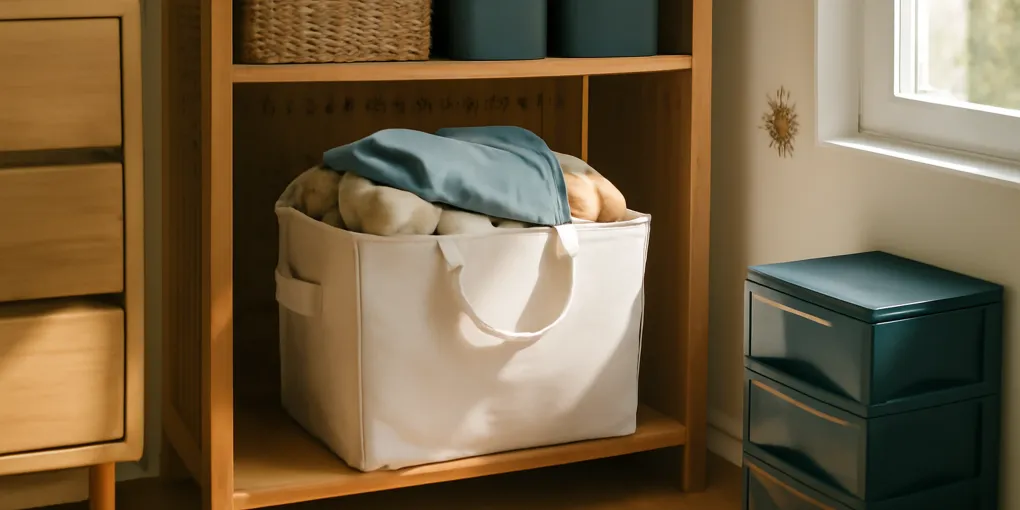
The One-Bin Donation System: A Low-Friction Decluttering Protocol
ProtocolDecluttering often fails because the decision and the exit are separated. You decide a shirt does not fit, then put it back because there is nowhere obvious to send it. You notice an unused kitchen tool, then leave it in the drawer because a full decluttering session sounds exhausting.
How to use this protocol
- Choose one donation container: Use a bin or bag large enough for weekly donations but small enough to force regular drop-offs.
- Place it where decisions happen: Put the bin near laundry, closets, a mudroom, or a storage shelf rather than hidden in long-term storage.
- Set an exit rule: When the bin is full or on a scheduled day, move donations to the car or pickup location.
Use these steps as the working order for the setup guidance below; they keep the project focused on the items that actually land in the space.
Quick picks
Use this as a shortcut to the products mentioned below; verify dimensions and mounting limits against your space before buying.
- collapsible laundry basket: See current price on Amazon
- handled storage tote: See current price on Amazon
- fabric storage bin with handles: See current price on Amazon
- label maker for home organization: See current price on Amazon
The one-bin donation system lowers the friction. It creates one visible place for good-condition items that are ready to leave the home.
Why One Bin Works
A donation bin is a physical implementation intention: if you find a usable item you no longer need, then it goes in the bin. That removes the need to schedule a major decluttering project for every small decision.
The system works because it is:
- Visible enough to prompt action.
- Limited enough to prevent hoarding donations.
- Specific enough to avoid becoming a miscellaneous bin.
- Easy enough for multiple household members to use.
The bin is not the final destination. It is a short-term transfer station.
Pick the Right Container
Choose a container based on your exit routine. If you drive donations to a charity shop, a sturdy handled tote may work. If you use pickup bags, a hamper-style bin that holds a bag open may be better.
Useful shopping links include collapsible laundry basket (See current price on Amazon), handled storage tote (See current price on Amazon), fabric storage bin with handles (See current price on Amazon), and label maker for home organization (See current price on Amazon). These are search links so readers can compare current labels, prices, sellers, and return policies before buying.
Avoid oversized containers. A giant donation box can sit for months and become part of the room. The best container creates useful pressure to finish the loop.
Place It Where Decisions Happen
The bin should live near decision points, not in a forgotten corner. Good locations include:
- Inside or beside the primary closet.
- Near the laundry area.
- In a mudroom or hallway cabinet.
- Near a kids’ clothing storage area.
- On a garage shelf if the garage is part of your weekly routine.
If you often notice unwanted items in multiple places, start with the highest-friction category. Clothing is a common first win because fit and wear decisions happen during laundry.
Create Donation Rules
Without rules, the bin can collect items that should not be donated. Post or memorize a short checklist:
| Donate | Do not donate |
|---|---|
| Clean clothing in usable condition | Stained or damaged clothing |
| Working household items | Broken electronics or unsafe items |
| Duplicate tools or kitchen items | Recalled products |
| Books in good condition | Personal papers or sensitive documents |
| Unused decor | Trash, recycling, or hazardous materials |
When in doubt, check the receiving organization’s guidelines. Donation is not a shortcut for disposal.
Set an Exit Trigger
The exit trigger is the most important part. Choose one:
- When the bin is full, move it to the car.
- Every first Saturday, drop donations off.
- When scheduling errands, add the donation location.
- When pickup bags arrive, fill one immediately.
A donation system that never exits is just a storage system with nicer intentions.
Make It Household-Friendly
If multiple people use the system, avoid vague labels. “Donate” is clear. “Maybe” is not. If someone needs review before items leave, add a small “review first” tag or use a two-step process: donation bin first, final check before drop-off.
For children’s items, the bin can support gradual decluttering, but be careful with sentimental objects. A separate memory box works better than mixing sentimental review with ordinary donations.
Troubleshooting
If the bin overflows, it is too large, too hidden, or missing an exit date. If no one uses it, it is too far from the decision point. If trash appears in it, the label or rules are unclear.
Adjust one variable at a time. Move the bin before buying a different bin. Add a label before adding more containers.
Bottom Line
The one-bin donation system turns decluttering into a small repeated action. Give unwanted usable items one obvious place to go, keep the container limited, and build the exit into your routine. The simpler the system, the more likely it is to survive normal weeks.
How we score one bin donation system
For a one-bin donation system, compare visibility, fill line, bag compatibility, exit route, and whether questionable items have a decision deadline instead of becoming permanent storage.
Practical reader notes for one bin donation system
Use the scoring notes above to narrow the practical choice: match the product or protocol to your space, risk tolerance, maintenance capacity, and the specific constraints described above.
For product comparisons, prioritize fit and repeat use over impressive feature lists. A cheaper item that is easy to place, clean, dose, adjust, or return often beats a premium item that adds friction. Check dimensions, serving size, material notes, warranty language, and whether replacement parts or refills are easy to find. For health and wellness topics, compare the article’s evidence notes with your own risk profile, medications, sleep schedule, training load, and clinician guidance. Stop using any protocol that creates pain, dizziness, allergic symptoms, digestive distress, or a behavior pattern that feels hard to control.
A useful first test is a two-week trial with a clear success metric. Choose one outcome that matters: fewer missed sessions, faster cleanup, less morning stiffness, better adherence, lower noise, easier travel, or a more predictable measurement routine. Keep the rest of the setup stable so you can tell whether the change helped. If the result is neutral, return or retire the item quickly instead of expanding the system around it. If it helps, document the settings, dose, location, or schedule that made it work so the benefit survives busy weeks.
Readers should also separate evidence strength from personal fit. Stronger evidence can justify trying a category, but it does not guarantee that a particular brand, accessory, or routine will be the best match. Weak or emerging evidence does not automatically make a topic useless; it means the trial should be lower cost, lower risk, and easier to abandon. This is why our recommendations emphasize transparent trade-offs, realistic setup instructions, and situations where skipping the purchase is the smarter move.
Finally, revisit the choice after the novelty period. If the product is not used, if the protocol creates more steps than it saves, or if the article’s safety caveats apply to you, the right answer may be to simplify. The goal is not to own the highest-scoring option. The goal is to solve the reader problem with the least friction and the most honest understanding of benefits, limits, and uncertainty.
Field checks before relying on one bin donation system
A good field check is specific enough that a reader can repeat it on a normal week. Put the item, routine, or buying criterion into the exact setting where it is supposed to help. For a training or supplement topic, that means the same meal timing, sleep window, workout duration, and recovery day pattern you normally use. For a home or pet product, that means the real doorway, cabinet, litter area, couch, crate, bathroom, or storage shelf rather than a cleared-off test space. The point is to see whether the recommendation survives ordinary friction.
Track three observations: what became easier, what became more annoying, and what you would change before recommending it to another person. If the answer is vague after two weeks, treat that as a weak result. A useful choice should reduce decision load, make the next action obvious, or solve a measurable problem without demanding constant attention. If it only works when everything else is perfect, it is probably not the right primary pick.
When to skip or downgrade the pick
Skip specialty sorting products if the donation habit fails because items never leave the house. Downgrade to one open bin or bag in the exact room where rejects appear: closet, laundry area, toy shelf, or entry. Upgrade only if the container has a full-bin trigger, a transport plan, and a destination already chosen. Multiple labeled bins can feel organized while delaying the actual handoff.
Test the system with the next three real rejects, not a whole-house cleanout. If each item reaches the bin immediately and the bin leaves on the scheduled errand, the system is sufficient. If family members debate categories, rescue items repeatedly, or forget the bin in a closet, simplify the rule to one visible container and one recurring drop-off date.
Maintenance and follow-through plan
A small visible bin also prevents the project from turning into a hidden closet backlog that nobody remembers to empty.
Plan the follow-through before buying or changing the routine. Decide where the item will live, who resets it, how often it needs cleaning or replacement, and what signal tells you it is no longer useful. For nutrition and fitness choices, write down the dose, timing, contraindications, and stop conditions. For organization and pet-care choices, write down the reset interval, cleaning method, and what would make the setup unsafe or impractical.
Review the decision after fourteen days and again after six weeks. The first review catches immediate fit problems; the second catches novelty effects. Keep the choice only if it is still being used without reminders and the benefit is visible in normal life. If it fails, record why: wrong size, wrong flavor, too much noise, confusing instructions, insufficient evidence, poor comfort, or simply not the bottleneck you needed to solve. That note is often more valuable than another product search.
Decision checklist
Before changing purchases, routines, or setups, confirm measurements, fit, contraindications, and current seller details for your household or clinician-reviewed situation.
If two options look similar, prefer the one with clearer instructions, fewer hidden assumptions, and easier reversibility. A transparent mid-priced choice usually beats a premium choice that depends on perfect adherence. Keep notes on the actual outcome rather than the expected benefit. That habit makes future choices faster and helps you avoid repeatedly buying solutions for the same unresolved constraint.
Maintenance detail: place the donation bin where decisions already happen, such as a closet shelf or laundry area, rather than in storage. Label a firm pickup or drop-off trigger—full bin, monthly errand, or seasonal closet reset—so the system does not become another holding pile.
Frequently Asked Questions
- Keep it near the place where you notice unwanted items, such as a closet, laundry room, mudroom, or hallway cabinet.
- Small enough to fill within one to four weeks. Oversized bins delay the exit step and become clutter.
- Avoid broken, dirty, unsafe, recalled, or personally sensitive items. Dispose, recycle, repair, or securely shred those instead.