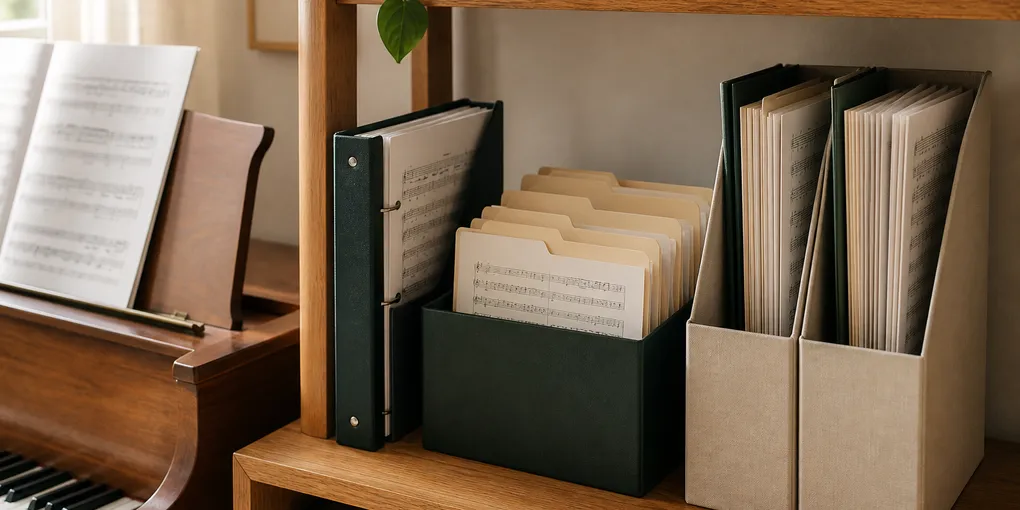
Sheet Music Storage: Binders, File Folders, and Magazine Holders
ProtocolWhen the next piece is somewhere between the piano bench, a music stand, and a paper pile, sort by access rather than volume. Give each kind of score a job-shaped home: a small binder for the music you open now, file folders for loose groups, and magazine holders for upright collections outside the current rotation.
The useful label is the one that matches the question you ask. “What am I practicing this month?” calls for a binder. “Where is the spring concert packet?” calls for a folder. “Which shelf section holds chamber music?” calls for an upright holder.
Start with the next time you will use the pages
Before choosing a container, make three short stacks. Put current practice or rehearsal music in one stack. Put groups of loose pages that belong together in another. Put music you want to keep nearby but do not expect to open this week in the third.
Those stacks can all look like paper, but they need different kinds of access. A current set needs to open and close easily. A loose group needs to travel as one unit. An inactive collection needs to stand upright on a shelf without taking over the piano top.
| If you need to… | Give it this home | Keep it working by… |
|---|---|---|
| Open the same few pieces at a lesson, rehearsal, or practice session | Binder | Limiting it to the current set |
| Keep a multi-page packet together without altering the pages | File folder | Using one folder per meaningful group |
| Keep several grouped folders visible on a shelf | Magazine holder | Standing folders upright and leaving room to pull one out |
Skip a fourth stack called “to organize.” Choose a home for each group while the differences are still obvious.
Use a binder for the small active set
A binder works when you want the music to behave like one working book. Put in the pieces you expect to open repeatedly, such as the handful you are learning now or the folder you take to a recurring rehearsal. Aim for quick retrieval instead of maximum capacity. You should be able to see the current set without flipping past old material.
Decide how the pages will attach before you add them. If a score can be punched and the holes will not interfere with its use, place it behind a divider. If it should remain unpunched, use a clear sleeve or keep that score in the folder system instead. Mixing a few loose sheets into the front or back pocket is how a useful binder becomes another paper pile.
Give each divider a job, not a vague label. “Warmups,” “September recital,” and “duets with Maya” tell you where to turn. “Miscellaneous” only moves the decision later.
When the binder starts to feel thick, it has usually crossed from active set into archive. Move the music you finished to its folder instead of buying a larger binder. A slim binder that travels with you is easier to keep current than a shelf-sized one packed with every piece you have played.
Use file folders to keep loose pages together
File folders answer a different problem: several pages belong together, yet they can stay loose and outside the practice rotation. A folder can hold a full ensemble part, a seasonal packet, a composer’s short works, or the pages for one event.
Name the folder around retrieval. A player who usually remembers the composer can use that route. An ensemble with a calendar-driven repertoire may find “winter program” faster. A household with several musicians may lead with instrument or ensemble, then add the composer in smaller writing after a dash.
For example, a folder labeled “Choir — winter program” makes sense if you unpack music by concert. “Piano — Debussy” makes sense if you return to a composer’s pieces over time. Use the label scheme that leads you to the right packet before you start opening folders.
Keep one folder for pages waiting to join the active binder, but give it a limit. At the end of a lesson cycle, rehearsal run, or performance season, either move those pages into the current set or file them under their settled label.
Put the folder collection upright in magazine holders
Magazine holders are useful at the shelf level. They keep groups of folders vertical, visible from the side, and easier to remove than a horizontal stack. Use one holder for a broad shelf section, such as solo piano, band parts, or seasonal programs. Keep the individual groups inside as folders; the holder organizes the shelf while each folder keeps a set together.
The key detail is slack. If a holder is packed tightly enough that removing one folder requires tugging several others along, it has become a paper wedge. Leave a finger-width of room or split the section into two holders. If the pages lean or slide forward, put the thinnest groups in a sturdier folder with a fuller back panel before they go on the shelf.
Label the holder at the front edge with the broadest category. Let the folder tabs carry the more specific names. That two-level system prevents a shelf from turning into a row of long, repeated labels.
Make the handoff from practice to shelf deliberate
The system holds together when music has a clear moment to leave the active binder. After a performance, lesson unit, or concert season, take five minutes to remove finished pages. Put the set back in its named folder, return the folder to its holder, and leave only the next active pieces in the binder.
This is also the moment to catch duplicate copies and incomplete packets. Keep the copy that belongs with the working set, then place the other pages with their matching group if you need them. Return the set that just stopped being active; a full history sort can wait for a separately chosen project.
A note about uncommon or fragile music
This setup is for ordinary working copies and everyday household collections. If a score is rare, fragile, historic, or unusually important to keep in its present condition, treat it as a collections-care question. The Library of Congress advises different handling and storage practices for works on paper, including avoiding fasteners and using supportive protective enclosures where appropriate. In that situation, use collections-care guidance or consult a qualified conservator before using this routine.
Set up the first shelf section today
- Pull out the music you expect to open in the next few weeks and place it in one slim active binder.
- Put every remaining loose group into a folder with a label based on how you search for it.
- Stand related folders in one magazine holder, with room to remove each group.
- Put the holder near the place where music returns after practice, rather than in a distant general-paper area.
- At the end of the next project or season, remove the finished set from the binder and file it back on the shelf.
If the active binder keeps refilling with old favorites, that is a sign to create a small “return often” folder beside the current set—not to let every played piece stay in circulation forever.
Sources
- Library of Congress: Care, Handling and Storage of Works on Paper
- Library of Congress: Preferred Preservation Formats for Musical Scores
Frequently Asked Questions
- Use a binder for a small set you open repeatedly and a file folder for loose pages that need to stay grouped without being punched. The choice follows the next action: turn pages in the active set, or retrieve a whole group later.
- Label it by the cue you use to look for music. A solo player may use composer or instrument; a choir may use season or ensemble; a performer may use an event name. Choose one primary route, then add a short second cue only when it saves a real search.
- They can hold upright folders or slim binders when the contents already stay together. A holder is a shelf-level container, not a substitute for folders: loose single sheets can separate or slump inside it.
- Keep the pieces you are actively learning, rehearsing, or about to perform, plus only the notes that belong with that set. Move finished music to its labeled folder or holder so the binder remains easy to scan.