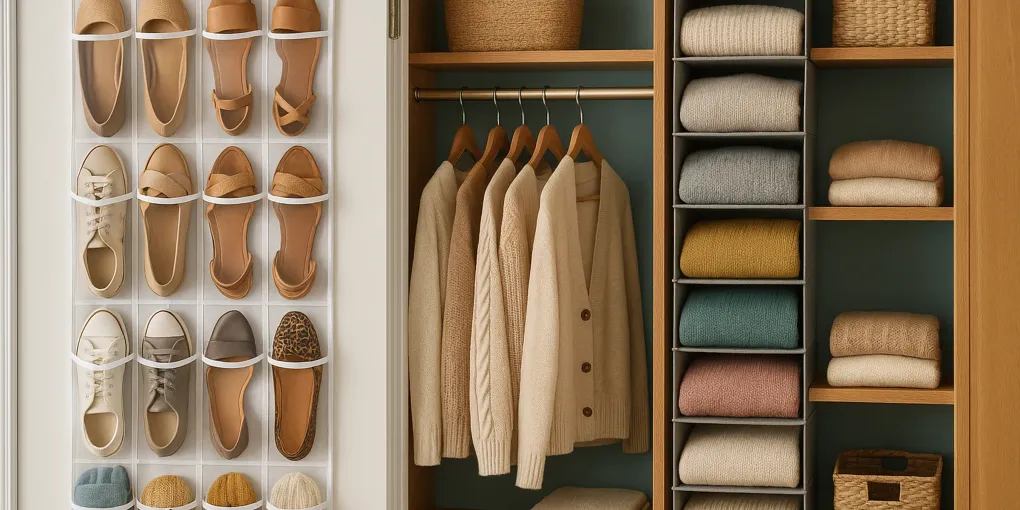
SimpleHouseware Over-Door 24-Pocket vs Whitmor Hanging Sweater: Which Is Better?
Buyer's GuideSimpleHouseware Over-Door 24-Pocket Organizer
Best for Shoes and AccessoriesMaterial: Clear pocket fabric with metal over-door hooks
$16-$26
Quick picks
| Product | Key Specs |
|---|---|
| See price on Amazon |
|
| See price on Amazon |
|
Product availability, certifications, and retailer details can change; check the current Amazon page before buying.
Direct Answer
For most bedrooms, the better option depends on item type: SimpleHouseware Over-Door 24-Pocket is better for shoes and accessories, while Whitmor Hanging Sweater 10-Shelf is better for folded sweaters. If your clutter is mostly small items, choose the 24-pocket design. If your pain point is sweater piles collapsing on shelves, choose the Whitmor. The two products are complementary, not true substitutes, because they use different closet resources.
TL;DR
- Best for accessory overflow: SimpleHouseware Over-Door 24-Pocket
- Best for sweater organization: Whitmor Hanging Sweater 10-Shelf
- Best combined setup: Use both when door-back and rod space are available
- Key trade-off: More compartments (24 pockets) vs larger compartments (10 sweater shelves)
Closet organization often fails when the storage format does not match the object size. That is the core issue in this comparison. Shoes, belts, socks, and small accessories benefit from high compartment count and visibility. Bulky folded garments benefit from deeper shelf volume and better vertical support. These two organizers represent those two strategies. The right pick comes from matching your main clutter category, not from a generic “best organizer” label.
Why This Comparison Matters
Many buyers compare these two because they are similarly priced, tool-free, and popular in bedroom and closet setups. But they are designed for different workflows. The over-door organizer turns the back of a door into 24 quick-access zones. The hanging shelf organizer turns a section of closet rod into vertical shelving for folded garments.
Behavioral science supports this kind of category-based zoning. Verplanken and Wood (2006, doi:10.1509/jppm.25.1.90) found that repeated behaviors become easier when environmental cues are stable and specific. In practical terms, if each item category has a consistent home, maintenance effort drops and re-cluttering slows. Roster et al. (2016, doi:10.1016/j.jenvp.2016.03.003) also found clutter burden falls when people reduce ambiguous storage decisions.
This is why the decision here is less about “quality winner” and more about matching the physical format to your dominant clutter type.
SimpleHouseware Over-Door 24-Pocket Organizer Review
The SimpleHouseware organizer is a high-density accessory system. It hangs over a standard interior door and creates 24 visible pockets without drilling or hardware installation.
Where It Performs Best
It works best when your closet has many small objects with no fixed home: socks, undergarments, scarves, belts, lightweight shoes, or grooming accessories. The 24-pocket format gives each item category a specific location, which lowers search time and reduces shelf pileups.
The biggest advantage is net-new storage. If shelves and rods are already busy, door-back space is usually the last underused area in a bedroom closet. This product converts that dead space into daily-use storage quickly.
Constraints and Fit Issues
Pocket depth and width are limited. Bulky sweaters, heavy items, or oversized shoes can cause sagging and make the organizer less stable. Door clearance also matters. If your closet door already has tight tolerance to frame or trim, loaded pockets may rub.
It is also less ideal for people who want a clean minimal visual profile. Because everything is visible, the system looks efficient but can look busy unless categories are disciplined.
Scoring - SimpleHouseware Over-Door 24-Pocket
| Criterion | Weight | Score | Notes |
|---|---|---|---|
| Capacity & Dimensions | 30% | 8.5 | 24 zones create strong density for small-item storage |
| Material Quality | 25% | 7.8 | Good for light-to-moderate loads; heavy items reduce lifespan |
| Ease of Assembly & Use | 20% | 9.4 | No tools, installs in minutes, fast visual retrieval |
| Long-Term Value | 15% | 8.2 | Strong value for accessory-heavy households |
| User Signals | 10% | 8.0 | Broad adoption; positive use-case fit when item type is correct |
| Composite Score | 8.3/10 |
Whitmor Hanging Sweater Organizer 10-Shelf Review
Whitmor’s 10-shelf unit is a garment-oriented organizer that hangs from a closet rod and provides larger shelf compartments for folded knitwear.
Where It Performs Best
This organizer wins when the core problem is sweater stacking. Each shelf is larger than a pocket and supports folded garments without the compression and distortion common in smaller pocket systems. It also keeps knitwear visible and separated, which reduces “buried inventory” where sweaters disappear in deep stacks.
The shelf format is easier for seasonal rotation. You can dedicate upper shelves to in-season items and lower shelves to less-used pieces without mixing categories.
Constraints and Fit Issues
It requires available rod length and vertical clearance. Closets with long hanging garments may not have enough uninterrupted drop for a full 10-shelf column. If your rod area is already saturated with long coats or dresses, this design can conflict with current hanging capacity.
Fabric shelf systems can also deform under chronic overloading. If each shelf is packed beyond intended volume, side panels and shelf boards wear faster than wire-based systems.
Scoring - Whitmor Hanging Sweater 10-Shelf
| Criterion | Weight | Score | Notes |
|---|---|---|---|
| Capacity & Dimensions | 30% | 8.6 | Larger shelves fit folded sweaters better than pocket systems |
| Material Quality | 25% | 8.0 | Appropriate for garment loads; durability depends on load discipline |
| Ease of Assembly & Use | 20% | 8.8 | Fast setup; no tools; straightforward shelf categorization |
| Long-Term Value | 15% | 8.4 | High practical value for sweater-heavy wardrobes |
| User Signals | 10% | 8.2 | Consistent satisfaction when used for folded garments |
| Composite Score | 8.4/10 |
Head-to-Head Comparison
| Feature | SimpleHouseware Over-Door 24-Pocket | Whitmor Hanging Sweater 10-Shelf |
|---|---|---|
| Best storage type | Small accessories and shoes | Folded sweaters and knitwear |
| Compartment count | 24 pockets | 10 shelves |
| Compartment size | Smaller | Larger |
| Installation location | Door back | Closet rod |
| Tool requirement | None | None |
| Main risk | Overloading pockets with bulky/heavy items | Overloading fabric shelves with dense stacks |
| Typical use case | Accessory overflow | Sweater stack control |
| Price range | $16-$26 | $22-$30 |
| Composite score | 8.3/10 | 8.4/10 |
Who Should Choose Which?
Choose SimpleHouseware Over-Door 24-Pocket if
- Your biggest pain point is accessory and shoe clutter
- You need new storage without sacrificing shelf or rod space
- Your closet door has enough swing clearance
- You want maximum compartment count at lower cost
Choose Whitmor Hanging Sweater 10-Shelf if
- Your biggest pain point is folded sweater management
- You have available closet rod section and vertical drop
- You need larger compartments, not more tiny compartments
- You want better knitwear visibility and category separation
Choose Both if
- Your closet has both unused door-back space and rod space
- You have mixed clutter: accessories plus sweater overflow
- You are building a full system instead of solving one bottleneck
Final Verdict
The Whitmor Hanging Sweater 10-Shelf wins by a small margin for this direct comparison because it fits the highest-friction category in many closets: unstable folded sweater stacks. It scores slightly higher overall (8.4 vs 8.3) due to better garment-fit and stronger long-term utility for knitwear.
The SimpleHouseware Over-Door 24-Pocket remains the better buy for accessory-heavy households and for closets where shelf and rod capacity are already consumed. In many real closets, the best solution is staged: use Whitmor for garments and SimpleHouseware for accessory overflow.
Frequently Asked Questions
Is this comparison mainly about quality or mainly about closet layout?
Mostly closet layout. Both products are viable, but they solve different storage bottlenecks. The deciding factor is whether your dominant clutter is bulky folded garments or smaller accessory items.
What should I measure before buying either organizer?
Measure door clearance for over-door models and rod-to-floor vertical space for hanging shelf models. Also check whether your closet’s current mix of long-hang garments leaves enough rod section for a 10-shelf unit.
Which option is better for renters who cannot drill holes?
Both are renter-friendly because they are no-drill systems. Over-door and rod-hanging installs avoid permanent hardware changes when used as directed.
Can these organizers reduce clutter long term, or just temporarily?
They can support long-term order when each category has a fixed home and capacity limits are respected. Behavioral research suggests stable cues and defined storage zones improve maintenance consistency over time.
Which one is better value per dollar?
For accessory volume, the 24-pocket model usually provides stronger value density. For sweater-heavy closets, the 10-shelf design typically delivers better functional value despite slightly higher price.