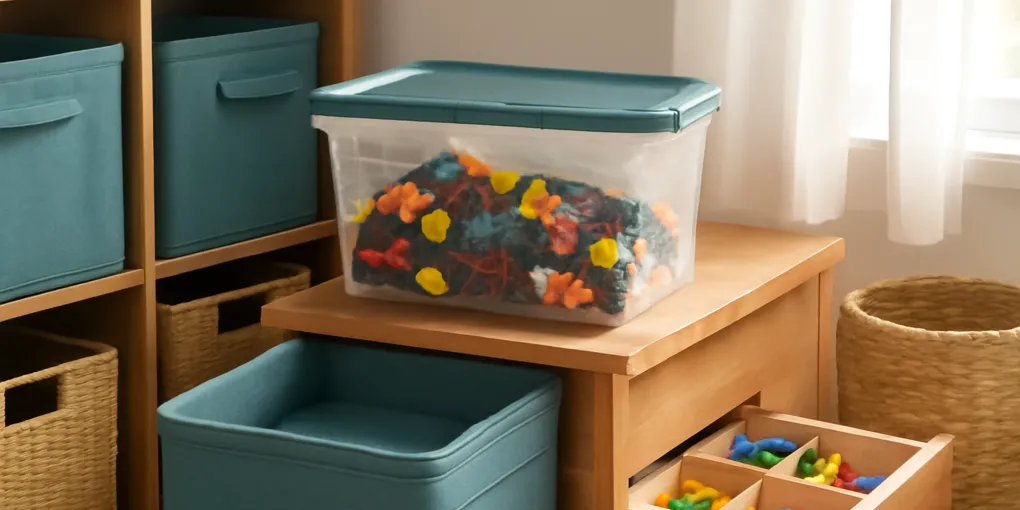
Toy Small-Parts Quarantine Bin Protocol for Safer Playroom Resets
ProtocolQuick picks
| Product | Key Specs |
|---|---|
| See price on Amazon |
|
| See price on Amazon |
|
| See price on Amazon |
|
Product availability, certifications, and retailer details can change; check the current Amazon page before buying.
Open toy bins are fast, but they are bad at separating risk. A puzzle piece, doll shoe, broken wheel, marble, button battery cover, magnet, and snack wrapper can all land in the same soft cube. The toy small-parts quarantine bin protocol creates one adult-controlled stop before those pieces disappear back into the room.
This is not a prettier way to keep every toy fragment. It is a sorting rule: loose pieces that are too small, broken, sharp, battery-related, or separated from their set do not go straight back into open play. They go into a closed review box until an adult decides whether to reunite, repair, relocate, or discard them.
For the behavior pattern behind this mess, read why toy bins hide small parts. For the larger rotation system, pair this protocol with toy rotation bin protocol for small apartments.
Quick setup
- Best container: Search Amazon for clear lidded small-parts boxes.
- Best set-friendly option: Search Amazon for photo storage cases.
- Best adult-only option: Search Amazon for locking small-parts organizers.
- Storage rule: the quarantine container lives high, closed, and outside unsupervised child access.
The protocol works because it adds a decision point at the exact moment adults usually say, “I will figure out where this goes later.” Later needs a safe container.
What belongs in quarantine
Put loose game tokens, doll accessories, toy food pieces, puzzle pieces, building-set extras, marbles, beads, broken wheels, detached eyes, tiny screws, and unknown plastic pieces into quarantine. Add any toy part that is sticky, cracked, sharp, or likely to be mouthed by a younger sibling.
Button batteries and loose magnets deserve stricter handling. They should not sit in a general toy-parts box that a child can open. HealthyChildren’s childproofing guidance highlights small objects and household hazards as home-safety concerns, and Safe Kids Worldwide specifically treats toy safety as an age-fit and small-parts issue. Keep batteries, magnets, and repair hardware in a separate adult-only container or remove them from the playroom entirely.
Do not quarantine trash. Snack wrappers, broken foam, dried markers, and pieces from toys you no longer own can leave immediately. The bin is for uncertain items, not for delaying obvious disposal.
The four-bin decision
Every quarantined item should leave through one of four decisions.
- Reunite: the piece has a known set and the set still gets used.
- Repair: the toy is worth fixing and the repair item is safe for adult storage.
- Relocate: the piece belongs to older-child storage, a board game, or a craft zone.
- Remove: the piece is broken, unsafe, unmatched after a review cycle, or no longer worth keeping.
This prevents the quarantine box from becoming a permanent mixed-parts archive. If an item cannot earn one of those four decisions, it should not remain in the room.
Product fit matrix
A shallow clear latch box is best for weekly resets because adults can see the categories without dumping the box. Choose compartments large enough to grab pieces easily. Tiny tackle-box dividers can trap small parts and make review slower.
A photo storage case works when the household has many small sets: mini puzzles, card games, doll clothes, train accessories, and building-set extras. Each inner case can hold one set’s orphaned pieces until the next rotation.
A locking craft organizer is the right choice when the quarantine category includes magnets, button batteries, replacement screws, glue, or sharp repair tools. Store it high even if it locks. A latch is a delay, not a supervision plan.
Weekly reset protocol
- Walk the play area with an empty bowl.
- Pick up loose pieces before dumping large bins.
- Put obvious trash directly in the trash.
- Put unknown or small items into the closed quarantine box.
- Match pieces to sets before returning any item to an open bin.
- Move older-child pieces out of shared toddler spaces.
- Store batteries, magnets, screws, and repair supplies in adult-only storage.
- Empty the quarantine box every week or when it reaches half full.
The half-full rule matters. A full box is already too late. It invites dumping and makes the review feel like a project rather than a five-minute safety pass.
Add one more rule for mixed-age homes: review the floor after older-child play ends, not the next morning. Tiny pieces migrate under sofas, rugs, and low shelves when cleanup is delayed. A flashlight pass along the baseboard is often faster than re-sorting the whole room. If the same category keeps appearing in quarantine, move that toy set to a higher shelf, a closed case, or a supervised-use basket instead of blaming the child for a storage system that is too open.
Toy small-parts FAQ
What size toy part is risky?
Use age labels and product warnings first. For mixed homes, any piece that could be mouthed by a younger child deserves adult review, especially round, hard, magnetic, battery-related, or broken pieces.
Should the quarantine box be clear?
Clear is useful for adults because it reduces forgotten parts. It should still be closed and stored out of reach when younger children use the space.
What about small building-brick pieces?
Keep age-graded building pieces in an older-child zone if younger children share the room. Do not let them drift into floor-level open bins used by toddlers.
How does this reduce clutter?
It stops loose pieces from contaminating every bin. Sets stay usable, broken items leave faster, and adults stop buying replacements for pieces that were simply buried.
Sources
- Safe Kids Worldwide, Toy Safety: https://www.safekids.org/safetytips/field_risks/toy-safety
- American Academy of Pediatrics, Childproofing Your Home: https://www.healthychildren.org/English/safety-prevention/at-home/Pages/Childproofing-Your-Home.aspx
Frequently Asked Questions
- It is a temporary adult-controlled container for loose toy pieces that need matching, repair, disposal, or age-safety review before returning to play bins.
- Not when younger children use the room. Small pieces, batteries, magnets, and broken parts need adult review and closed storage.
- Empty it weekly or when it is half full. A quarantine bin that never gets reviewed becomes another junk drawer.
- Only if they are stored above reach or in a closed adult-managed zone when younger children are present.