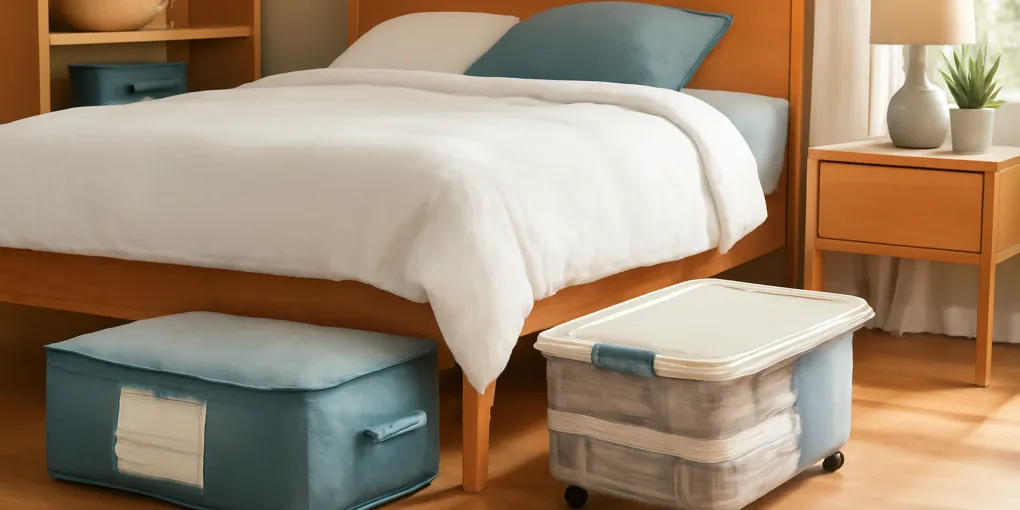
Under-Bed Storage Bags vs Rolling Bins: Which Is Better for Small Bedrooms?
Buyer's GuideLifewit Under Bed Storage Bag
Best soft bagBest for: Low beds, sweaters, linens, and soft seasonal clothes
Quick picks
| Product | Key Specs | Pros / Cons |
|---|---|---|
| See price on Amazon |
|
|
| See price on Amazon |
|
|
| See price on Amazon |
|
|
Product availability, certifications, and retailer details can change; check the current Amazon page before buying.
Quick product shortlist
Use this shortlist to choose a product style before you measure. The links are named product or brand searches so you can compare current dimensions, finishes, prices, and return terms before buying.
- Best soft bag: Lifewit Under Bed Storage Bag (Search Amazon for Lifewit under bed storage bag) for low beds, sweaters, linens, and soft seasonal clothes. Watch-out: soft sides sag when dragged overloaded.
- Best rolling bin: Onlyeasy Rolling Under Bed Storage (Search Amazon for Onlyeasy rolling under bed storage) for higher beds and clothes accessed several times per season. Watch-out: wheels need smooth floor and pull-out space.
- Best rigid box: Sterilite Clear Underbed Box (Search Amazon for Sterilite clear underbed storage box) for shoes or folded clothing that need shape protection. Watch-out: rigid height must clear bed supports.
Under-bed storage is tempting in a small bedroom because the square footage already exists. But it can either become a clean seasonal storage zone or a dusty archive of forgotten items.
Quick picks
Use this as a shortcut to the products mentioned below; verify dimensions and mounting limits against your space before buying.
- under bed storage bags: See current price on Amazon
- rolling under bed storage bins: See current price on Amazon
- under bed shoe organizer: See current price on Amazon
- vacuum storage bags for seasonal clothes: See current price on Amazon
The two most common options are soft under-bed storage bags and rigid rolling bins. Both can work. The better choice depends on how often you need access, what you are storing, and how much clearance your bed actually has.
Quick Recommendation
Choose rolling bins for items you access monthly or more often. Choose storage bags for lightweight textiles you access seasonally.
| Factor | Storage bags | Rolling bins |
|---|---|---|
| Best for | Sweaters, linens, off-season clothing | Shoes, kids’ items, hobby supplies, bedding rotations |
| Access | Slower, often two-handed | Easier pull-out access |
| Dust protection | Varies by zipper and fabric | Often better if lid seals well |
| Low clearance | Usually better | Needs wheel and lid clearance |
| Heavy items | Not ideal | Better, within weight limits |
| Visual neatness | Soft sides can slump | More structured |
Measure Clearance First
Do not estimate. Measure from floor to bed frame at the lowest point, then subtract at least one inch for easy movement. If the container barely fits empty, it will be frustrating when full.
Also measure the pull-out path. A bin may fit under the bed but hit a nightstand, rug edge, wall, or dresser when you try to access it.
When Storage Bags Make Sense
Soft bags are useful when the contents are soft, light, and rarely needed. Seasonal sweaters, extra sheets, guest blankets, and holiday linens are good candidates.
They are also better for low-clearance beds because fabric can compress. Clear-top bags help with visibility, but labels are still important. Without labels, every bag becomes a mystery.
The downside is structure. Soft bags can slump, snag, or become hard to slide when overfilled. They are not ideal for heavy shoes, books, tools, or anything with sharp edges.
When Rolling Bins Make Sense
Rolling bins are better for categories that need repeated access. The wheels reduce friction, and the rigid sides protect contents from crushing.
They work well for:
- Shoes in rotation but not daily use.
- Kids’ seasonal clothing.
- Gift wrap supplies.
- Hobby materials.
- Extra bedding.
- Dorm or apartment overflow storage.
Check wheel quality and lid design. Tiny wheels can jam on rugs. Loose lids invite dust. A clear lid or front label makes the bin easier to maintain.
Dust, Moisture, and Pests
Under-bed zones collect dust because they are close to the floor and often hard to vacuum. Store only clean, dry items. Avoid food, scented items, damp textiles, and anything that would attract pests.
If your bedroom has humidity issues, be cautious with long-term textile storage. Breathable fabric may be better for some textiles, while sealed plastic may be better for dust. The right answer depends on your climate and cleaning routine.
What Not to Store Under the Bed
Under-bed storage should not become a guilt archive. Avoid:
- Unsorted memorabilia.
- Important papers needed quickly.
- Broken items to repair someday.
- Food or pantry overflow.
- Electronics without protection.
- Anything you would be embarrassed to find in two years.
If the category has no next use, decide whether it belongs in the home at all.
Label the Short Side
Most under-bed containers are viewed from one side. Put the label where you can see it while the container is under the bed. Good labels are specific: “winter sweaters,” “guest sheets,” or “gift wrap.” Bad labels are vague: “misc,” “extra,” or “stuff.”
For couples or shared bedrooms, use person-specific labels to prevent one container from becoming communal overflow.
Bottom Line
Under-bed storage works best for clean, labeled, low-frequency categories. Choose bags when you need compression and low clearance. Choose rolling bins when you need easier access and structure. In both cases, measure first and avoid turning the space under the bed into invisible clutter.
How we score under bed storage bags vs rolling bins
For under-bed storage, compare dust protection, handle strength, wheel clearance, fabric breathability, and how easily the container can be pulled out without unpacking the bed area.
Practical reader notes for under bed storage bags vs rolling bins
Use the scoring notes above to narrow the practical choice: match the product or protocol to your space, risk tolerance, maintenance capacity, and the specific constraints described above.
For product comparisons, prioritize fit and repeat use over impressive feature lists. A cheaper item that is easy to place, clean, dose, adjust, or return often beats a premium item that adds friction. Check dimensions, serving size, material notes, warranty language, and whether replacement parts or refills are easy to find. For health and wellness topics, compare the article’s evidence notes with your own risk profile, medications, sleep schedule, training load, and clinician guidance. Stop using any protocol that creates pain, dizziness, allergic symptoms, digestive distress, or a behavior pattern that feels hard to control.
A useful first test is a two-week trial with a clear success metric. Choose one outcome that matters: fewer missed sessions, faster cleanup, less morning stiffness, better adherence, lower noise, easier travel, or a more predictable measurement routine. Keep the rest of the setup stable so you can tell whether the change helped. If the result is neutral, return or retire the item quickly instead of expanding the system around it. If it helps, document the settings, dose, location, or schedule that made it work so the benefit survives busy weeks.
Readers should also separate evidence strength from personal fit. Stronger evidence can justify trying a category, but it does not guarantee that a particular brand, accessory, or routine will be the best match. Weak or emerging evidence does not automatically make a topic useless; it means the trial should be lower cost, lower risk, and easier to abandon. This is why our recommendations emphasize transparent trade-offs, realistic setup instructions, and situations where skipping the purchase is the smarter move.
Finally, revisit the choice after the novelty period. If the product is not used, if the protocol creates more steps than it saves, or if the article’s safety caveats apply to you, the right answer may be to simplify. The goal is not to own the highest-scoring option. The goal is to solve the reader problem with the least friction and the most honest understanding of benefits, limits, and uncertainty.
Field checks before relying on under bed storage bags vs rolling bins
A good field check is specific enough that a reader can repeat it on a normal week. Put the item, routine, or buying criterion into the exact setting where it is supposed to help. For a training or supplement topic, that means the same meal timing, sleep window, workout duration, and recovery day pattern you normally use. For a home or pet product, that means the real doorway, cabinet, litter area, couch, crate, bathroom, or storage shelf rather than a cleared-off test space. The point is to see whether the recommendation survives ordinary friction.
Track three observations: what became easier, what became more annoying, and what you would change before recommending it to another person. If the answer is vague after two weeks, treat that as a weak result. A useful choice should reduce decision load, make the next action obvious, or solve a measurable problem without demanding constant attention. If it only works when everything else is perfect, it is probably not the right primary pick.
When to skip or downgrade the pick
If your bed clearance is under the container height plus an inch, skip the purchase and use a closet shelf or one labeled tote instead. Downgrade from rolling bins to soft bags when the category is seasonal textiles, the floor is carpeted, or wheels would catch on a rug. Downgrade from bags to one rigid bin when shoes, gift wrap, or hobby supplies need structure and a label you can read from the side. The wrong upgrade is the container that fits only when empty or has to be dragged out with both hands every time.
Test the choice on laundry day, not after a deep clean. If the bag or bin slides out, opens, and returns under the bed without moving the nightstand or leaving dust on bedding, it is practical enough. If you have to unload it to reach one sweater, if the lid scrapes the frame, or if the label disappears once stored, choose fewer containers or a different storage zone before buying more.
Maintenance and follow-through plan
Plan the follow-through before buying or changing the routine. Decide where the item will live, who resets it, how often it needs cleaning or replacement, and what signal tells you it is no longer useful. For nutrition and fitness choices, write down the dose, timing, contraindications, and stop conditions. For organization and pet-care choices, write down the reset interval, cleaning method, and what would make the setup unsafe or impractical.
Review the decision after fourteen days and again after six weeks. The first review catches immediate fit problems; the second catches novelty effects. Keep the choice only if it is still being used without reminders and the benefit is visible in normal life. If it fails, record why: wrong size, wrong flavor, too much noise, confusing instructions, insufficient evidence, poor comfort, or simply not the bottleneck you needed to solve. That note is often more valuable than another product search.
Decision checklist
Before changing purchases, routines, or setups, confirm measurements, fit, contraindications, and current seller details for your household or clinician-reviewed situation.
If two options look similar, prefer the one with clearer instructions, fewer hidden assumptions, and easier reversibility. A transparent mid-priced choice usually beats a premium choice that depends on perfect adherence. Keep notes on the actual outcome rather than the expected benefit. That habit makes future choices faster and helps you avoid repeatedly buying solutions for the same unresolved constraint.
Frequently Asked Questions
- Rolling bins are better for frequent access and heavier items. Storage bags are better for soft seasonal textiles and low-clearance beds.
- Seasonal clothing, spare linens, guest bedding, and rarely used soft goods work well if they are clean, dry, and labeled.
- Avoid food, damp items, paperwork needed often, fragile valuables, and unlabeled miscellaneous clutter.