Quick picks
| Product | Key Specs |
|---|---|
| See price on Amazon |
|
| See price on Amazon |
|
| See price on Amazon |
|
| See price on Amazon |
|
Product availability, certifications, and retailer details can change; check the current Amazon page before buying.
When small supplies spread across a compact desk, it is tempting to treat every organizer as the same answer. The current listings here describe different physical formats: a rail with three 48-by-16-inch shelves, an over-door organizer with four baskets, a mesh organizer with five compartments and two drawers, and an eight-pack of 21-quart lidded bins. Those details can sit on one note sheet, but they do not describe the same location or storage route.
This is a record of what the named listings say. Keep the desk surface, the available vertical location, and the path to frequently retrieved supplies as separate observations. That makes a missing dimension or an unclear included part easier to spot before relying on a listing.
Put the location details in separate columns
| Listed format | Details named in the current listing | Location question it describes | Detail to keep separate |
|---|---|---|---|
| Rubbermaid FastTrack rail shelf kit | Three 48-by-16-inch wire shelves, rail, uprights, brackets, and speed clips | The listed rail-and-shelf component set | Installation and wall suitability |
| HapiRm over-door organizer | Four metal baskets and an adjustable coat hook | A vertical over-door format | A rail-and-shelf component set |
| Marbrasse mesh desk organizer | Five compartments plus two drawers | A contained organizer at the work surface | A wall or door location |
| IRIS USA lidded bins | Eight 21-quart bins with lids | A multi-container storage format | Drawer and shelf component details |
The table keeps unlike fields from being compared as though they were interchangeable. A rail kit can name shelves and brackets; a desk organizer can name compartments and drawers; a lidded-bin listing can name quantity and container volume.
Read rail and shelf details as a component list
Rubbermaid’s FastTrack Rail Garage Shelf Kit page names three 48-inch-by-16-inch wire shelves, nine shelf brackets with speed clips, three 47-1/2-inch uprights, and one 48-inch rail. It also lists the kit as steel and says assembly is required. Those are product-page fields to record with that rail system, alongside the exact kit name and the current included-parts list.
The HapiRm listing in the same availability record names an over-door organizer with four metal baskets and an adjustable coat hook. Put that wording in its own row, alongside the listing’s stated format.
These descriptions cover component formats; room-specific conditions remain separate from the listing record. If a listing omits a detail that matters to the space, leave the field blank and consult current maker documentation.
Current vertical-storage listings
Read desktop storage as compartments and drawers
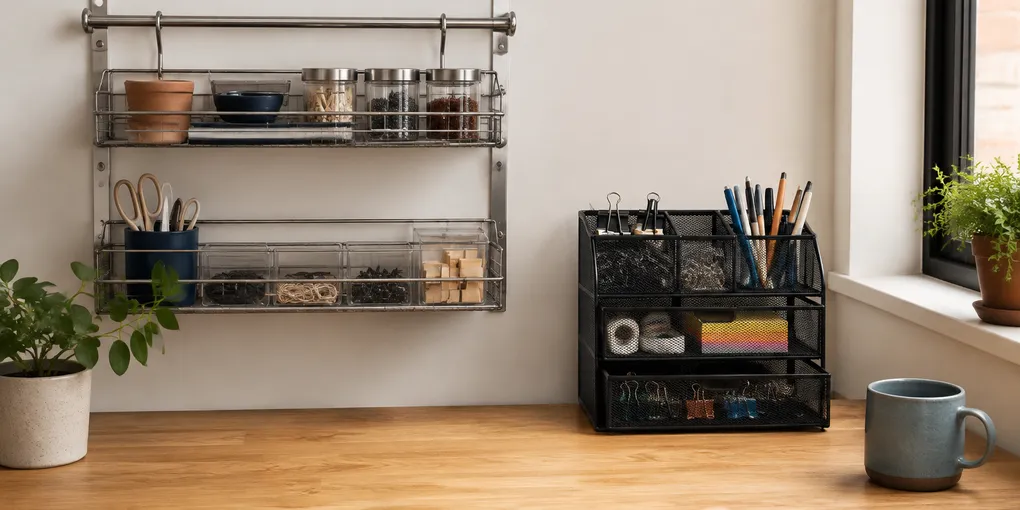
The Marbrasse listing names a mesh desk organizer with five compartments and two drawers. That description gives a way to record what the organizer presents at the work surface: open sections and two drawer spaces. Keep rail-system fields in a separate record.
The Container Store’s desk-drawer-organizer category likewise groups modular bins, stackable trays, dividers, and organizers as drawer-storage formats. That category context supplies vocabulary, while each product retains its own measurement and included-piece fields.
Write down the desktop’s usable width and depth separately from the organizer description. Then keep the category of supplies with the location note—for example, clips, pens, or small craft pieces—and retain the listing’s own capacity wording.
Current desktop listing
Keep portable lidded containers in their own note
The IRIS USA listing names an eight-pack of 21-quart storage bins with lids. That is a fourth format in the current set: several lidded containers rather than a wall component or a desktop drawer unit. Record the pack quantity, stated quart size, and lid wording together.
This separate line records a portable container format alongside drawer and vertical component systems. It preserves the distinction between a product’s listed format and any assumption about where it will be used.
Current lidded-bin listing
Make one neutral listing note
For each product page, use the same four fields:
- Format: rail shelf kit, over-door organizer, desktop organizer, or lidded-bin pack.
- Named components: shelves and brackets; baskets and hook; compartments and drawers; or bins and lids.
- Published dimensions or quantity: copy only the dimensions or quantity actually supplied for that named listing.
- Open question: a missing measurement, included part, or room-specific detail that the page does not answer.
The note preserves the source of each fact. A 48-by-16-inch shelf figure remains with the FastTrack kit; a two-drawer detail remains with the Marbrasse organizer; the eight-pack quantity remains with the IRIS bin listing. Add the check date beside the page name when a later update changes the published description, components, or quantity. The same record stays tied to its named listing.
Evidence boundary
This page summarizes current maker and listing details for four available products. It does not assess installation, wall or door suitability, load, durability, room fit, or how any storage format will perform in a home. Product details and included parts can change; confirm the current manufacturer and product listing information before buying or using a product.
Sources
- Rubbermaid: FastTrack Rail Garage Shelf Kit
- The Container Store: Desk Drawer Organizers
- Amazon product detail page: HapiRm over-the-door organizer
- Amazon product detail page: Marbrasse mesh desk organizer
- Amazon product detail page: IRIS USA 21-quart bins
Frequently Asked Questions
- Record the stated rail, shelf, bracket, and included-part details. Keep those fields separate from a wall's condition, installation requirements, and any load decision.
- Record the named compartments, drawer count, overall exterior dimensions when supplied, and where the unit would sit. A desktop organizer and a wall system use different location details.
- An over-door organizer places storage vertically without being a rail-and-shelf kit. Its listing details belong in the same location note, while its hook and basket format remain distinct from wall components.
- The listed bin format records a portable container with lids and an eight-pack quantity. It gives a separate way to note contained supplies without treating it as a desk drawer or wall system.