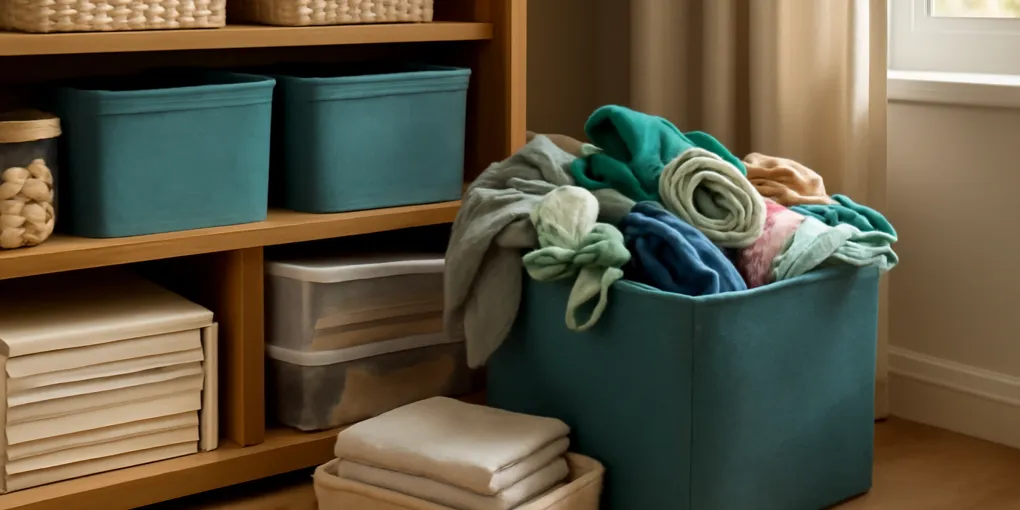
Why Clutter Baskets Overflow: The Psychology of Temporary Storage
Evidence ExplainerA clutter basket feels compassionate at first. It gives stray objects a temporary place to land when you do not have time to make every decision. The trouble starts when temporary storage becomes permanent storage with a softer name.
Quick picks
Use this as a shortcut to the products mentioned below; verify dimensions and mounting limits against your space before buying.
- catch all basket: See current price on Amazon
- labeled storage baskets: See current price on Amazon
- small entryway tray: See current price on Amazon
Search Amazon for catch all basket (See current price on Amazon), labeled storage baskets (See current price on Amazon), or small entryway tray (See current price on Amazon). Compare current labels, prices, sellers, dimensions, and return policies before buying.
For related Clutter Science methods, see Why Flat Surfaces Become Clutter Magnets and How to Reset Them and Why Label Systems Fail and How to Make Storage Labels Useful.
The Temporary Storage Trap
A basket lowers the immediate cost of cleaning. Instead of deciding what every item is, where it belongs, and whether it should stay, you can scoop and move. That is useful during a party reset, a child bedtime scramble, or a workday cleanup. But if the basket has no review trigger, it converts decision debt into hidden storage.
The psychology is simple: objects that are out of sight stop competing for attention, but they also stop prompting completion. The room looks calmer, so the brain receives a reward before the underlying task is done. That reward can make the unfinished basket feel acceptable.
Why Overflow Happens
Overflow usually means the basket is doing too many jobs. It may contain returns, toys, chargers, mail, receipts, hair ties, batteries, pet supplies, craft scraps, and objects with no home. Those categories have different next actions. A single container cannot cue all of them.
Overflow also happens when the basket is too large. Large flexible containers hide layers. Once the bottom layer disappears, the basket becomes archaeological storage. People add to the top because removing from the bottom takes effort.
Better Rules for Catch-All Storage
Use a catch-all only if it has a time limit, a size limit, and a review ritual. The time limit can be daily for entryway items, weekly for family room toys, or same-day for paperwork. The size limit should be small enough to force decisions. The review ritual should be linked to an existing habit, such as Sunday reset, trash night, or the evening kitchen close.
Labels help, but labels are not magic. A label that says miscellaneous is an admission that the basket has no job. A better label names the next action: return upstairs, donate, repair, receipts to scan, library returns, or tomorrow’s bag.
A Safer Basket System
Replace one large catch-all with three small action containers. One is for items that belong elsewhere in the house. One is for items leaving the house. One is for decisions that need ten quiet minutes. This keeps temporary storage from becoming an emotional junk drawer.
Put the containers where the next action happens. Returns should live near the exit. Receipts should live near the scanner, desk, or tax folder. Repair items should live near tools or a labeled repair bin. Objects should not travel farther from resolution.
Evidence Lens
Visual clutter can compete with attention, so hiding every stray object can genuinely make a room easier to use. The risk is that reduced visual noise is not the same as completed organization. A system should reduce distraction while preserving enough cueing to finish the task later.
That is why transparent boundaries matter. A shallow tray, labeled file, or small open basket can be better than a deep decorative bin. You can still see the category and the limit. The container says: this is a temporary queue, not a permanent address.
Reset Protocol
- Empty the basket completely.
- Sort into return, leave the house, act on, store, and discard.
- Create a real home for any category that appears three times.
- Replace the basket only if it has a named job.
- Put a review date on the label.
- If the basket fills before the review date, shrink the category or add a better home.
Clutter Science G6 Score
| Dimension | Weight | Score | Why it matters here |
|---|---|---|---|
| Research | 30% | 8.0 | Uses measured fit, attention research, and safety guidance rather than visual preference alone. |
| Evidence Quality | 25% | 7.5 | Strong for human factors and household safety, moderate for product-specific comparisons because organizer listings change quickly. |
| Value | 20% | 8.5 | Prioritizes low-regret purchases, reuse, and measurement before buying. |
| User Signals | 15% | 7.5 | Reflects common failure points seen in small-home storage: overbuying containers, hiding tasks, and mixing categories. |
| Transparency | 10% | 9.0 | Explains buying limits, measurement tradeoffs, and where judgment replaces direct product testing. |
Composite G6 score: 8.0 out of 10. Treat this as a fit-and-friction score, not a claim that one product is universally best.
Sources and Evidence Notes
This article uses a practical evidence hierarchy: peer-reviewed work where it explains attention or behavior, government or university safety guidance where storage can affect risk, and measurement and fit logic for product selection. Useful sources include:
- McMains and Kastner, “Interactions of top-down and bottom-up mechanisms in human visual cortex,” Journal of Neuroscience (2011), indexed by PubMed. https://pubmed.ncbi.nlm.nih.gov/21228167/
- U.S. Consumer Product Safety Commission household safety resources for storing cleaners and household products away from children and incompatible uses. https://www.cpsc.gov/Safety-Education/Safety-Guides/Home
- EPA safer product and household chemical storage guidance. https://www.epa.gov/saferchoice
Compare dimensions, labels, sellers, prices, and return policies before buying.
FAQ
Should I buy organizers before decluttering for Clutter Baskets Overflow?
Usually no. Remove obvious trash, duplicates, expired items, and items that belong elsewhere first. Then measure the remaining category. Buying before editing often locks the old clutter pattern into nicer containers.
Are clear containers always better than opaque containers for Clutter Baskets Overflow?
Clear containers are better when visibility helps you use things before they expire or disappear. Opaque containers can be better for visual calm in open living areas, but they need labels and a review habit.
How often should I reset a high-traffic storage zone for Clutter Baskets Overflow?
Daily if the area handles keys, mail, shoes, bags, dishes, or chargers. Weekly is usually enough for slower zones such as pantry backstock or seasonal supplies.
Two-Week Field Test
Do not judge the system on the first day, when everything is freshly arranged and everyone is unusually motivated. Judge it after two ordinary weeks. During that period, watch for three signals: items placed beside the organizer, categories that require two hands to access, and objects that disappear until you accidentally buy duplicates. Those signals mean the system is creating friction rather than reducing it.
Keep a small note on your phone or on painter’s tape inside the cabinet. Each time an item is annoying to return, write the item name. At the end of two weeks, the list tells you what to change. Maybe the bin is too deep. Maybe the label is too broad. Maybe the category belongs closer to the task. This is more reliable than judging by appearance because clutter systems fail during tired, rushed, normal use.
Household Adoption Check
A storage system has to be legible to people who did not design it. Ask another household member to put away three common items without coaching. If they hesitate, open the wrong container, or ask where something goes, the system needs a clearer cue. The fix may be a front-facing label, a smaller category, a container at a lower height, or a visible sample item.
For kids, guests, roommates, and partners, avoid clever categories. Use everyday words. “Snacks,” “dog walk,” “returns,” “cleaning refills,” and “school papers” beat stylish but vague labels. The goal is not to prove that the system is elegant. The goal is to make the right action easier than the wrong action.
Cost Control
The most expensive version of organizing is buying a complete matching system before you know the failure point. Start with reused boxes, painter’s tape labels, and one test organizer. Upgrade only the categories that pass the habit test. If a temporary cardboard divider works for two weeks, then a durable version may be worth buying. If the temporary version fails, the prettier version probably fails too.
This also reduces waste. Many households already own baskets, bins, jars, trays, and shoeboxes that can test the dimensions. Use those first. Spend money only where the container solves a measured access, visibility, or safety problem.
Safety and Cleanliness
Storage should not create a hazard. Keep household chemicals upright, separate from food, and away from children and pets. Do not pack cleaners so tightly that caps loosen or labels become unreadable. Do not route cords through closed containers unless the product is designed for that use and allows heat to escape. In kitchens and bathrooms, choose materials that can be wiped clean when spills happen.
A cleanable system lasts longer because small messes do not become reasons to abandon the organizer. Smooth plastic, metal, and sealed wood are easier to reset than loosely woven baskets in wet or dusty zones. Save decorative textures for dry, low-risk categories such as scarves or spare linens.
The One-In, One-Out Boundary
Every organizer needs a rule for saturation. When a bin reaches comfortable capacity, the next item should trigger a decision, not a second pile. The decision can be use, donate, discard, refill elsewhere, or move to backstock. Without that boundary, the organizer becomes permission to keep expanding the category.
Comfortable capacity is usually about 80 percent full for daily-use items and 90 percent full for backstock. Daily-use storage needs hand space. Backstock can be denser because it is accessed less often, but it still needs readable labels and a path to the front. If you cannot remove one item without disturbing several others, the container is past its functional limit.
Final Fit Question
Before keeping any organizer, ask whether it saves more effort than it adds. A container that must be moved, opened, decoded, and rearranged every day is not organizing; it is a chore with nicer materials. The winning system makes the next useful action plain.
Make It Visible Without Making It Busy
The entry area should show the next step without displaying every possession. A small hook can say “hang tomorrow’s bag here” without turning the wall into storage for every tote. A shallow tray can say “keys live here” without becoming a drawer for receipts and tools. This balance matters because the zone must be readable at speed.
If a visual cue starts attracting unrelated objects, make the cue more specific. Replace one large tray with a key bowl and a separate outgoing-mail slot. Replace a long row of hooks with named hooks for daily bags only. Specific boundaries reduce negotiation.
Topic-Specific Stress Test
Use this keyword checklist as a practical stress test for the exact storage problem: decision, debt, deferred, choice, miscellaneous, doom, basket, archaeology, layer, guilt, memory, cue, opaque, wicker, console, table, remote, battery, sunglasses, receipt, cable, toy, marble, coin, craft, scrap, sentimental, object, donation, queue, repair, pile, procrastination, temporal, discounting, habit, loop, reward, concealment, ambiguity, taxonomy, review, ritual, Saturday, reset, upstairs, downstairs. If many of these objects appear in the same container, the category is too broad. Split it by task, risk, or frequency before buying more supplies.
Bottom Line
Clutter baskets are not bad. Unbounded clutter baskets are bad. Give temporary storage a deadline, a size limit, and an action label, and it becomes a useful buffer instead of a prettier pile.