Quick picks
Heat-resistant hair tool mat or pouch
★ Top pick Best immediate safety upgrade- Best For: Curling irons and straighteners that need a safe cooling spot
- Caveat: Does not make it safe to store plugged-in tools
Wall-mounted or over-cabinet hair tool holder
Best counter-clearing option- Best For: Bathrooms with limited drawer space and several tools
- Caveat: Needs cord clearance, heat-safe spacing, and no blocked outlets
Cord wraps for small appliances
Best cord-control add-on- Best For: Dryers and brushes whose cords tangle across the vanity
- Caveat: Wrap only after the tool is unplugged and cool
Bathroom hair tools become clutter because they have three awkward states: hot, wet-adjacent, and corded. A curling iron cannot go straight into a random drawer while hot. A hair dryer cord spreads across the counter. A straightener needs a cool-down spot that is not the sink edge, towel pile, or floor.
That is why hair-tool storage should be treated as a safety and workflow problem, not just a vanity-organization project. The goal is to create one heat-safe landing area, one final storage home, and one cord rule: unplugged and off the walking surface.
For broader bathroom storage, pair this with our simplehuman tension shower caddy review or under-sink storage safety protocol depending on where your products currently spill.
Quick picks for hair-tool clutter
- Cooling spot: Search Amazon for heat-resistant hair tool mats. Choose this when hot tools currently rest on towels, counters, or sink edges.
- Final storage: Search Amazon for wall-mounted hair tool holders. Choose this when drawers are too shallow or tools tangle together.
- Cord control: Search Amazon for small appliance cord wraps. Choose this when cords are the part that keeps the counter messy.
Why hair tools resist normal organizing
Most bathroom products are either wet, dry, or disposable. Hair tools add heat and electricity. A drawer divider that works for makeup brushes may be unsafe or annoying for a hot curling iron. A basket that works for lotions may turn into a cord knot when it holds a dryer, straightener, hot brush, and attachments.
The category also has timing pressure. Hair tools are used during morning routines, when people are leaving soon and do not want to wait for a tool to cool. If the storage system requires perfect patience, the tool will stay on the counter.
A good system separates the stages: in-use, cooling, and stored. One product rarely handles all three unless the household has only one tool.
The fire-risk part is the storage part
The Electrical Safety Foundation International explains that ground-fault circuit interrupters are important protection in areas where electricity may meet water, including bathrooms. The everyday storage lesson is straightforward: keep tools unplugged after use, away from sinks and wet counters, and out of places where a still-hot surface can contact towels, paper, cosmetics, or plastic.
A heat-resistant mat is not a permission slip to ignore the tool. It is a controlled landing zone while the tool cools. The final storage location should still be unplugged, dry, ventilated enough for the material, and separate from loose paper or towels.
Shopping option: Search Amazon for heat-resistant hair tool mat or pouch. Look for size, heat-rating claims, and whether the pouch fits your longest tool.
Why cords create visual noise
Hair-tool cords are long because bathrooms and mirrors vary. That same length creates visual clutter when the cord loops across a vanity, drops onto the floor, or tangles with another tool.
The fix is not to wrap a hot tool immediately. The fix is a two-step habit: unplug and cool, then wrap or clip the cord before final storage. Cord wraps, silicone ties, or built-in hook-and-loop straps can keep the cord attached to its tool so the drawer or holder does not become a knot.
Shopping option: Search Amazon for hair tool cord wraps. Choose soft wraps that do not pinch or sharply bend the cord.
The best holder depends on where heat goes
Wall-mounted and over-cabinet hair tool holders work when they keep barrels upright, separate cords, and avoid crowding outlets. They are especially useful in bathrooms without deep drawers.
Before buying, measure the tool diameter and handle length. Large hot brushes and dryer barrels may not fit narrow curling-iron rings. Check whether the holder material is meant for warm tools or only cool storage. If the listing is vague, use it for fully cooled tools and keep a separate heat mat on the counter.
Shopping option: Search Amazon for wall mounted hair tool holder over cabinet. For rentals, over-cabinet designs can avoid drilling, but make sure the door closes without scraping cords.
A safer bathroom hair-tool protocol
Use this order:
- Keep one heat-resistant landing mat beside the outlet, not beside the sink basin.
- Plug in only the tool in active use.
- Put the hot tool on the mat between passes, not on a towel.
- Turn it off and unplug it immediately after use.
- Let it cool on the mat or in a heat-safe pouch.
- Wrap the cord only after cooling.
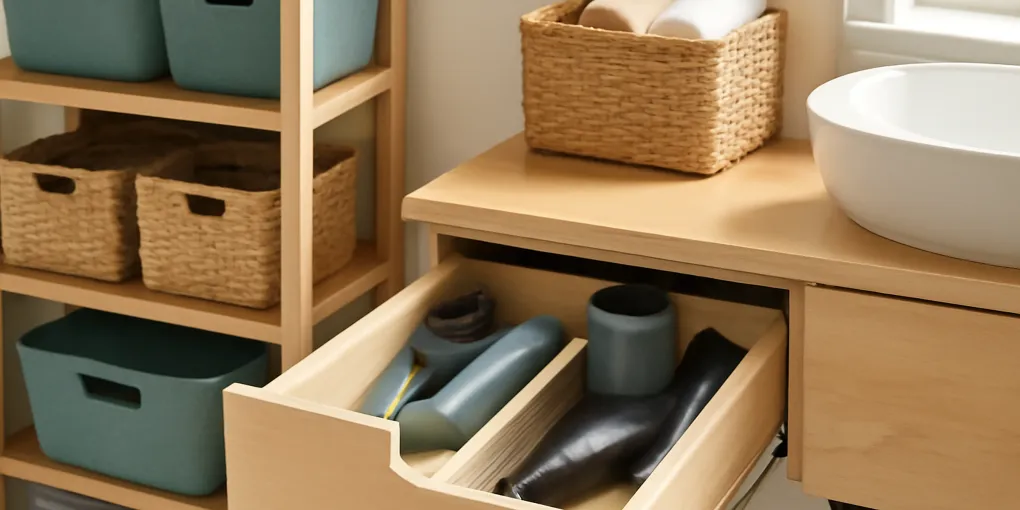
- Store it in a holder, drawer, or bin where the cord cannot spill into the walkway.
This setup gives each stage a place. The tool is not expected to jump from hot use to closed storage in one step.
What to remove from the counter
Remove duplicate tools that do the same job, almost-empty styling products, travel tools not used at home, and accessories that belong in a separate hair drawer. A counter with a dryer, straightener, curling wand, hot brush, clips, sprays, and backup products will defeat almost any organizer.
Keep only the active tool and daily styling product at the vanity. Store occasional tools in a labeled bin or drawer after they cool. If a tool has not been used in six months and is not for a specific event, it may be a storage burden rather than a useful option.
Bathroom hair tool FAQ
Is an over-cabinet holder safe for hot tools?
Only if the product materials and instructions support warm or hot-tool use. Many over-cabinet holders are best for cooled tools. Use a heat-resistant mat for cooling unless the holder clearly says otherwise.
Can I store a hair dryer under the sink?
Yes, if the area is dry, the cord is wrapped, and the dryer does not block plumbing access. Avoid storing electrical tools where leaks would soak them or where they hide shutoff valves.
What should I do with attachments?
Use a small labeled pouch or bin for diffusers, concentrators, and brush heads. Attachments should not sit loose on the counter because they make the tool category look larger than it is.
How many hair tools should stay in the bathroom?
Keep daily tools in the bathroom and move occasional or travel tools to a labeled backup bin. If every tool is stored at the outlet, the counter becomes permanent staging rather than a work surface.
Sources
- Electrical Safety Foundation International. Ground-fault circuit interrupters: https://www.esfi.org/gfci/. Supports extra caution around bathroom electrical devices and water exposure.
- Electrical Safety Foundation International. Extension cord safety: https://www.esfi.org/extension-cord-safety-tips/. Supports cord-routing guidance and avoiding cords in traffic paths.
Frequently Asked Questions
- Do not put a hot tool into a closed drawer unless the manufacturer specifically provides a heat-safe storage method. Use a heat-resistant mat or pouch while it cools, then store it unplugged.
- No. Unplug hair tools after use and keep cords away from sinks, wet counters, and walking paths.
- A heat-aware holder with separate slots works better than one basket where cords and hot barrels touch. Check tool diameter, cord exits, and mounting limits before buying.
- Use over-cabinet holders, heat-resistant pouches, and removable bins before drilling. Make sure the cabinet door still closes and cords do not rub against hinges.