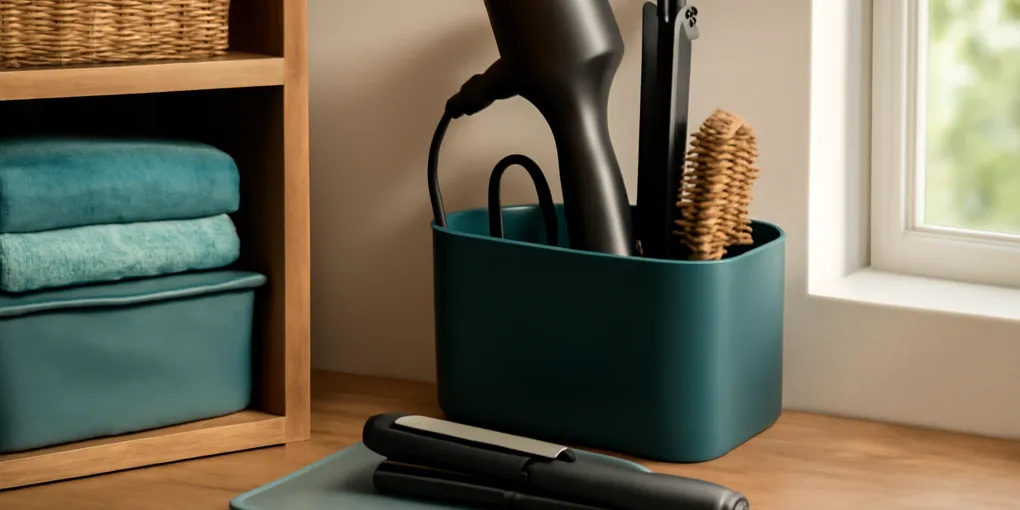
Hot Hair Tool Cooling Station Protocol: Stop Bathroom Counter Burn Risk and Cord Clutter
ProtocolQuick picks
Silicone heat-resistant mat and pouch
★ Top pick Best first purchase- Best For: Flat irons and curling irons that need a defined cooling pad
- Look For: Wide surface, grippy texture, and pouch or wrap option
Wall or cabinet hair tool holder
Best counter clearer- Best For: Daily tools that need vertical storage after they are cool
- Look For: Metal cups, cord hooks, and mounting hardware
Cord wrap clips for hair tools
Best small fix- Best For: Keeping unplugged cords from sprawling across drawers
- Look For: Flexible silicone clips that do not pinch the cord sharply
A bathroom counter becomes risky when the hot tool has no landing zone. The flat iron rests on a towel for just a second. A curling iron cord snakes across the sink. A blow dryer goes back into a drawer with the cord still warm and twisted. The fix is not a prettier basket. It is a cooling station with a rule: hot tools cool in one visible, heat-safe place before they are stored.
This protocol is for households where flat irons, curling irons, hot brushes, and blow dryers create morning counter clutter. It pairs with our simplehuman tension shower caddy review when the broader bathroom also needs better bottle and tool zoning, but the heat station should be handled first because it has a safety job.
Quick picks
- First purchase: Search Amazon for silicone heat mats that are large enough for the whole hot barrel or plate area.
- Counter-clearing upgrade: Search Amazon for wall-mounted hair tool holders after you know which tools stay in daily rotation.
- Cord control: Search Amazon for hair tool cord wraps for unplugged, cooled tools.
Holder fit depends on your tools, mounting surface, outlet location, and heat clearance. Do not buy a holder before measuring tool barrel width and the distance from outlet to cooling zone.
Step 1: Pick the cooling zone
Choose a flat section of counter or vanity top that is not directly beside sink water, tissue, towels, paper packaging, aerosol products, or loose cords. The cooling zone should be visible when you leave the bathroom. If the tool is hidden behind a basket, you are more likely to forget whether it is unplugged.
ESFI’s extension-cord safety guidance warns against overloading cords, running cords under rugs or through high-traffic conditions, and using damaged cords (ESFI extension cord safety). In a bathroom setup, that translates into a simple rule: do not build a hair-tool station around an extension cord or power strip. Use a proper outlet location and keep cords away from wet areas.
Step 2: Add a heat-resistant surface
A silicone mat or manufacturer-approved heat pouch gives the hot end a defined place to land. It also protects the counter from scorch marks and reduces the temptation to set the tool on a towel. The mat should be longer than the heated section and wide enough that the tool cannot roll off easily.
If two people use hot tools at the same time, one tiny mat is not enough. Either create two lanes or make a rule that only one hot tool can be active on the counter. Overlapping hot tools and cords recreate the clutter problem in a smaller footprint.
Step 3: Separate active cooling from storage
Do not put a hot tool straight into a closed drawer, woven basket, plastic bin, or under-sink cabinet. The station needs two states: active cooling on the mat, and storage after the tool is cool. A wall holder, cabinet-door holder, or drawer insert is storage. The mat is the cooling zone.
For households with children, pets, or guests, choose a cooling zone that cannot be grabbed accidentally. HealthyChildren’s home childproofing guidance includes keeping small and hazardous household items out of children’s reach (HealthyChildren.org childproofing). Hot tools deserve the same controlled-access thinking as other bathroom hazards.
Step 4: Make unplugging visible
The best hair-tool station makes the unplugged state obvious. After styling, turn the tool off, unplug it, and lay the plug end beside the mat where you can see it. Do not wrap the cord around the tool while the barrel or plates are still hot.
A small cord clip or hook helps only after the tool cools. Wrap cords loosely, without tight bends at the strain relief. If a cord is frayed, stiff, cracked, or heating abnormally, remove the tool from service instead of organizing it better.
Step 5: Choose a holder that matches the tool mix
Wall holders work well when they have metal cups or heat-tolerant compartments sized for your tools. Check whether the holder is meant for cooled storage or safe hot placement. Many attractive bathroom organizers are only storage cups, not heat shields.
Over-cabinet holders can work in rentals, but they may scrape cabinet doors or swing when the door opens. Adhesive holders can fail in humid bathrooms. Screw-mounted holders are sturdier, but only if the mounting surface is appropriate.
If you own one flat iron and one dryer, a small mat plus cord wraps may be enough. If the counter holds a curling iron, flat iron, hot brush, dryer, combs, sprays, clips, and makeup, a wall holder should be paired with category editing, not used as permission to keep every tool out.
Fit checklist
| Bathroom condition | Best fix | Avoid |
|---|---|---|
| One hot tool used daily | Silicone mat plus loose cord wrap | Large holder that crowds the vanity |
| Multiple tools stay out | Wall or cabinet holder after cooling | Woven basket for hot tools |
| Small children can reach counter | Higher cooling zone or adult-only storage | Low open caddy with hot barrels |
| Outlet is far from mirror | Rework location if possible | Extension cord across sink or walkway |
| Drawer is packed with cords | Cord clips and fewer active tools | Tight wrapping around hot barrels |
Maintenance rhythm
Once a week, remove hair, product residue, and dust from the mat and holder. Sticky hairspray buildup makes tools harder to place securely. Check cords for cracks or crushed bends while you clean.
Once a season, decide which hot tools are active. Keep daily tools in the station and move rarely used attachments or travel tools to a labeled bin. If a tool has not been used in six months and duplicates another tool, the station is paying rent for clutter.
Hair tool cooling FAQ
Is a silicone mat enough for bathroom safety?
It is the starting point, not the whole system. You still need to unplug the tool, keep it away from water and combustibles, and store it only after it cools.
Can I hang a hot flat iron in a wall holder?
Only if the holder and tool manufacturer allow hot placement and the holder has heat-tolerant contact points. When in doubt, cool on the mat first, then store vertically.
What about blow dryers?
A blow dryer usually creates cord clutter more than hot-surface risk, but the nozzle can stay warm. Let it cool briefly, then store it with a loose cord wrap in a holder or drawer lane.
Reader test
A reader can choose a silicone mat for the immediate hot landing zone, a wall or cabinet holder for cooled daily storage, and cord clips for unplugged tools. This guidance is specific to hair tools because it covers hot barrels, wet bathroom outlets, cord strain, counter scorch risk, and the difference between cooling and storage.
Frequently Asked Questions
- Put it on a heat-resistant mat in a clear counter zone away from towels, paper, cosmetics, cords, and sink water until it is cool enough for storage.
- No. Let the tool cool on a heat-safe surface first unless the manufacturer specifically provides a heat-safe storage sleeve for immediate use.
- No. Unplug after use, let the hot end cool in the station, then wrap the cord loosely before storing.