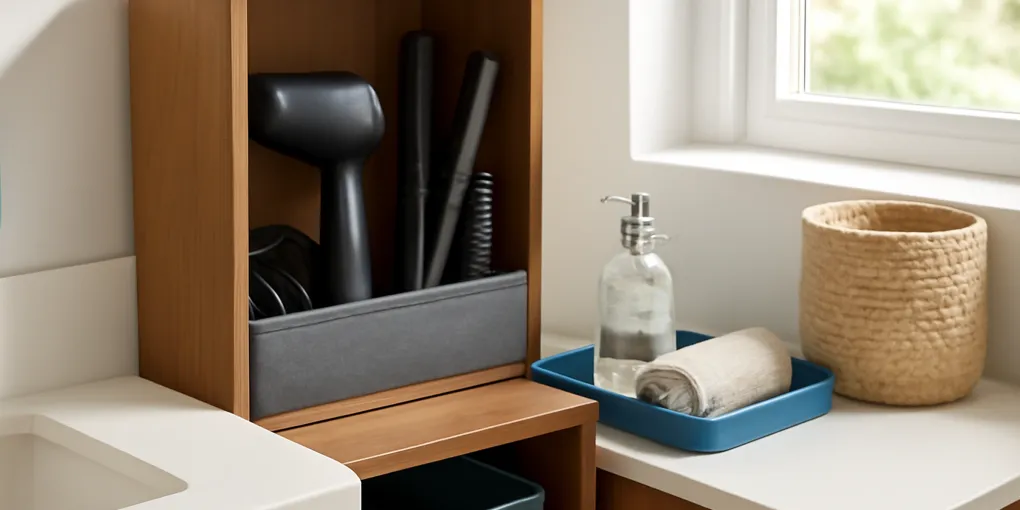
Bathroom Hair Tool Cooling Station Protocol: A Safer Way to Stop Counter Clutter
ProtocolQuick picks
Heat-Resistant Styling Tool Mat
★ Top pick Best first safety layer- Best For: Flat irons, curling irons, and hot brushes that need a defined cooling spot
- Caveat: A mat is not permission to leave tools plugged in
Wall or Cabinet Hair Tool Holder
Best after cooling- Best For: Dryers and cooled styling tools that otherwise sprawl across the vanity
- Caveat: Check heat rating, cord clearance, and lease limits before mounting
Reusable Cord Wraps
Best cord control- Best For: Keeping unplugged cords from falling into sinks, drawers, and cabinet doors
- Caveat: Wrap loosely after the cord and tool have cooled
A bathroom hair tool cooling station is a small rule set, not a decorative tray. Hot tools create a specific clutter pattern: the flat iron stays on the counter because it is too hot for a drawer, the cord crosses the sink because the outlet is nearby, and the whole setup remains visible long after the styling job is done.
If the counter is crowded even when heat is not involved, pair this protocol with our bathroom counter organizer guide. Do not put heat-producing tools into plastic storage until the cooling step is solved.
Quick picks
- Heat-safe landing zone: Search Amazon for heat-resistant styling tool mats.
- After-cooling storage: Search Amazon for wall-mounted hair tool holders.
- Cord control: Search Amazon for reusable cord wraps for hair tools.
The goal is simple: use, unplug, cool in one visible heat-safe spot, wrap loosely, then store.
Step 1: choose the cooling zone before you buy storage
Pick a flat, dry spot that is away from the sink basin, faucet spray, towels, cosmetics, tissue boxes, and plastic organizers. The cooling zone should be visible enough that nobody forgets a tool is there, but not in the main hand-washing path.
A heat-resistant mat is useful because it creates a boundary. Without a boundary, the tool migrates: first near the outlet, then on a towel, then half over the sink edge. Boundary beats reminder.
Do not choose the inside of a drawer as the first cooling zone. Drawers hide risk and trap heat around cords, plastics, and packaging. Storage comes after cooling.
Step 2: make unplugging part of the motion
The protocol is not complete until the tool is unplugged. Place the mat close enough to the outlet that unplugging feels natural. If the cord must stretch across the sink or floor to reach the mat, move the mat or change the storage plan.
ESFI extension-cord safety guidance emphasizes using cords properly and avoiding unsafe routing. For hair tools, that means no daisy-chained extension cords, no cord running through standing water zones, and no plug hidden behind a pile of products.
Step 3: cool, then wrap
Let the flat iron, curling wand, or hot brush cool on the mat with the cord loose and the heated plates or barrel fully visible. Do not coil a 6-foot cord around a warm barrel just to clear the counter faster; that trains the household to store before the tool is ready and can stress the cord near the handle.
After the tool and plug are comfortable to handle, make a wide cord loop and secure it with a hook-and-loop wrap. If the tool has a built-in cord keeper, use it gently. If not, a reusable wrap is better than a rubber band because it holds the loop without biting into the cord jacket.
Step 4: store by heat status
Create two positions: cooling and stored. The cooling position is the mat. The stored position can be a metal cup, wall holder, cabinet rack, or drawer insert that is appropriate for fully cooled tools.
Do not mix hot and cooled states in the same closed container. If a tool sometimes goes straight into a holder while warm, choose a holder designed for that use and keep it away from paper, cotton, aerosol cans, and plastic packaging.
Cooling-station buying checks
A hair-tool station has to solve heat, cord drag, and bathroom moisture at the same time. Check:
- Heat handling: use a silicone or heat-resistant landing spot for the first cool-down period, not a towel, paper, or plastic bin.
- Unplugging behavior: the storage layout should make unplugging the tool part of putting it down.
- Cord storage: wraps and holders should keep cords out of wet sink zones without tightly winding hot cords around the tool.
Best layout by bathroom type
For a pedestal sink, skip bulky storage and use a compact mat plus a nearby wall holder if mounting is allowed. Keep the cord off the floor because there is no cabinet to hide slack.
For a small vanity, put the cooling mat on the least-used side of the sink and store cooled tools vertically in a side bin or door holder. If the cabinet has cleaning products, keep tools in a separate zone so cords do not drag through bottles.
For a shared bathroom, add a visual cue: a mat color that contrasts with the counter, a label inside the cabinet, or a small empty slot for the cooled tool. Shared systems fail when nobody can tell whether the tool is in use, cooling, or abandoned.
What to avoid
Do not cool tools on towels. Towels move, fold, and hide heat. Do not leave cords hanging into sinks. Do not store aerosol products next to hot tools. Do not buy a closed plastic box as the first fix for counter clutter.
Avoid organizers that advertise capacity but show every tool jammed into one cup with cords hanging over the edge. Capacity is less important than heat state, cord path, and one-hand removal.
Weekly reset
Once a week, remove shed hair, wipe the mat, inspect cords, and return only the tools that are actually used. If two curling irons live on the counter because nobody knows which one works, test and remove the unused one.
Check that the outlet area remains visible. If product bottles creep in front of the plug, the protocol will drift back toward hidden cords and rushed unplugging.
FAQ
Can a flat iron go straight into a drawer after use?
Not unless the manufacturer specifically allows that storage method and the tool is cool enough for the drawer materials. A visible cooling mat is the safer default.
Is a silicone mat enough for bathroom hair tool safety?
It is only one layer. You still need to unplug the tool, keep the area dry, avoid towels and paper, and store the cord without tight bends after cooling.
Where should the hair dryer go?
A dryer usually belongs in a vertical holder or side bin after use, with the cord loosely wrapped. Do not let the cord dangle into the sink or become trapped in a cabinet door.
Source notes
For home electrical safety and extension-cord guidance, see Electrical Safety Foundation International: https://www.esfi.org/extension-cord-safety-tips/. For burn prevention basics in the home, see Safe Kids Worldwide: https://www.safekids.org/safetytips/field_risks/burns-and-scalds.