Best Food Storage Lid Organizers for Deep Kitchen Drawers
Buyer's GuideAdjustable Food Container Lid Organizer Rack
Best overallBest For: Mixed round and rectangular lids in deep drawers
$18-32
Quick picks
| Product | Key Specs |
|---|---|
| See price on Amazon |
|
| See price on Amazon |
|
| See price on Amazon |
|
Product availability, certifications, and retailer details can change; check the current Amazon page before buying.
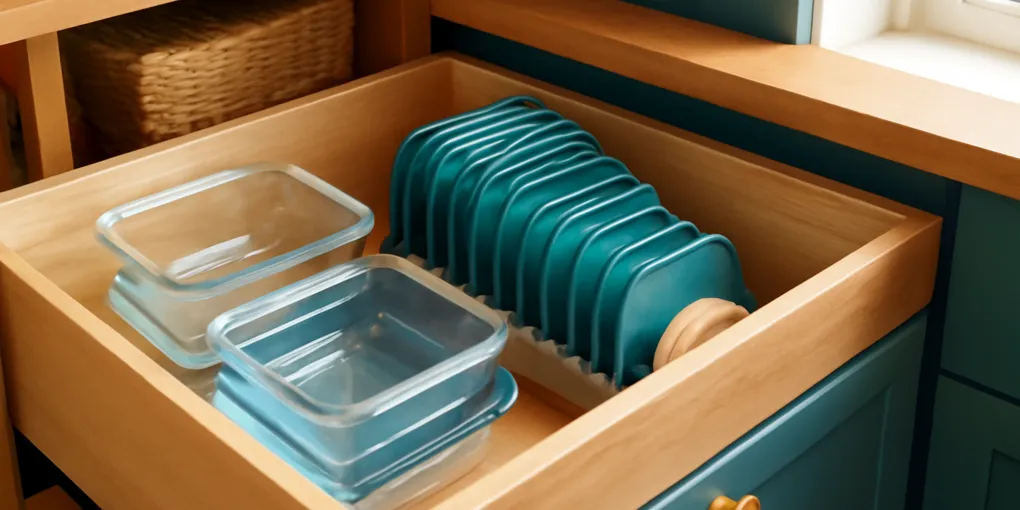
If your food storage drawer is deep enough to swallow lids but not organized enough to show them, the best upgrade is usually vertical storage. Lids are thin, varied, and easy to bury under bowls or containers. A drawer organizer turns that pile into a file system: every lid has a visible edge, every size has a lane, and the drawer can close without a daily plastic avalanche.
For most deep kitchen drawers, start with an adjustable food container lid organizer rack. It handles the real problem: lid collections are rarely uniform. Even if you buy containers as a matching set, replacement pieces, lunch boxes, and glass meal-prep lids eventually mix together. Fixed slots look tidy on day one but can become frustrating when one lid is too tall, too curved, or too thick for the section.
Pair this drawer reset with a broader kitchen visibility pass such as our guide to how to organize a deep pantry. Deep spaces work best when thin items stand vertically, frequent-use items live near the front, and every category has a boundary.
Quick picks for deep kitchen drawers
- Best overall: Search Amazon for adjustable lid organizers. Choose this if you own mixed brands or a changing set of round, square, and rectangular containers.
- Best budget: Search Amazon for divided lid bins. Choose this when you want a washable, inexpensive container for lightweight lids.
- Best upgrade: Search Amazon for file-style lid organizers. Choose this for heavier glass-container lids, wider drawers, or a drawer you open constantly.
Do not buy the largest organizer first. Empty the drawer, match lids to containers, remove orphaned pieces, and measure the real clearance. The right organizer is the one that fits the edited collection, not the one that stores every stray lid you have ever kept.
What makes a lid organizer work in a deep drawer?
A good food storage lid organizer must solve three separate problems: visibility, retrieval, and containment. Visibility means you can see the edge or face of each lid without unpacking the drawer. Retrieval means you can pull one lid out with one hand while holding a container or leftovers in the other. Containment means the rest of the lids stay standing when one lid is removed.
Deep drawers make the issue more complicated. They offer vertical clearance, which is useful, but they also hide short items at the bottom. A shallow tray may slide around in a deep drawer and still let lids slump sideways. A tall vertical rack, divided bin, or file-style frame uses the drawer depth intentionally. Instead of stacking lids flat, it turns them on edge and uses the drawer as a pull-out cabinet.
Before buying, measure four things: interior drawer width, front-to-back depth, usable height under the counter lip, and the widest lid you actually keep. Do not use the drawer front height as your only height measurement. Many drawers lose clearance at the back rail, under a countertop overhang, or where the slide hardware intrudes. If your tallest lid plus organizer base is too high, the drawer will scrape or jam.
Also decide whether lids should live with containers or separately. In a very deep drawer, separating lids often works better: containers can nest in one zone while lids stand vertically in another. If your containers are glass and heavy, this separation also prevents lighter plastic lids from being crushed under nested bowls.
Adjustable food container lid organizer rack
An adjustable lid organizer rack is the safest recommendation for most kitchens because it adapts. The usual design is a rectangular base with removable or sliding dividers. You create narrow slots for small round lids, wider slots for rectangular meal-prep lids, and an oversized lane for odd pieces such as lunch-box lids or silicone stretch covers.
The advantage is not just customization; it is recovery after real life happens. Food storage systems change. A lid cracks, a container disappears at work, a new glass set arrives, or someone keeps a takeout container because it is useful. Adjustable dividers let the drawer absorb those changes without turning back into a heap.
Look for dividers that lock firmly into the base rather than simply resting in shallow grooves. In a deep drawer, lids are often pulled upward and forward, which can knock flimsy dividers loose. A slightly heavier base or non-slip feet also helps because the whole organizer should not migrate toward the back of the drawer with repeated opening.
This option can disappoint if most of your lids are heavy glass or unusually thick snap-lock pieces. Thin plastic dividers can flex, and a short rack may allow large lids to lean. If your lid collection is mostly heavy, the sturdier file-style option is worth considering.
Shopping option: Search Amazon for adjustable food container lid organizers.
Divided plastic lid organizer bin
A divided plastic bin is the simplest drawer solution: an open container with built-in sections. It does not need assembly, it can be lifted out for cleaning, and it usually costs less than adjustable or premium rack systems. For many kitchens, especially those with one main food-storage set, that simplicity is enough.
The best use case is a drawer where lids already fall into a few natural categories: small rounds, medium rectangles, and large rectangles. Put each group into its own section and stop there. You do not need every lid to have a private slot. You need each category to stay upright and visible.
Plastic also has a cleaning advantage. Food storage lids often return to the drawer with a little dishwasher moisture, a crumb caught in a gasket, or a drop of sauce along the rim. A washable plastic bin handles that better than unfinished bamboo. If you use plastic containers for kids’ lunches or freezer leftovers, a bin you can rinse in the sink is practical.
Fixed sections are the tradeoff. If one section is too narrow for your square lids and another is too wide for small rounds, you may end up with a tidy-looking organizer that still does not fit your actual collection. Some bins are also too low to support tall lids in a deep drawer.
Shopping option: Search Amazon for divided plastic food storage lid organizer bins.
File-style bamboo or metal lid organizer
A file-style organizer borrows the logic of a desktop file sorter. Lids stand vertically between stronger ribs, rails, or dividers. The frame is usually bamboo, coated metal, or a hybrid material. Compared with a light plastic bin, the upgrade is stability. Large lids do not collapse into a pile as easily, and the organizer tends to feel more intentional in a deep drawer.
This format is especially useful for glass meal-prep containers. Glass lids and thick snap-lock plastic lids are heavier than simple deli-style lids. They need a stronger support structure and wider slots. A file-style rack can also work well when you want to store cutting boards, silicone baking mats, or sheet-pan lids in the same deep drawer, though the best layout keeps food container lids in their own section.
Bamboo looks warm and furniture-like, which matters if the drawer is frequently open during meal prep. Metal is often slimmer and easier to wipe around, though coating quality matters. If the organizer will sit below a sink-adjacent prep zone or near a dishwasher, inspect whether moisture could sit against unfinished wood.
Premium organizers are less forgiving if you measure poorly. A beautiful rack that is half an inch too tall is useless in a drawer. Some bamboo models also have fixed spacing, so very thick lids may not fit between dividers.
Shopping option: Search Amazon for file-style bamboo or metal lid organizers.
Fit checks that matter
For food-storage lids, the useful checks are drawer fit, divider stability, cleanability, and whether the organizer keeps lids upright after a normal dishwasher unload:
| Fit check | What to verify |
|---|---|
| Fit and safety | Breadth of organizer formats considered, measurement fit, and suitability for deep drawers rather than only countertop use. |
| Verifiable details | Preference for observable design traits: divider stability, cleanability, material behavior, and whether manufacturer dimensions are specific enough to verify. |
| Value and capacity | Cost relative to usable capacity, adjustability, durability, and whether one organizer can replace several improvised bins. |
| Daily friction | Patterns from long-term household use: lids staying upright, drawers closing cleanly, and complaints about flimsy dividers or poor fit. |
| Listing clarity | Clear dimensions, material labeling, realistic product photos, and honest limits about what lid sizes fit. |
Using that model, adjustable racks score highest for most deep drawers because they combine fit flexibility with good value. Divided plastic bins score well on cost and cleaning but lose points when fixed sections do not match real lid collections. File-style bamboo or metal organizers score highest for stability and appearance, but their value depends heavily on accurate drawer measurements and lid thickness.
Deep drawer sizing guide
Start with the drawer, not the product photo. Remove the current contents and measure the inside box. Write down the interior width, the front-to-back depth, and the usable height. Then measure your tallest lid standing on edge. Add the height of the organizer base, usually about half an inch to an inch, and leave a small clearance gap so the drawer does not scrape.
For a drawer under 4 inches of usable height, lid storage may need to be shallow and angled rather than fully vertical. For 4 to 6 inches, most adjustable racks and divided bins can work. For 6 inches or more, you can usually store lids vertically with enough clearance to see labels or gasket colors.
Width matters because many deep drawers are also wide. Do not automatically buy the widest organizer available. A better layout may be one organizer on the left and nested containers on the right, or two smaller organizers separated by container type. If you have both plastic and glass containers, separate them. Plastic lids are usually lighter and more flexible; glass-container lids often need wider, stronger support.
Depth matters because front-to-back lanes can become too long. If lids are placed in a long bin without enough dividers, they slide and lean. Adjustable dividers every few inches usually work better than one long open channel.
How to set up the drawer in 20 minutes
Empty the drawer completely. Match every lid to a container. Recycle or repurpose orphaned lids unless they serve a specific use. This is the step that makes the organizer work; buying storage for pieces you cannot use only preserves clutter in a nicer shape.
Next, sort lids into three piles: small, medium, and large. If you use both round and rectangular containers, split by shape inside those piles. Put the largest lids into the organizer first because they determine the spacing. Then add medium lids, then small lids. Small lids are easy to tuck into leftover gaps, but large lids need planned lanes.
Keep the most-used lids closest to the drawer front. This is basic friction design: the easier item should be the everyday item, not the occasional holiday leftover container. If lunch containers leave the house every morning, their lids should be visible in the front third of the drawer. Freezer or party lids can live farther back.
If the organizer slides, add a non-slip drawer liner under it or use small clear bumpers at the corners. Do not permanently attach the organizer until you have lived with the layout for at least a week. Lid systems reveal problems through daily use: the wrong lane gets crowded, one tall lid scrapes, or a family member keeps returning lids to the easiest open slot.
Material and cleaning considerations
Food storage lid organizers live near food, dishwashers, and hands that may be wet or greasy. The organizer does not usually touch food directly, but it still needs to tolerate moisture and cleaning.
Plastic is the easiest material to wash. It is a sensible choice under a dishwasher-adjacent drawer or in a household where lids are put away before they are perfectly dry. Look for smooth corners rather than decorative grooves that catch crumbs. Clear plastic can help visibility, but it may show water spots.
Bamboo looks better and can be sturdy, but it should stay dry. If you choose bamboo, let lids fully dry before storing them and wipe spills quickly. Bamboo can be a good fit for a drawer that stores dry, clean lids away from the sink zone.
Metal racks can be strong and slim. Coated metal is usually easier to wipe than raw wood, but inspect coating quality and avoid chipped or sharp edges. Metal dividers are useful for heavy lids because they resist bending better than thin plastic.
The FDA’s food packaging resources are a reminder that food-adjacent storage should support clean handling rather than slow searching at the counter. FDA kitchen safety guidance likewise emphasizes clean, timely storage practices. A lid drawer does not make leftovers safer by itself, but it can reduce the frantic search that leaves food cooling on the counter while someone digs for the right top.
What not to buy
Avoid lid organizers that do not publish dimensions. Deep drawer fit is a measurement problem, and vague listings create unnecessary returns. If a product photo shows lids but does not state total height, base dimensions, or slot limits, skip it unless the return policy is excellent.
Avoid countertop-only lid holders unless you have confirmed drawer clearance. Many are designed for pot lids, cutting boards, or cabinet shelves. They may be too tall, too narrow, or too open for small food container lids.
Avoid very narrow slots if you own snap-lock lids. Thick gasketed lids need more space than flat deli-style lids. Over-compressing them makes retrieval annoying and may stress flexible edges over time.
Avoid buying a huge organizer before editing the collection. If half the lids are orphaned, warped, or for containers you never use, a larger organizer will only make the drawer look more official while keeping the same problem.
FAQ
Should food storage lids be stored with containers or separately?
Separately is usually better in a deep drawer. Nesting containers saves volume, while vertical lid storage preserves visibility. The exception is a very small matching set where each container is used with its lid every time. For mixed household collections, separate zones are easier to maintain.
How deep should a drawer be for a vertical lid organizer?
Most vertical lid organizers work best with at least 4 inches of usable drawer height, and 5 to 7 inches is more comfortable. Measure from the drawer bottom to the lowest obstruction, not just the drawer front. Tall snap lids may need more clearance.
Are bamboo lid organizers okay near the dishwasher?
They can work if lids are dry before storage, but plastic or coated metal is safer in a damp zone. Bamboo may swell, stain, or roughen if it repeatedly traps moisture. If the drawer is next to the dishwasher and people unload quickly, choose a washable plastic bin or metal rack.
What is the best organizer for glass food storage container lids?
A file-style metal or sturdy bamboo organizer is usually best for heavy glass-container lids. Adjustable plastic racks can work if the dividers lock firmly and the slots are wide enough, but flimsy dividers may bend or pop loose under heavier lids.
How many lid organizers do I need for one deep drawer?
One is enough for many kitchens, but two smaller organizers can be better than one oversized unit. Use one for everyday plastic lids and another for heavier glass or meal-prep lids. Leaving a dedicated container-nesting zone often matters more than filling the entire drawer with organizers.
Final recommendation
The best food storage lid organizer for a deep kitchen drawer is the one that keeps lids vertical, visible, and stable after a normal week of cooking. For most households, that means an adjustable food container lid organizer rack. It gives you room to change the spacing as your container collection changes. A divided plastic bin is the budget-friendly choice when lids are lightweight and categories are simple. A file-style bamboo or metal rack is the better upgrade when heavy lids need stronger support.
Measure first, edit orphaned lids second, and buy third. That order prevents the common mistake of purchasing a nice-looking organizer for the wrong drawer or for lids you should have discarded. Once the drawer is set up, keep the everyday lids at the front and treat vertical space as the asset it is. Deep drawers are not the problem; unmanaged depth is.
Sources
- FDA, Food Ingredients and Packaging: https://www.fda.gov/food/food-ingredients-packaging
- FDA, Food Safety in Your Kitchen: https://www.fda.gov/food/buy-store-serve-safe-food/food-safety-your-kitchen