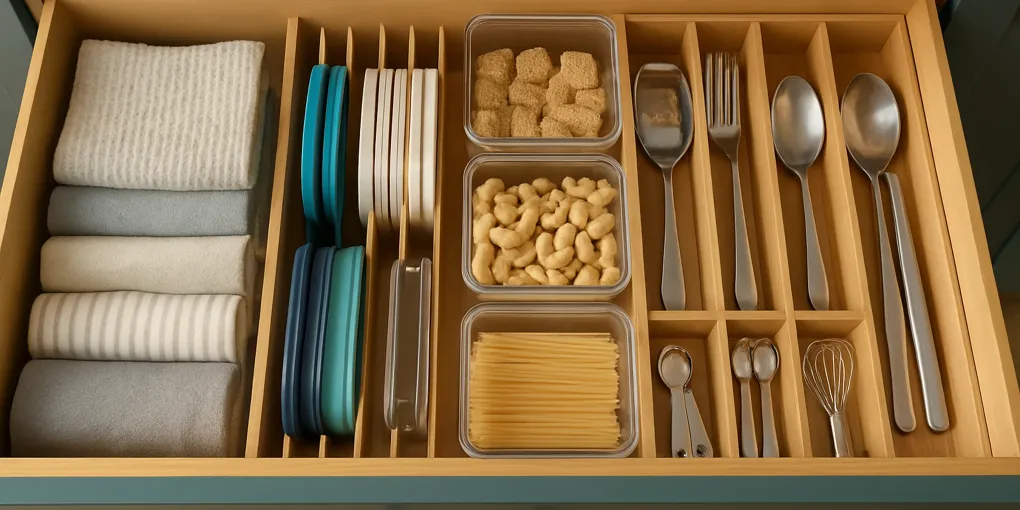
Bambusi Expandable Bamboo Drawer Dividers
Best adjustable lanesBest for: Deep drawers holding utensils, wraps, towels, or prep tools
Quick picks
| Product | Key Specs | Pros / Cons |
|---|---|---|
| See price on Amazon |
|
|
| See price on Amazon |
|
|
| See price on Amazon |
|
|
Product availability, certifications, and retailer details can change; check the current Amazon page before buying.
Quick product shortlist
Use this shortlist to choose a product style before you measure. The links are named product or brand searches so you can compare current dimensions, finishes, prices, and return terms before buying.
- Best adjustable lanes: Bambusi Expandable Bamboo Drawer Dividers (Search Amazon for Bambusi expandable bamboo drawer dividers) for deep drawers holding utensils, wraps, towels, or prep tools. Watch-out: measure interior width and divider height.
- Best utensil tray: OXO Good Grips Expandable Utensil Organizer (Search Amazon for OXO Good Grips expandable utensil organizer) for flatware and common utensils in a wide drawer. Watch-out: fixed compartments may not fit oversized tools.
- Best for lids: YouCopia StoraLid Food Container Lid Organizer (Search Amazon for YouCopia StoraLid food container lid organizer) for food-storage lids that disappear in a deep drawer. Watch-out: large lids may need the wide version.
Deep kitchen drawers are useful because they can hold bulky tools, towels, lids, wraps, and prep gear. They also fail quickly because their capacity hides mixed categories. The best drawer dividers make the drawer’s job visible every time it opens.
Quick Picks by Drawer Problem
| Check price | Drawer problem | Best organizer type |
|---|---|---|
| expandable drawer dividers (See current price on Amazon) | Utensils sliding sideways | Expandable bamboo or plastic dividers |
| food storage lid organizer (See current price on Amazon) | Food storage lids | Upright lid organizer or narrow bins |
| bamboo drawer dividers (See current price on Amazon) | Towels and linens | Long spring-loaded dividers |
| clear drawer organizer bins (See current price on Amazon) | Small prep tools | Modular clear bins |
| kitchen wrap organizer drawer (See current price on Amazon) | Wraps and bags | Wrap dispenser or long channel divider |
Compare current listings by drawer measurements, divider stability, material, recent buyer feedback, and return policy before buying. Recheck the usable interior width after accounting for the divider feet or spring ends, because those small parts can steal enough space to make a row of utensils bind.
How to compare deep drawer organizers
Compare deep drawer organizers on capacity and dimensions, material quality, ease of setup and reset, long-term value, user-signal fit, and transparency. For deep drawers, the most important factor is not how organized the drawer looks on day one. It is whether the dividers prevent categories from mixing after two weeks of normal cooking.
| Organizer type | Capacity & dimensions | Material quality | Ease of use | Long-term value | Best fit signal |
|---|---|---|---|---|---|
| Expandable dividers | 9 | 8 | 9 | 9 | 8.8/10 |
| Modular clear bins | 8 | 8 | 9 | 8 | 8.3/10 |
| Upright lid racks | 8 | 7 | 8 | 8 | 7.8/10 |
| Fixed utensil trays | 7 | 8 | 8 | 7 | 7.5/10 |
| Decorative baskets | 6 | 7 | 5 | 6 | 6.0/10 |
Best Overall: Expandable Drawer Dividers
Expandable dividers are the safest first buy for deep kitchen drawers because they adapt to drawer width and create lanes. They work especially well for spatulas, wooden spoons, tongs, rolling pins, dish towels, and folded linens.
Look for rubberized ends, strong spring tension, and enough height to keep tools from jumping lanes. Measure inside drawer width, depth, and height before ordering. A divider that is too short will wobble; one that is too tall may scrape the drawer above.
Best fit:
- Cooking utensil drawers.
- Towel drawers.
- Baking tool drawers.
- Mixed prep drawers with large tools.
Skip if:
- The drawer is shallow.
- You need many tiny compartments.
- The drawer sides are uneven or fragile.
Best for Food Storage Lids: Upright Lid Organizer
Food storage lids are a classic deep-drawer problem because they are thin, flexible, and easy to bury. An upright lid organizer creates file-like slots so lids can be retrieved without lifting the whole stack.
Choose an organizer with adjustable sections if your household uses several container brands. If lids vary wildly in size, use two narrow bins instead: one for small lids and one for large lids. Do not mix lids with the containers unless the drawer is wide enough to keep them separated.
Evidence note: this is a retrieval-design problem. Don Norman’s design principles around visibility and mapping apply directly here. If the lid category is visible and mapped to a slot, the user does not need to search through a pile.
Best for Small Tools: Modular Clear Bins
Clear bins work better than long dividers when a drawer holds small items: measuring spoons, bag clips, corn holders, peelers, thermometers, funnels, pastry tips, and specialty prep tools. The bins create removable categories, which makes cleaning easier.
Choose rectangular bins that use the full drawer depth efficiently. Rounded decorative trays waste space. If the drawer is extra deep, use a second layer only for rarely used items; stacked bins can make daily retrieval annoying.
Best fit:
- Prep-tool drawers.
- Coffee and tea accessory drawers.
- Lunch-packing drawers.
- Bag clips and small closures.
Skip if:
- The drawer holds long utensils.
- You dislike lifting bins for cleaning.
- The drawer already has built-in compartments.
Best for Wraps and Bags: Long Channel Organizers
Plastic wrap, foil, parchment, freezer bags, sandwich bags, and reusable bags need a different layout. They do best in long lanes, not small compartments. You can use expandable dividers, a wrap dispenser, or one long bin that keeps boxes from sliding behind each other.
A wrap dispenser looks tidy, but it is not always the best value. If your household buys different box sizes or changes brands, a flexible channel may work longer. If you use the same wrap sizes every month, a dedicated dispenser can reduce box clutter.
Best for Towels: Two or Three Wide Lanes
Deep drawers are excellent for dish towels, microfiber cloths, and napkins if they are divided into wide lanes. Do not create tiny stacks. File-fold towels so the edge faces up and the category remains visible.
A good towel drawer has two or three categories at most:
- Dish towels.
- Microfiber cloths.
- Napkins or cleaning cloths.
If cleaning rags and food-contact towels share a drawer, use separate lanes and labels. The Centers for Disease Control and Prevention’s food-safety guidance emphasizes avoiding cross-contamination in kitchens. The practical storage translation is simple: do not make it easy to confuse cleaning cloths with towels used around food.
What to Measure Before Buying
Measure the inside dimensions, not the cabinet face:
- Inside width.
- Inside depth.
- Usable height when the drawer closes.
- Obstructions from slides, screws, or drawer curvature.
- The longest item you plan to store.
Then empty the drawer and group items by use. Do not buy dividers for items that should not stay in the drawer. If the drawer contains expired coupons, loose batteries, takeout menus, broken gadgets, and cooking tools, the first organizer is a trash bag and a relocation basket.
Deep Drawer Setup Protocol
- Empty the drawer completely.
- Remove duplicates and rarely used gadgets.
- Assign one primary drawer job.
- Pick the organizer type based on the category size.
- Put daily items in the front half.
- Test the drawer for one week before adding labels.
The one-week test matters. If the categories move around after normal cooking, the divider layout is wrong or the drawer has too many jobs.
Material Guide
| Material | Strength | Cleaning | Best use |
|---|---|---|---|
| Bamboo | Warm, sturdy, attractive | Wipe, avoid soaking | Utensils and towels |
| Plastic | Lightweight, washable | Easy | Food storage lids, small tools |
| Acrylic | Clear and rigid | Easy but shows smudges | Small visible categories |
| Metal | Strong, thin profile | Easy | Heavy tools, commercial look |
| Fabric | Soft | Harder near food | Linens only |
For food-adjacent drawers, choose materials that can be wiped easily. For towel drawers, bamboo or fabric can work. For small sticky items like bag clips and coffee accessories, plastic is easier to reset.
Common Mistakes
The first mistake is buying a fixed utensil tray without measuring. Many trays waste depth or leave unusable gaps. The second is overcompartmentalizing. Too many small sections turn cleanup into sorting. The third is treating deep capacity as permission to store every kitchen gadget.
A drawer should pass the one-hand test: you can open it, grab the tool, and close it without moving three other categories.
How to choose without overbuying
For this category, the useful comparison starts with measurements, access friction, material durability, daily reset behavior, and clear product limits. Research fit includes ergonomics, retrieval friction, food-adjacent cleaning needs, and whether the divider design matches the drawer category. Evidence quality favors measurable fit, visible category boundaries, and safety guidance around kitchen textiles and cross-contamination. Value considers whether the organizer can adapt when tools change. User signals include drawer reviews about slipping dividers, warped bamboo, flimsy slots, and bins that waste depth. Transparency means noting when measurements and fit constraints matter more than brand choice.
This scoring method rewards flexible systems. Expandable dividers and modular bins usually beat one-piece trays because deep drawers vary widely in width and depth. A beautiful fixed tray can score well only if it fills the drawer efficiently and matches the exact tools stored there.
Drawer-by-Drawer Recommendations
For a cooking utensil drawer, create three lanes: daily stirring tools, turners and tongs, and specialty tools. Keep sharp items elsewhere unless the divider is designed for blades. Long utensils should face the same direction so handles are visible.
For a food storage drawer, separate containers and lids unless the sets nest reliably. If lids are always the problem, prioritize an upright lid rack over another container bin. A lid should be removable without lifting a stack.
For a baking drawer, use wider lanes for rolling pins, pastry brushes, measuring cups, parchment, and silicone mats. Small baking tips or clips belong in a removable bin, not loose in a long divider lane.
For a towel drawer, file-fold cloths and use two wide dividers rather than six narrow sections. Towels need air and quick retrieval. Overcompressed stacks look neat once and then collapse.
For a lunch-packing drawer, use modular bins for bags, reusable wraps, small containers, napkins, and labels. Keep snacks in a pantry zone unless the drawer is intentionally a lunch station. Mixing food, wrap, and school papers usually creates a new junk drawer.
Durability and Cleaning Notes
Bamboo dividers should be wiped, not soaked. Plastic bins tolerate crumbs, sticky residue, and quick washing. Acrylic looks clean but shows smudges and can crack if overloaded. Metal dividers can be strong but may rattle or scratch if they lack padded ends. For rental kitchens or older drawers, avoid aggressive adhesive organizers that may damage drawer interiors.
Sources and Evidence Notes
- Norman, D. A. “The Design of Everyday Things.” Basic Books, revised edition, 2013. Used for visibility, mapping, and affordance principles.
- Centers for Disease Control and Prevention food safety guidance on cleaning and avoiding cross-contamination in kitchens.
- Sweller, J. “Cognitive load during problem solving: Effects on learning.” Cognitive Science, 1988. doi:10.1207/s15516709cog1202_4.
Frequently Asked Questions
What type of divider is best for deep kitchen drawers?
Expandable dividers are the best first choice for large utensils, towels, and tools. Use modular bins or lid racks when the drawer holds smaller categories.
Are bamboo drawer dividers better than plastic?
Bamboo looks warmer and can be durable, but plastic is easier to wash. Choose based on what the drawer holds and how much food residue or moisture it sees.
How do you keep deep kitchen drawers from becoming junk drawers?
Give each drawer one job, remove unrelated items, and use dividers that make categories visible before the drawer fills again.
Bottom Line
The best deep kitchen drawer divider is the one that preserves categories during normal cooking. Start with expandable dividers for large items, use bins for small tools, and keep the drawer’s job narrow enough that it resets in seconds.