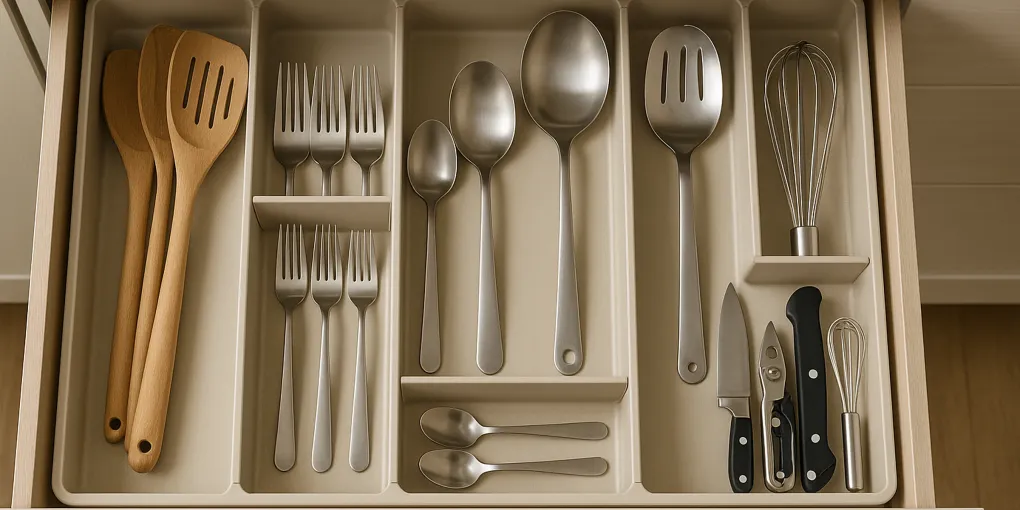
Quick picks
OXO Good Grips Expandable Utensil Organizer
OXO Good Grips Large Expandable Kitchen Tool Organizer
Start with the drawer, not the organizer
The best drawer organizer is the one whose current documented layout matches the inside of the drawer you are trying to use. Measure the interior width at its narrowest point, then note the front-to-back depth, usable height, and the longest or widest items that need a home. Those notes make the product comparison concrete.
Choose between the two layouts by matching the current product documentation to your drawer measurements and the categories you want to separate. One is intended for an expandable utensil layout, while the other suits a larger kitchen-tool layout; neither is ranked here by ratings, prices, or review summaries.
For adjacent planning, see our guides to kitchen drawer organizers, kitchen utensil organizers, and how to organize a junk drawer.
Quick picks: compare current details on Amazon
OXO Good Grips Expandable Utensil Organizer
Choose this product option if its current documented dimensions and compartment arrangement match a drawer devoted mainly to utensils. Skip it if the current listing does not clearly answer your width, depth, or layout questions.
OXO Good Grips Large Expandable Kitchen Tool Organizer
Choose this product option if its current documentation better matches a drawer that needs a larger kitchen-tool arrangement. Skip it if the product details leave a material fit question unresolved or the drawer measurements differ from the documented configuration.
A measurement-first comparison
Keep a note with three columns before you compare the two options: drawer measurements, item categories, and current product documentation. The first column prevents an exterior drawer measurement from being mistaken for usable interior space. The second keeps the decision focused on what needs to be stored. The third gives you a place to record the exact model name and any dimensions or layout details shown at the time you shop.
An expandable organizer can still be the wrong choice when the measured drawer or the items inside it do not align with its documented configuration. Likewise, a larger organizer is not automatically preferable; it needs to leave a usable arrangement for the items you actually keep in that drawer. Treat the product page as a source to check, not a promise that a named product fits every kitchen.
Check these details before checkout
Interior width and depth
Measure inside the drawer rather than across its front. Drawer boxes can narrow toward the back or have hardware that reduces the usable space. Compare the smallest usable width and the front-to-back depth with the current documentation for the exact product you are considering.
The items that need compartments
Lay out the utensil and tool categories you want to separate. Long-handled tools, flat utensils, and small gadgets call for different arrangements. Use the current product images and documentation to see whether the stated configuration addresses those categories; do not infer a compartment layout from a similar model.
Usable height and access
Check the height of the drawer box and whether the organizer still allows the drawer to close with its tallest contents in place. Also consider how you will reach frequently used items. These are fit questions, not quality claims, and the answer depends on your drawer and tools.
Current seller terms
Before buying, check the current Amazon listing and the manufacturer or seller information for the exact model, included components, return terms, and warranty details. Product pages and policies can change. If a detail matters to your decision and is not currently documented, pause rather than assume it matches a prior listing.
How the two options do different jobs
The OXO Good Grips Expandable Utensil Organizer is the candidate to investigate when the drawer’s job is primarily utensil sorting. The OXO Good Grips Large Expandable Kitchen Tool Organizer is the candidate to investigate when the stored categories call for a larger kitchen-tool arrangement. That distinction is a starting question for current documentation, not a universal performance claim.
If your drawer is used for a different job—such as bathroom supplies, desk materials, or a mixed junk-drawer collection—begin with the same measurement record. A broader category guide may be more useful once you know the drawer’s dimensions and contents, including our bathroom drawer organizer guide and desk drawer organizer guide.
Keep the comparison current
Product family names can cover different configurations. Recheck the exact product title, dimensions, included components, and seller terms on the current listing before ordering. A price label or a photograph is not enough to establish fit, and this article does not substitute for the documentation available when you shop.
Use the same notes if you return to the comparison later. The useful outcome is a product identity paired with the measurements and layout questions that matter for your specific drawer.
FAQ
What should I measure before choosing a drawer organizer?
Measure the interior width, front-to-back depth, and usable height at the narrowest points. Then compare those measurements with the current product documentation for the exact organizer.
How do I choose between the two OXO options?
Compare the current documented layout with the drawer and item categories you measured. Choose only when the current product details answer your material fit questions.
Can a product photo confirm that an organizer will fit?
No. A product photo provides context, but it does not replace your measurements or the current documented dimensions and components.
Where should I check returns and warranty details?
Check the current Amazon listing and the manufacturer or seller terms before purchase. Those policies can change and may apply differently to different listings.