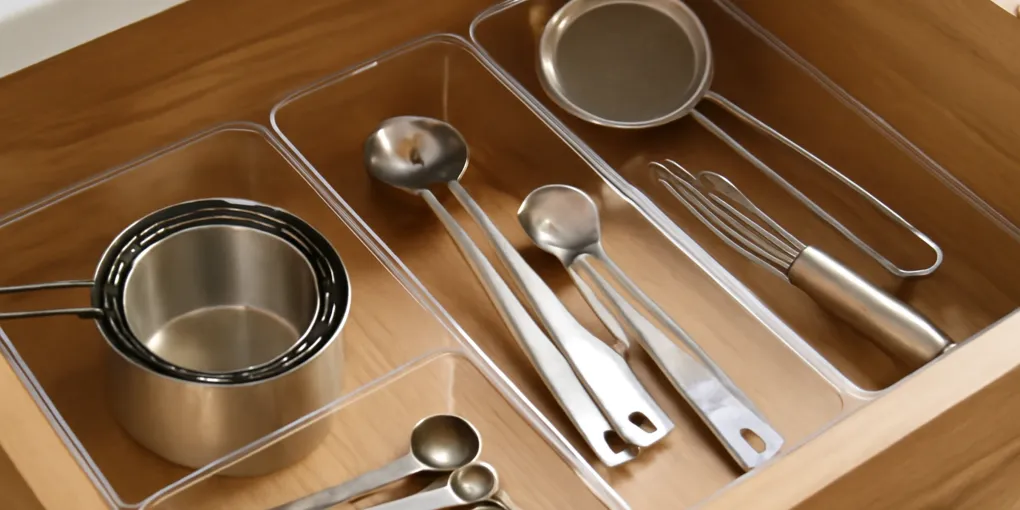
Low-profile divided drawer tray
Best for most drawersBest For: Nested cups, loose spoons, small spatulas, and baking drawer tools
$12-30
Quick picks
| Product | Key Specs |
|---|---|
| See price on Amazon |
|
| See price on Amazon |
|
| See price on Amazon |
|
Product availability, certifications, and retailer details can change; check the current Amazon page before buying.
Measuring cups and spoons are small enough to look like a minor kitchen problem, but they create a real friction point. One missing teaspoon delays baking. One jammed cup handle can stop a drawer from closing. A ring-bound spoon set looks tidy until wet spoons get trapped together and the size marks face the wrong way.
The best measuring cup and spoon organizer is usually a low-profile divided tray that gives cups, spoons, and small baking tools separate lanes. Frequent bakers may prefer a cabinet-door rack for spoons and a drawer section for cups. If the tools themselves are the problem, a magnetic spoon set can be a better purchase than another bin.
For larger utensil layouts, see our best drawer dividers for utensils guide. This page is narrower: it is about baking-measure tools that need fast size recognition.
Quick picks
- Mixed baking drawer: Search Amazon for measuring cup spoon drawer organizer. Best when cups, spoons, spatulas, and small whisks share one drawer.
- Cabinet-door spoon access: Search Amazon for measuring spoon rack cabinet door. Best when you bake often and want each spoon visible.
- Replacement for loose ring sets: Search Amazon for magnetic measuring spoons set. Best when the old set is bent, incomplete, or hard to read.
- Deep drawer cup lane: Search Amazon for expandable kitchen drawer divider bamboo. Best when cup handles need a dedicated long channel.
First decide whether the tools or the drawer are failing
A tray cannot fix a bad tool set. If the spoon sizes are worn off, the ring is bent, or the cups no longer nest because one piece is missing, replace the set before buying another organizer. If the tools are fine but migrate under peelers, bag clips, and spatulas, the drawer needs lanes.
The National Institute of Standards and Technology notes that measuring tools and volume standards matter for consistency in everyday measurement (NIST measurement basics). In a home kitchen, that translates into a simple organization rule: the tablespoon, teaspoon, half teaspoon, and quarter teaspoon should be identifiable without guessing.
Best overall: low-profile divided drawer tray
A shallow divided tray works for most homes because it keeps the tools near the flour, sugar, mixer, or prep counter. Choose a tray with one long lane for cups, one narrow lane for spoons, and a small extra compartment for bench scrapers, mini spatulas, or leveling tools.
Before ordering, measure the drawer height. A stack of measuring cups can be taller than the tray itself. The drawer should close without the top cup handle scraping the frame. If the drawer is shallow, store cups sideways in a long lane or move them to a cabinet shelf bin.
Clear plastic trays are easy to wipe. Bamboo trays look warmer but need dry tools; wet spoons left in wood compartments can stain or swell the finish. Either material works if you unload clean dry tools instead of tossing them in straight from the sink.
Best for frequent bakers: cabinet-door spoon rack
A cabinet-door rack solves the most annoying spoon problem: every size hangs separately, and the one you need comes off without opening a ring. It works best inside a baking cabinet where flour, sugar, and leavening ingredients already live.
Check door clearance before mounting. Close the cabinet slowly with the rack taped in place. If spoons hit a shelf, hinge, or container lid, the rack will become a daily nuisance. For renters, use removable hooks only if the surface is smooth and the adhesive can handle repeated tugging.
FDA kitchen-safety guidance reminds cooks to wash hands, surfaces, and utensils and to keep food-contact tools clean during prep (FDA food safety in your kitchen). For measuring tools, that means the rack should not be above a trash can, pet bowl, or splashy sink zone where clean spoons can get contaminated before use.
Best replacement move: magnetic spoon set
Magnetic spoon sets are not magic organizers, but they reduce scatter. The spoons stack by size, the ring is gone, and the set is easier to lift as one unit. This is useful if your current spoons catch on every utensil in the drawer.
Look for etched or stamped size markings, not only printed labels that can wear off. Dual-ended oval and round spoons are helpful when one end fits spice jars and the other handles liquids, but they need a longer compartment. If you already own accurate stainless tools that feel good in your hand, do not replace them just to chase a neater product photo.
Fit matrix
| Drawer problem | Better fix | Watch out for |
|---|---|---|
| Spoons vanish under utensils | Narrow tray lane or door rack | Rings keep sizes together but slow access |
| Cups jam the drawer | Long cup lane with handles aligned | Measure drawer height with the tallest cup |
| Wet tools sit in wood slots | Plastic tray or open drying spot | Dry before storing in enclosed compartments |
| Size marks are unreadable | Replacement magnetic or etched set | Organizer will not fix worn measurement labels |
| Baking tools share one drawer | Expandable tray plus one divider | Do not let peelers and bag clips invade the cup lane |
What to check before ordering
Check drawer width, usable depth, and inside height, not just the cabinet face. Many kitchen drawers lose usable height at the back because of a frame rail or slide hardware. Put your tallest measuring cup in the drawer and close it slowly. If the handle rubs now, a tray underneath will make the problem worse.
Count the pieces you actually use. A four-cup nesting set, a six-spoon set, a coffee scoop, and a small liquid measuring cup do not need the same organizer as a serious baking drawer with two cup sets, odd-size spoons, a scale, and bench tools. Buy for the real tool count, then leave one empty space so the drawer can absorb a new favorite item without collapsing.
Look at how the organizer handles labels. A door rack should let spoon sizes face out. A drawer tray should let cup handles point one way. A replacement spoon set should have markings that remain visible after washing. If you need to squint or rotate every piece, the system will fail during a busy recipe.
When to split cups and spoons
Small kitchens often improve when measuring cups and spoons stop living together. Spoons can stay in the main prep drawer because they are used for spices, baking powder, vanilla, and small amounts of oil. Cups can move to a baking shelf bin beside flour and sugar, especially if the drawer is shallow.
That split also helps households with kids. A low drawer can hold safe everyday utensils, while sharper scrapers, fragile glass measuring cups, and specialty baking tools stay higher. The organizer should support how the kitchen is used, not force every measuring object into one crowded rectangle. If two people cook at once, split storage also prevents the common conflict where one person needs a teaspoon for spices while another is digging for measuring cups beside the mixer. That small friction is exactly what the organizer should remove.
A simple drawer layout
Put the most-used spoons closest to the drawer front. Align cup handles in one direction. Keep leveling tools and mini spatulas beside, not on top of, measuring tools. If the drawer also stores cookie cutters, piping tips, or food coloring, move those to a small lidded bin; they are occasional project supplies, not everyday measuring tools.
For small kitchens, store cups in a cabinet shelf bin and keep spoons in the drawer. That split is better than forcing everything into a shallow drawer that catches every time someone cooks.
Measuring Cup and Spoon Organizer FAQ
Should measuring spoons stay on the ring?
Only if the ring helps your household keep the set together. If it makes every spoon hard to remove or dry, a narrow tray lane, hook strip, or magnetic set is easier.
Can measuring cups go in a utensil crock?
They can, but a crock hides cup sizes and invites handle tangles. A drawer lane or shelf bin makes it easier to see the quarter cup, third cup, and half cup quickly.
What should I do with duplicate measuring spoons?
Keep duplicates only if they serve a real cooking pattern, such as dry and wet tablespoons during baking. Otherwise, duplicates make the drawer look stocked while increasing the chance that the exact size you need is buried.
Are bamboo organizers safe for measuring tools?
Bamboo organizers are fine for dry tools. If spoons often go away damp, choose plastic or metal compartments that wipe clean and dry faster.
Bottom line
Choose the organizer after you know the failure. A divided tray fixes mixed baking drawers. A cabinet-door rack fixes spoon visibility. A magnetic replacement set fixes a tool set that fights you. The goal is not a perfect photo; it is being able to grab the exact tablespoon, half teaspoon, or cup without searching through a metal pile.
Frequently Asked Questions
- Store measuring spoons where each size is visible, dry, and easy to remove without opening a tight ring or lifting a pile of cups.
- Nesting saves space, but the handles should face one direction and the stack should not be buried under heavier utensils.
- A wall rack is better for frequent bakers with mounting space; a drawer tray is better for renters and mixed baking-tool drawers.