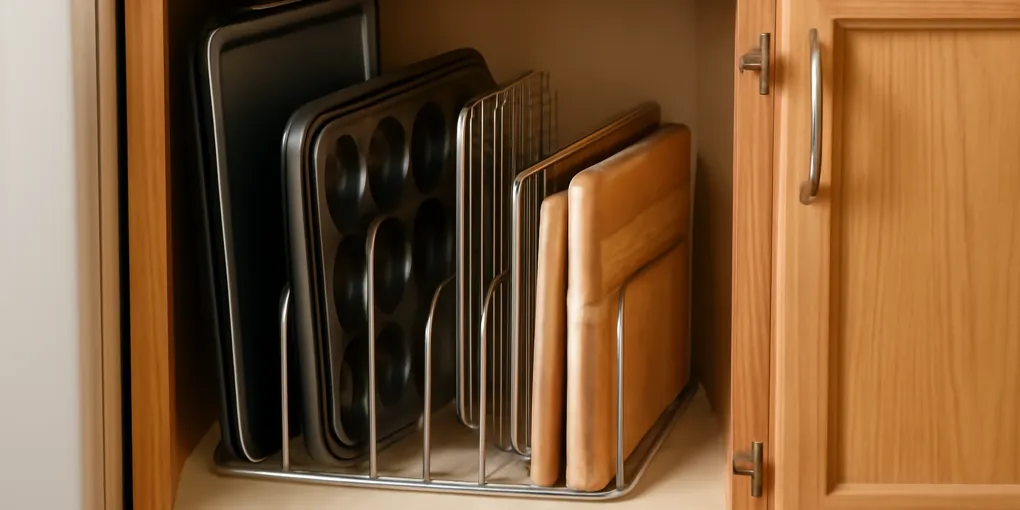
YouCopia StoreMore adjustable bakeware rack
$20-$35
Quick picks
| Product | Key Specs | Pros / Cons |
|---|---|---|
| See price on Amazon | — |
|
| See price on Amazon | — |
|
| See price on Amazon | — |
|
| See price on Amazon | — |
|
Product availability, certifications, and retailer details can change; check the current Amazon page before buying.
Baking sheets are awkward because they are wide, thin, loud, and usually stored where visibility is poor. In a small kitchen, a stack of sheet pans, muffin tins, cutting boards, wire cooling racks, pizza pans, and splatter screens can turn one base cabinet into a metal avalanche.
A vertical baking sheet rack fixes the problem only if it fits the cabinet and the cookware mix. The right rack lets you pull one pan without lifting six others. The wrong rack adds another object to a cabinet that was already too crowded.
Quick picks
- Best adjustable rack: Search Amazon for YouCopia StoreMore adjustable bakeware rack
- Best budget rack: Search Amazon for SimpleHouseware bakeware organizer rack
- Best pull-out upgrade: Search Amazon for Lynk Professional pull-out tray divider
- Best door option: Search Amazon for over cabinet door bakeware rack
When vertical storage works best
Vertical storage works when the items are flat, used individually, and annoying to unstack. Sheet pans, cutting boards, cooling racks, muffin tins, and baking mats fit that pattern. It works less well for heavy cast-iron griddles, nested roasting pans, and items used as a complete set.
Food-safety guidance from university extension and the FDA emphasizes cleanable food-contact surfaces and avoiding cross-contamination. That matters for pan storage because cutting boards, raw-meat trays, and baking sheets should not be jammed together while damp or dirty. Sources: University of Maine cutting-board safety and FDA food safety basics.
Best overall: adjustable bakeware rack
An adjustable rack is the safest recommendation for mixed cookware because slot spacing can change. Put thin cooling racks together, give cutting boards wider slots, and leave enough room for the pan you use most. The YouCopia-style design works well in a base cabinet if the cabinet floor is flat and deep enough.
Measure before buying. The rack has to fit the cabinet depth with the door closed, and the tallest pan must clear the shelf above. If the rack slides when you pull a pan, add a grippy liner or choose a model with feet that stay put.
Best budget: fixed wire rack
A simple wire rack is enough when the set is small: two sheet pans, one muffin tin, one cooling rack, and one cutting board. It is cheap, light, and easy to move during cabinet cleaning.
The tradeoff is fixed spacing. Thick wood cutting boards may not fit, and very thin pans can rattle. Do not overload a budget rack with heavy griddles or glass bakeware.
Best upgrade: pull-out tray divider
A pull-out divider is worth considering for a deep base cabinet or a low shelf where bending and reaching cause the pile to reform. The slide-out motion makes back-row pans visible, and installation adds stability.
This is the most useful option for homeowners who can screw into the cabinet base. Renters or people who do not want installation should choose a freestanding rack first.
Best door-mounted option
An over-door rack can hold lightweight cutting boards, silicone mats, or thin sheet pans when cabinet floor space is limited. Check hinge clearance, door thickness, and whether handles or rails hit interior shelves.
Avoid using a door rack for heavy cookware. A cabinet door is not the right place for cast iron, stoneware, or a stack of heavy pans.
Setup sequence
- Pull every flat kitchen item from the cabinet.
- Remove duplicate pans you never choose.
- Separate food-prep boards from baking-only pans if they are stored damp or heavily used.
- Measure the cabinet and tallest item.
- Put the most-used pan in the easiest slot.
- Keep one empty slot if possible so the rack does not become a squeeze puzzle.
If this cabinet also holds lids, use a separate food-storage lid organizer instead of forcing lids into pan slots.
Cabinet and pan measurements that matter
Before buying, measure the cabinet interior width, depth, and clear height from the cabinet floor to the shelf or drawer above. Then measure the tallest item you plan to store upright. Half-sheet pans, cutting boards with handles, splatter screens, and cooling racks can all exceed the height that looks available when the cabinet is empty.
Door hardware matters too. A rack can technically fit inside the cabinet and still collide with a hinge, door stile, or pull-out trash track. If the cabinet has a center stile, check whether the largest pan can angle through the opening. Many small kitchens have enough interior width but not enough opening width for a loaded rack to be comfortable.
Product-fit matrix
| Kitchen problem | Better rack style | What to avoid |
|---|---|---|
| Mixed pans, boards, and cooling racks | Adjustable freestanding rack | Fixed slots that squeeze thick boards |
| Deep low base cabinet | Pull-out installed divider | Loose rack that hides back-row pans |
| Rental cabinet with no drilling | Freestanding wire rack with grippy feet | Screw-mounted slides |
| Only cutting boards and thin mats | Door-mounted rack | Heavy pans on a cabinet door |
| No cabinet space at all | Countertop vertical rack used inside a baking zone | Tall rack near a stove burner |
How to load the rack
Put the most-used sheet pan in the easiest slot, usually at the front or the side where your dominant hand reaches. Put thin cooling racks together only if they do not tangle. Store muffin tins beside pans only when the rack slot is wide enough for their shape; otherwise they turn the divider into a scraping point.
Cutting boards should be dry before storage, especially wood boards. If the board used for raw meat is stored with baking sheets, make sure it is washed, dried, and not rubbing damp edges against bakeware. The rack is for access, not for drying dirty tools.
When not to buy a vertical rack
Do not buy a rack if the real problem is too many duplicate pans. If you own six sheet pans but use two, a divider will make the cabinet look busier without improving retrieval. Keep the sizes you actually use: perhaps one rimmed half-sheet, one quarter-sheet, one cooling rack, one muffin tin, and one cutting board category.
Also skip a vertical rack for very heavy cookware. Cast iron griddles, stoneware, and glass baking dishes need stable flat storage unless the divider is built and mounted for that weight.
Small-kitchen placement tips
The best location is close to the oven but not so close that heat, splatter, or foot traffic makes retrieval awkward. A base cabinet next to the range is common. If that cabinet is already used for pots, move either pots or bakeware; mixing tall pans with nested pots usually recreates a noisy stack.
If the kitchen has one narrow cabinet, use the rack for the pieces that cause the most friction and store rarely used holiday pans elsewhere. A small rack with five useful slots beats a large rack that has to hold every flat object in the kitchen.
Cleaning and noise control
Vertical racks collect crumbs, pan flakes, and cabinet dust along the bottom rails. Choose a rack that can be lifted out for cleaning unless it is a mounted pull-out system. If the rack has many narrow wires, check whether crumbs will be trapped where the cabinet floor meets the divider feet.
Noise is another practical test. Thin sheet pans can clang every time a cabinet opens. Put the loudest pans beside cutting boards or silicone mats, or choose adjustable dividers that hold each pan with less wobble. Avoid wrapping pans in towels because fabric can hide dampness and makes the system slower to reset.
Buying mistakes that create a new pile
The most common mistake is buying from the product photo instead of from cabinet measurements. Product photos often show tall cabinets, minimal cookware, and perfectly matched pans. Real kitchens have hinges, pipes, shelf pins, warped pans, and one odd cutting board with a handle.
The second mistake is storing every flat kitchen item together. Pizza stones, roasting pans, sheet pans, cutting boards, cooling racks, and splatter screens do not all need the same organizer. Put only the thin, frequently used pieces in the vertical rack and move seasonal or heavy pieces elsewhere.
Frequently Asked Questions
Should baking sheets face front to back or side to side?
Use the direction that lets you grab the short edge without scraping the cabinet. In many base cabinets, front-to-back slots are easier. In wide shallow cabinets, side-to-side can work if the door opens fully.
How many pans should one rack hold?
Fewer than the product photo suggests. Leave enough gap for the pan to slide without dragging. If every slot is packed, the rack becomes a vertical stack and the advantage disappears.
Can I store cutting boards with pans?
Yes if boards are dry and clean before storage. Keep raw-meat boards or heavily used prep boards from being wedged against bakeware while damp.
Bottom line
The best vertical baking sheet rack is the one that fits your cabinet and your actual pan mix. Choose adjustable spacing for mixed boards and pans, a budget wire rack for a small set, a pull-out divider for deep cabinets, and a door rack only for lightweight pieces. Measure first, edit duplicates, and leave enough space for one-handed retrieval.