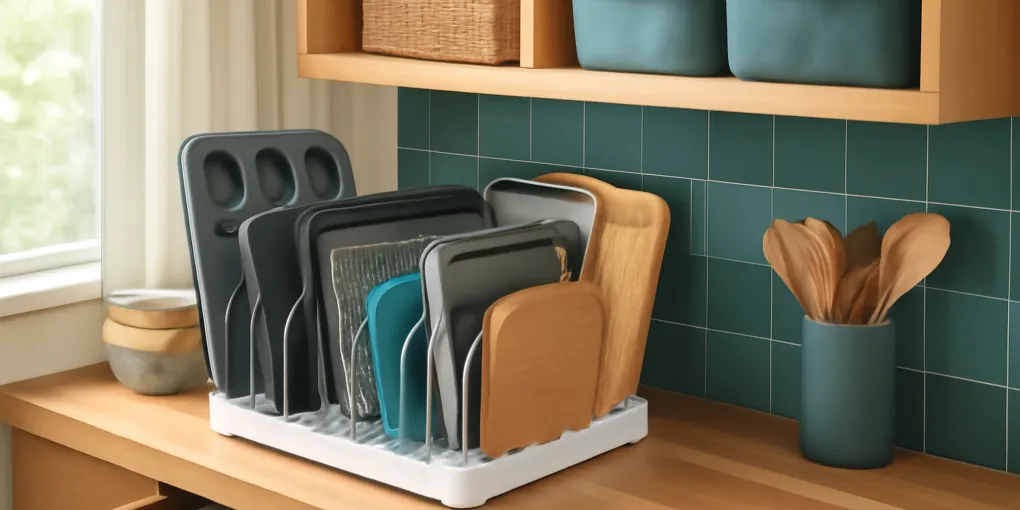
YouCopia StoreMore-style adjustable bakeware rack
Best adjustable cabinet fixBest For: Sheet pans, muffin tins, cutting boards, cooling racks, and lids in a lower cabinet
$20-35
Quick picks
| Product | Key Specs |
|---|---|
| See price on Amazon |
|
| See price on Amazon |
|
| See price on Amazon |
|
Product availability, certifications, and retailer details can change; check the current Amazon page before buying.
The YouCopia StoreMore bakeware rack solves one specific cabinet failure: stacked flat items that have to be lifted as a pile. Sheet pans, cutting boards, muffin tins, cooling racks, and splatter screens look tidy when stacked, but the bottom item is punished. Every time you need it, the whole stack comes out.
A vertical bakeware rack turns that pile into lanes. The question is whether an adjustable StoreMore-style rack is the right fix for your cabinet, or whether a simpler metal divider or pull-out organizer would serve better.
This review is intentionally narrow. If your broader kitchen problem is deep shelves and duplicate food, start with our pantry backstock rotation protocol or pantry turntable explainer. If the problem is flat bakeware, keep reading.
Quick verdict
Buy a YouCopia StoreMore-style adjustable bakeware rack if you have a lower cabinet with a flat shelf, enough vertical clearance, and a mix of sheet pans, cutting boards, and cooling racks that do not stack cleanly.
Skip it if your cabinet is short, the shelf is wire, or most items are heavy cast iron, stoneware, or glass baking dishes. Those need stronger shelves, pull-out hardware, or a different cabinet zone.
Quick picks
- Best adjustable fix: Search Amazon for YouCopia StoreMore bakeware racks if divider spacing matters.
- Best budget alternative: Search Amazon for metal sheet pan organizers for simple lanes.
- Best deep-cabinet upgrade: Search Amazon for pull-out bakeware organizers when reaching into the back is the real failure.
What the rack does well
The adjustable divider design is the reason to choose this style over a fixed file rack. A muffin tin needs a wider lane than a cooling rack. A flexible cutting board needs more support than a rimmed sheet pan. Adjustable dividers let you build lanes around the actual items instead of forcing everything into equal slots.
The second advantage is visibility. When pans stand vertically, you can grab one without moving five others. That reduces the daily friction that makes people leave sheet pans on the counter or in the oven.
The third advantage is category boundary. A bakeware rack quietly says this cabinet lane is for flat bakeware. It discourages the slow migration of food storage lids, plastic wrap, random trays, and appliance manuals into the same pile.
Where it disappoints
The rack is only as good as the cabinet it sits in. If the shelf flexes, slopes, or has wire gaps, the base may shift. If the cabinet opening is shorter than the tallest pan, vertical storage will not work no matter how good the rack is.
It also does not make heavy items lighter. Thick wooden boards, cast-iron griddles, and glass baking dishes can overload a light organizer or make it slide forward. Use the rack for flat, moderately light items. Store heavy pieces low and separately.
Finally, an adjustable rack can become too adjustable. If every lane changes weekly, the system is unstable. Set lanes for the items you actually use: sheet pans, muffin tin, cutting boards, cooling rack, and maybe one splatter screen. Do not make the rack responsible for every flat object in the kitchen.
Measure before buying
Measure the cabinet interior width, depth, and usable height. Usable height means the distance from shelf to the lowest obstruction, not the outside cabinet face. Hinges, face frames, pipes, and shelf lips can steal space.
Then measure the tallest item. A half sheet pan, large cutting board, or oversized cooling rack may be taller than the opening when stored on its long edge. If the item has to tilt dramatically to enter the cabinet, daily use will be annoying.
Also check depth. Some lower cabinets are deep enough that a rack can sit at the front while another item hides behind it. That back zone often becomes clutter. If you cannot see behind the rack, either use the full depth with a pull-out unit or leave the back empty.
YouCopia-style rack vs metal file rack
A metal file-style organizer is cheaper and can work beautifully for one category: sheet pans of similar thickness. It has fewer moving parts and usually looks simple. Choose it when all you need is vertical separation.
Choose a StoreMore-style adjustable rack when the category mix is uneven. Cutting boards, muffin tins, shallow pans, cooling racks, and lids need different widths. Adjustable dividers reduce rattling and leaning.
The tradeoff is fuss. More pieces mean more setup. If your household will not adjust dividers carefully, a fixed metal rack may be better because it asks less from the user.
When a pull-out organizer wins
A pull-out bakeware organizer wins in deep lower cabinets. Instead of reaching over a front row to grab the back pan, the whole rack slides toward you. That is especially helpful for shorter users, older adults, or cabinets below a deep counter.
The cost and installation are the drawbacks. Pull-out organizers need careful width measurement, secure mounting, and enough clearance for the slides. Renters may prefer a freestanding rack.
Food-contact and cabinet hygiene note
Bakeware storage is not usually a food-safety system, but clean storage still matters. The FDA’s kitchen food-safety guidance emphasizes clean surfaces and avoiding cross-contamination in food-prep areas (FDA kitchen food safety). In this cabinet, that means dry pans before storage, wipe crumbs from the rack, and do not store cleaning chemicals or sticky bottles in the same lane as cutting boards.
If cutting boards share the rack, keep raw-meat boards clean, dry, and separated from serving trays. The organizer should make the category easier to inspect, not hide residue in a tight slot.
Fit matrix
| Cabinet problem | Best choice | Avoid |
|---|---|---|
| Mixed pan and board thicknesses | Adjustable StoreMore-style rack | Fixed dividers that pinch boards |
| Similar sheet pans only | Metal vertical pan organizer | Overspending on adjustability |
| Deep cabinet hides back row | Pull-out bakeware organizer | Front rack plus mystery back pile |
| Heavy glass or cast iron | Low separate shelf | Lightweight freestanding dividers |
| Short cabinet opening | Horizontal stack or different cabinet | Forcing tall pans upright |
Setup protocol
Empty the whole cabinet before installing the rack. Remove duplicate warped pans, stained liners, appliance manuals, and lids that belong elsewhere. Put only flat bakeware and boards back.
Build lanes from widest to narrowest. Put heavy or frequently used items near the sides where they have more support. Keep the daily sheet pan in the easiest front lane. Put rarely used holiday pans in a different cabinet if they force daily items to lean.
After one week, check whether the rack moved. If it slid forward, add a non-slip liner under the base or move heavier items lower. If a pan keeps falling sideways, widen that lane or remove the item.
Bakeware rack FAQ
Can this organizer hold cutting boards?
Yes, if the boards fit the height and the rack has enough lateral support. Very thick wooden boards may need a sturdier base or separate shelf.
Should sheet pans be stored vertically or horizontally?
Vertically, when cabinet height allows it, is usually easier for daily access. Horizontal stacking works for rarely used or identical pans.
Will this fix an overstuffed cabinet?
Only after editing. If every pan, tray, board, cooling rack, lid, and serving platter must fit in one narrow cabinet, no rack will make the category easy.
Reader test
A reader can choose a StoreMore-style rack for adjustable pan and board lanes, a metal file rack for cheap sheet-pan separation, or a pull-out organizer for deep cabinets. This article is specific to bakeware because it deals with sheet pan height, muffin-tin lane width, cutting-board hygiene, cabinet face-frame clearance, and vertical versus stacked flat storage.
Frequently Asked Questions
- It is worth considering when stacked sheet pans and cutting boards are the cabinet problem and your cabinet has enough height for vertical storage.
- Measure cabinet width, depth, usable height, shelf flatness, and the tallest pan or cutting board you plan to store upright.
- A pull-out organizer is better for deep cabinets and heavy bakeware, but it costs more and may require installation. Countertop racks are easier but add visual clutter.