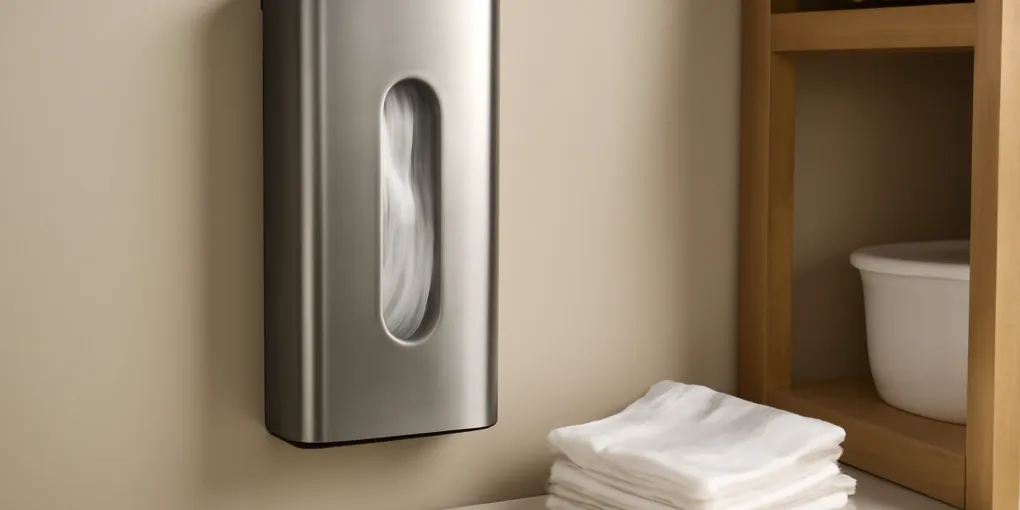
simplehuman Wall-Mount Grocery Bag Dispenser
Best tidy wall-mounted optionBest For: Households that reuse a moderate number of plastic grocery bags
$15-25
Quick picks
| Product | Key Specs |
|---|---|
| See price on Amazon |
|
| See price on Amazon |
|
| See price on Amazon |
|
Product availability, certifications, and retailer details can change; check the current Amazon page before buying.
The simplehuman wall-mount grocery bag dispenser is a good product for a narrow problem: loose plastic grocery bags that are reused for small trash cans, pet cleanup, wet clothes, or quick household jobs. It is not a complete bag system, and it will not help much with reusable totes.
Our practical rating is 4.1 out of 5. It earns points for a compact shape, clean look, and one-hand dispensing. It loses points when households overfill it or mount it in a cabinet that should stay clear for plumbing and cleaning supplies.
For a broader kitchen reset, compare it with our under-sink storage safety protocol and cabinet door organizer guide.
Quick verdict
- Best fit: moderate plastic-bag reuse with a clear wall, pantry, or cabinet side.
- Best search path: Search Amazon for simplehuman grocery bag dispensers.
- Better no-drill path: Search Amazon for over-cabinet grocery bag holders.
- Skip it if: your real goal is to stop accumulating single-use bags or store reusable totes.
A dispenser should create a limit, not permission to keep every bag.
What works well
The best feature is the vertical format. Bags that would otherwise puff out of a cabinet or drawer get compressed into one visible column. The front opening makes it easier to pull one bag without emptying a bin.
The second strength is location flexibility. A wall-mounted dispenser can live inside a pantry, on a mudroom wall, or on a cabinet side if there is clearance. That matters because bags are often used away from the shopping tote zone.
The third strength is wipeability. A hard dispenser is easier to clean than a fabric sack if a bag carried food residue or damp items.
What does not work as well
The dispenser can become a stuffed tube. When it is packed too tight, bags do not dispense cleanly, and the household starts piling overflow beside it. That is a signal to reduce bag intake or move reusable totes closer to the exit.
Under-sink mounting is only sometimes a good idea. The space around pipes, disposal units, and cleaning products is already constrained. If leaks, sprays, or chemical bottles are likely, use a pantry wall instead.
It also does not organize reusable bags. Reusable totes need a bin, hook, or car-return habit. Mixing them with plastic bags makes both categories harder to use.
simplehuman dispenser scorecard
| Factor | Weight | Score | Rationale |
|---|---|---|---|
| Research | 30% | 23/30 | The product solves retrieval and containment for a specific bag category. |
| Evidence Quality | 25% | 18/25 | Safety and usefulness depend on mounting location, bag cleanliness, and household reduction goals. |
| Value | 20% | 16/20 | Reasonable price if it replaces bag piles; poor value if reusable totes are the main problem. |
| User Signals | 15% | 13/15 | One-hand dispensing and a visible limit support repeat use. |
| Transparency | 10% | 9/10 | It is a plastic-bag dispenser, not a universal shopping-bag organizer. |
Best mounting locations
A pantry side wall is usually the cleanest option. It keeps bags near kitchen tasks without competing with pipes. A mudroom works if bags are used for shoes, pet walks, or car cleanup.
Inside a cabinet door can work only if the dispenser clears shelves and does not hit stored items. Test the door swing with a cardboard outline before drilling.
An under-sink side wall is acceptable only when it is dry, reachable, and away from heavy bottles. Keep bags away from cleaners that could leak or scent the plastic.
Setup protocol
- Empty every loose plastic bag from drawers, cabinets, cars, and closets.
- Discard dirty, torn, or damp bags according to local recycling or trash rules.
- Keep a realistic quantity, such as what the household uses in two to four weeks.
- Pick a mount location near actual use.
- Check for pipes, wires, shelf clearance, and door swing.
- Load bags loosely instead of packing them tight.
- Put reusable totes in a separate bin or hook near the exit.
The EPA’s waste-reduction hierarchy favors reducing and reusing before recycling. A dispenser should make reuse easier while also showing when too many single-use bags are entering the home.
Before drilling, load the dispenser loosely on a counter and count how many bags fit without forcing the front opening to bulge. That number is the household limit. If weekly groceries produce more bags than the dispenser can dispense cleanly, the fix is a reusable-bag return habit, not a second wall tube.
Who should skip it
Skip it if plastic bags are already banned or rare in your household. Skip it if you primarily use bulky reusable totes. Skip it if the only possible mount is a damp, crowded cabinet beside cleaning chemicals.
A simple open bin may be better if several people need to toss bags in quickly. A wall dispenser is best for households willing to fold or push bags into a single controlled spot.
Grocery bag dispenser FAQ
Does the dispenser reduce clutter by itself?
It contains one category, but it does not reduce incoming bags. Set a maximum fill level and remove extras when the dispenser is full.
Can it be used for reusable bags?
Not well. Reusable totes are too bulky and should be stored in a separate bin, hook, or car-return station.
What source supports the reduction-first approach?
EPA sustainable materials guidance prioritizes source reduction and reuse before recycling, which is the right lens for bag storage: https://www.epa.gov/recycle/reducing-and-reusing-basics.
Frequently Asked Questions
- It is worth considering if you reuse plastic bags and have a narrow wall or cabinet spot. It is less useful if you are trying to reduce bag accumulation or mainly store bulky reusable totes.
- Mount it where bags are used: inside a pantry, on a mudroom wall, or on a dry under-sink side wall with pipe clearance. Avoid damp leak-prone areas.
- Keep only the amount you actually reuse between shopping trips. If the dispenser is packed tight, the issue is bag intake, not storage capacity.