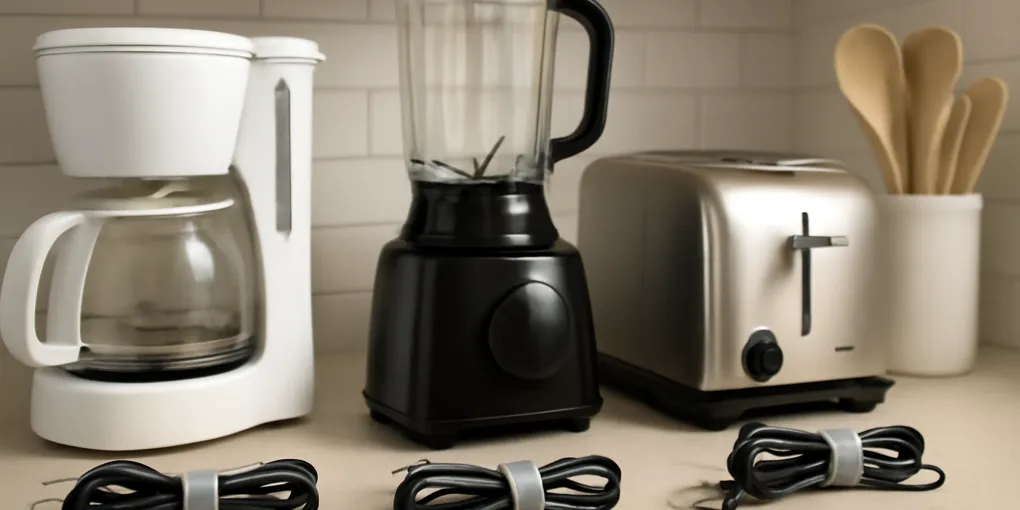
Aieve Appliance Cord Organizer Wrap
Best for stand mixersBest For: Mixers, blenders, and coffee makers with cool rear panels
$8-14
Quick picks
| Product | Key Specs |
|---|---|
| See price on Amazon |
|
| See price on Amazon |
|
| See price on Amazon |
|
| See price on Amazon |
|
Product availability, certifications, and retailer details can change; check the current Amazon page before buying.
Small appliance cords create counter clutter because they are attached to objects that move: the mixer slides out for baking, the coffee grinder shifts beside the machine, the toaster gets pulled forward, and the air fryer cord lands in the only clear prep zone. A cord wrap helps only if it keeps the cord controlled without hiding heat, bending the cord sharply, or making the appliance harder to clean.
If your larger problem is where the appliance lives, start with our kitchen appliance storage guide. Cord wraps solve the last 18 inches of mess, not a cabinet-capacity problem.
Quick picks
- Best mixer option: Search Amazon for Aieve appliance cord wraps.
- Best low-profile option: Search Amazon for OXO appliance cord wraps.
- Best multi-pack: Search Amazon for silicone appliance cord holder sets.
- Best no-adhesive fallback: Search Amazon for reusable hook-and-loop cord ties.
The right choice depends less on color and more on heat clearance, cord thickness, and how often the appliance moves.
The safety check before any cord wrap
Look at the appliance back before buying. Do not cover vents, warning labels, model labels, feet, handles, removable panels, or any area that gets hot during use. ESFI’s extension-cord safety guidance is blunt about avoiding damaged cords, overloaded cords, and unsafe routing; the same habit applies here. A tidy cord is not a safe cord if it is kinked, pinched, or routed across a hot panel.
For air fryers and toaster ovens, be conservative. These appliances shed heat and often need rear or side clearance. If the only flat mounting spot sits near a vent, skip adhesive storage and use a loose cord tie after the appliance cools.
What to buy by appliance
For a stand mixer, choose a wider adhesive wrap with a hook that can handle a thick cord without forcing it into a tight spiral. The wrap should sit on the cool rear housing, not on the motor vent or near the tilt-head hinge.
Mixer cords are usually heavier than coffee-maker cords, so the weak point is not just the sticker. It is the bend where the cord leaves the appliance. A wrap that asks you to wind the cord around a narrow peg can make the plug look tidy while pulling sideways on the strain relief. Favor a broad S-shaped channel or a wide hook that lets the cord make two relaxed loops. If the mixer is stored in a lower cabinet and lifted onto the counter, skip adhesive altogether and use a removable tie so the wrap is not scraped every time the appliance moves.
For a coffee maker, choose a low-profile wrap that lets you pull out enough slack to refill the water tank and clean behind the machine. A wrap that is too aggressive makes the daily motion annoying, so the cord ends up left loose again.
Coffee stations also need splash tolerance. Do not mount an adhesive wrap where water drips during reservoir refills or where coffee oils collect behind the machine. A smooth side panel or cool rear panel is better than the bottom edge. If the machine slides forward daily, leave enough cord loose that the wrap is not acting like a handle.
For a blender or food processor base, adhesive can fail if the back surface is curved or textured. A silicone wrap with a generous pad is better than a tiny rigid hook. If the base is washed or wiped often, a removable tie may last longer.
Blender bases are a good place to check surface shape before buying a multi-pack. Many have curved backs, rubberized feet, or vents that make a flat sticker unreliable. A flexible silicone holder can conform better than a rigid plastic one, but only if the adhesive pad still sits fully on the housing. If half the pad hangs over a curve, it will peel when the cord is tugged.
For a toaster, griddle, air fryer, or toaster oven, heat wins over neatness. Use only a manufacturer-compatible cool surface, and never wrap the cord while the appliance is warm.
Air fryers are the easiest category to get wrong because many have rear vents, side vents, removable baskets, or hot exterior zones. If you cannot identify a cool, non-vented, non-removable panel, do not attach anything. Use a hook-and-loop tie stored in the drawer beside the appliance, then wrap only after the unit has cooled and been unplugged. A counter can look less styled, but the cord will avoid heat and tight bends.
Fit checklist before you click buy
Measure the cord thickness and the appliance surface, not just the cord length. A thin coffee-grinder cord can sit on a small low-profile hook; a stand-mixer cord needs a broader channel. If the plug is bulky or angled, make sure the final loop leaves the plug outside the wrap instead of wedged behind it.
Check the appliance manual or the label area before choosing a mount spot. A cord wrap should not cover the model label, voltage label, serial number, safety warning, removable panel, rubber foot, water reservoir, crumb tray, filter door, or screw access. Those details are boring until you need a replacement part, warranty support, or cleaning access.
For renters, shared kitchens, and appliances with textured plastic, a no-adhesive tie is often the smarter first purchase. Adhesive wraps look cleaner, but they commit you to one location and one appliance. Hook-and-loop ties travel with the cord, tolerate curved backs, and avoid residue. The tradeoff is that they are easier to misplace unless you keep one on the cord whenever the appliance is stored.
Adhesive, silicone, and tie styles compared
Adhesive silicone wraps are the most common because they are inexpensive and soft enough for ordinary appliance cords. They work best on smooth, cool panels that are wiped clean before installation. Their weakness is peel failure: steam, grease film, curved plastic, and repeated cord tugging all reduce the bond.
Rigid plastic hooks look neat on a square appliance but can create sharper bends. Use them only when the hook is wide, rounded, and placed so the cord rests rather than pulls. If the cord has to be forced under a lip, choose another style.
Reusable ties are less decorative but more forgiving. They are the best fallback for air fryers, toaster ovens, textured blender bases, and appliances that move from cabinet to counter. Choose wide ties rather than narrow zip-tie-style straps. Narrow pressure points are exactly what you are trying to avoid.
Two common buying mistakes
The first mistake is buying a pack based on color and then installing every wrap in the same place on every appliance. A mixer, toaster, coffee maker, and air fryer should not get identical placement. Start with the appliance whose cord creates the most daily mess, learn where the wrap actually survives, then use the remaining pieces only where the fit is safe.
The second mistake is treating the wrap as a storage excuse. If a counter has six appliances plugged in, a cord wrap may reduce visual clutter while preserving the underlying crowding. For rarely used appliances, cabinet storage or a dedicated appliance garage does more than a hook on the cord.
Appliance cord-wrap scorecard
| Factor | Weight | Score | Rationale |
|---|---|---|---|
| Research | 30% | 24/30 | Cord wraps solve a real counter-reset problem when matched to appliance heat and movement. |
| Evidence Quality | 25% | 18/25 | Safety depends on appliance design, manual warnings, and user behavior rather than the wrap alone. |
| Value | 20% | 17/20 | Multi-packs are cheap, but failed adhesive and wrong placement waste time. |
| User Signals | 15% | 12/15 | The best wraps make daily cleanup easier; bad ones get ignored after a week. |
| Transparency | 10% | 9/10 | The limits are clear: no hot surfaces, no vents, no tight bends. |
Installation rules that prevent regret
Clean the surface with mild soap and let it dry fully before applying adhesive. Place the wrap with the cord unplugged and loose so you can see the natural bend. If you have to pull the cord hard to make the last loop, the mount is in the wrong place.
Leave the plug visible. A hidden plug encourages yanking the cord or forgetting whether the appliance is unplugged. Keep enough slack at the strain relief so the cord does not angle sharply where it exits the appliance.
Wait before using the wrap. Most adhesive pads bond better after several hours. If the instructions call for a cure period, respect it before loading the cord.
What to avoid
Avoid tiny novelty wraps that require five tight turns around a narrow post. Avoid mounting anything over a serial number or manufacturer label. Avoid cord reels for small appliances unless the appliance was designed for one.
Do not use a cord wrap to keep an appliance plugged in permanently on a crowded counter. If cords, water, hot surfaces, and food prep all meet in one spot, the better fix may be moving the appliance or reducing what lives on the counter.
Appliance cord wrap FAQ
Can I use one wrap style on every appliance?
Not reliably. A mixer, coffee maker, toaster, and air fryer have different heat, movement, and cord-thickness profiles. Buy for the appliance that causes the most daily clutter first.
Will adhesive damage the appliance?
It can leave residue or lift weak finishes, especially on textured plastic or older painted surfaces. Test placement, avoid labels, and use a removable tie when warranty or finish risk matters.
What source should guide safety decisions?
The appliance manual comes first. For general cord habits, ESFI guidance on cord condition, loading, and routing is a useful safety baseline: https://www.esfi.org/extension-cord-safety-tips/.
Frequently Asked Questions
- Only when the wrap is mounted on a cool surface away from vents and the cord is not tightly wound. If the manual warns against rear accessories or heat clearance is limited, use a loose removable tie instead.
- No. Let the appliance cool, unplug it, then loop the cord loosely so the plug and strain relief are not pulled sideways.
- Sometimes, but adhesive pads hold best on smooth clean surfaces. On textured plastic or metal, hook-and-loop ties are usually more reliable.