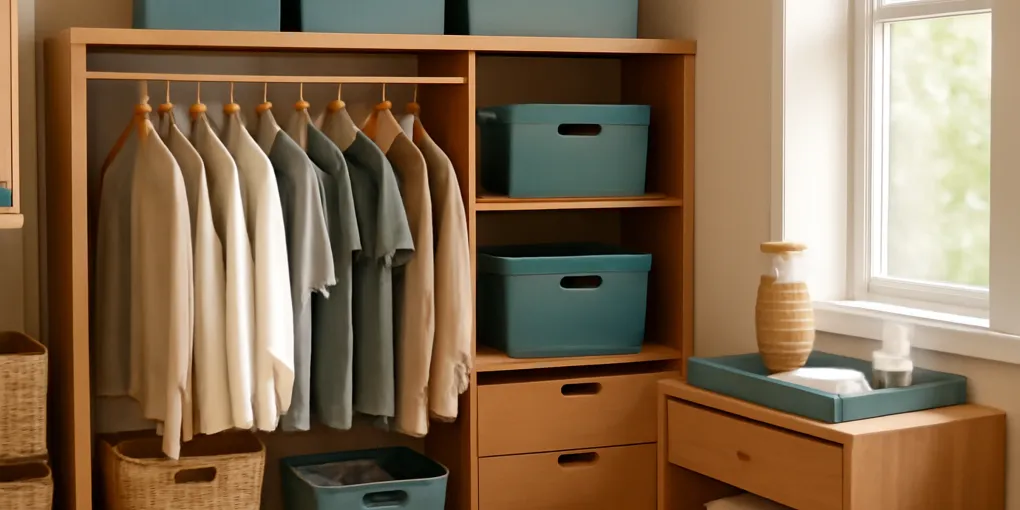
Closet Zone System Guide: A Lower-Friction Way to Keep Clothes Organized
ProtocolA closet zone system is a practical alternative to the common weekend closet overhaul. Instead of trying to make every shelf look perfect, the goal is to make every category easy to return after normal use. That distinction matters. A closet fails less often because people do not know how to fold and more often because the return path is too vague, too crowded, or too slow.
Recommended products
Search for View closet shelf dividers on Amazon, View fabric closet bins on Amazon, or View slim velvet hangers on Amazon. Compare current labels, prices, sellers, dimensions, and return policies before buying.
Overall rating: 4.3 out of 5 for shared closets, seasonal wardrobes, and small bedrooms where clothes migrate to chairs.
Best for: people who can group clothing by use case and maintain a weekly ten-minute reset.
Not best for: closets that are structurally too small for the amount of clothing kept, households that need a full wardrobe edit first, or anyone who wants a product to replace decision-making.
The Core Idea
A closet zone is a named parking place for a repeated clothing task. Work clothes, workout clothes, outerwear, laundry overflow, donation candidates, seasonal accessories, and rarely used formal clothing should not compete for the same shelf. When they do, the brain has to make a small sorting decision every time a shirt or bag is returned. Small decisions accumulate.
A zone system reduces that load by making the next action obvious. If a sweatshirt belongs in the casual upper-body zone, it goes back to that bin, hanger section, or shelf. If a pair of gloves belongs in the winter accessory zone, it does not drift into a drawer with belts and receipts. The system is not glamorous, but it reduces ambiguity.
Step 1: Audit by Frequency, Not by Category
Most closets are sorted by object type: shirts with shirts, pants with pants, shoes with shoes. That is a reasonable starting point, but frequency is the more useful design variable. Daily items deserve the easiest reach. Weekly items can sit one shelf higher. Seasonal items can move to labeled bins. Special-occasion items can be protected but less accessible.
Take everything out only if the closet is small enough to finish in one session. For a larger closet, audit one rail or shelf at a time. Make four piles: daily, weekly, seasonal, and uncertain. The uncertain pile is important because it prevents perfectionism from stopping the project. Anything in that pile gets a temporary review date rather than an immediate emotional decision.
Step 2: Create a Landing Zone
A closet needs one intentional landing zone for clothes in motion. Without it, the landing zone becomes a chair, bed, doorknob, or laundry basket. Use a shallow bin, hook row, or dedicated shelf for items that were worn briefly and are not ready for laundry. The rule is simple: the landing zone is allowed to exist, but it must be small enough to force a reset.
This is where many beautiful closet makeovers fail. They leave no place for transitional objects. Real homes have transitional objects: a hoodie worn for twenty minutes, a belt that needs to go back, a tote bag waiting for tomorrow, dry cleaning that needs to be dropped off. A system that ignores these objects punishes normal life.
Step 3: Choose Containers After the Zones
Do not buy bins first. First define the zone, measure the shelf, and count the objects that truly belong there. Then choose the smallest container that can hold the category with a little breathing room. Oversized bins invite unrelated items. Tiny bins create overflow.
For folded sweaters, shelf dividers may be better than bins because they preserve visibility. For accessories, fabric bins can work if each bin has one job. For workout gear, a drawer unit may beat a shelf because stretchy fabrics collapse into piles. For shoes, a low rack can help only if the household actually returns shoes to it. If shoes are dropped at the entry, solve the entry first rather than forcing the closet to absorb a behavior that happens elsewhere.
Step 4: Label for Behavior, Not Aesthetics
A label should answer the question someone asks while holding the item. “Winter” is weaker than “Hats and gloves.” “Accessories” is weaker than “Belts used weekly.” If the label is too broad, it becomes a junk category. If it is too narrow, it creates too many micro-decisions.
Shared closets benefit from plain-language labels. The goal is not to impress guests. The goal is to make the system usable when someone is tired, rushed, or putting away laundry at night.
G6 Clutter Science Score
| Factor | Weight | Score | Why it matters |
|---|---|---|---|
| Research fit | 30% | 8.4 | The recommendation is grounded in attention, friction, and household-behavior research rather than decoration alone. |
| Evidence quality | 25% | 8.0 | The evidence supports principles such as reduced visual load and easier resets, while product-specific claims remain conservative. |
| Value | 20% | 8.2 | The approach favors low-cost measurement, reusing existing containers when possible, and buying only after a failure point is clear. |
| User signals | 15% | 7.8 | The best signals are repeated daily use, fewer misplaced items, and a weekly reset that takes minutes rather than an hour. |
| Transparency | 10% | 9.0 | Shopping-result links are labeled clearly, not presented as product-identifier endorsements, and limitations are stated. |
Composite G6 score: 8.2 out of 10. A score above 8 means the system is likely to help a real household if the fit checks are completed before buying.
What to Buy, If Anything
Start with the least permanent tools. Slim hangers can create rail consistency, but they do not fix excess volume. Shelf dividers can stop stacks from slumping, but they do not decide which sweaters stay. Fabric bins can hide visual clutter, but they also hide overbuying. A hook rail can be excellent for bags and worn-once clothes if it has enough wall or door clearance.
A practical shopping order is: measuring tape, labels, shelf dividers, one or two trial bins, then specialized organizers only after a two-week test. If the trial bin fills with unrelated items, the zone definition is wrong. If the bin stays empty, the product may be unnecessary.
Weekly Reset Protocol
Once a week, set a timer for ten minutes. Empty the landing zone. Return daily items to their zones. Move laundry to the hamper. Move donation candidates to a bag that leaves the closet. Put seasonal items back into the less accessible zone. Stop when the timer ends. The point is to keep the system alive, not to rebuild it every weekend.
If the same object appears in the wrong place three weeks in a row, redesign around that behavior. Maybe the belt hook belongs closer to the mirror. Maybe the gym clothes need a drawer near the laundry area. Repeated drift is data.
Evidence Notes and Sources
This article uses organization research as a decision aid, not as medical advice. Useful background includes:
- Chae and Zhu, 2014, “Environmental Disorder Leads to Self-Regulatory Failure” in Journal of Consumer Research: https://doi.org/10.1086/674547
- McMains and Kastner, 2011, “Interactions of Top-Down and Bottom-Up Mechanisms in Human Visual Cortex” in Journal of Neuroscience: https://doi.org/10.1523/JNEUROSCI.3766-10.2011
- Saxbe and Repetti, 2010, “No Place Like Home” in Personality and Social Psychology Bulletin: https://doi.org/10.1177/0146167210386563
- U.S. Consumer Product Safety Commission safety education: https://www.cpsc.gov/Safety-Education
The practical recommendation is to reduce decision friction, make return paths visible, and avoid products that create hidden maintenance work.
Related Clutter Science Guide
For bedroom-adjacent behavior design, the same principle appears in our guide to why flat surfaces become clutter magnets.
Fit Test Before You Buy
Run a seven-day fit test before ordering the main organizer. Put a temporary container, hook, tray, or tape outline where the product would go. Use it exactly as the final system would be used. If the household ignores the temporary version, a more expensive version is unlikely to fix the behavior. If the temporary version works but looks messy, then a better product may be justified.
The fit test should answer three questions. First, is the location close enough to the moment of use? Second, is the return action obvious when someone is tired or carrying other items? Third, does the container create a visible limit before it becomes a hidden backlog? These questions matter more than the product finish.
Common Failure Modes
The first failure mode is overcapacity. When a container is too large, it attracts unrelated objects and becomes a mixed-storage zone. The second failure mode is undercapacity. When a container is too small, overflow appears immediately and the system feels broken. The third failure mode is hidden maintenance. Any solution with lids, drawers, deep bins, or stacked access asks for extra steps. That can be acceptable for rare-use items, but it is risky for daily clutter.
The fourth failure mode is buying for a fantasy routine. If the current habit is drop-and-go, choose an open landing place before choosing closed cabinetry. If the current habit is delayed decision-making, choose a review schedule before choosing archival storage. Products work best when they remove friction from an existing behavior rather than demanding a new personality.
Household Rules That Keep It Working
A durable system needs a limit, an owner, and a reset moment. The limit defines how much the zone can hold. The owner decides what happens when the zone is full. The reset moment is the recurring time when stray items are returned, donated, recycled, washed, or relocated. Without those three pieces, even good organizers drift into storage for undecided objects.
Use plain rules. One category per bin. Daily items at easy reach. Heavy items low. Wet or dirty items separated. Review anything that has not moved in a season. If a rule cannot be explained in one sentence, it probably will not survive a busy week.
FAQ
Should I declutter before buying Closet Zone System Guide?
Usually no. Remove obvious trash, donations, duplicates, and wrong-room items first. Then measure what remains. Buying first can lock you into the wrong capacity.
How long should I test a Closet Zone System Guide setup?
Test for at least one normal week. A weekend reset can make almost anything look successful for a day. A week shows whether the system survives workdays, errands, laundry, guests, or family routines.
What shows a Closet Zone System Guide system is failing?
The clearest sign is repeated overflow in the same place. Overflow is not a character flaw; it is feedback that the zone is too small, too far away, too hidden, or assigned to the wrong category.
Bottom Line
A closet zone system works because it reduces tiny return decisions. Buy organizers only after you know the zone, the measurement, and the behavior you are trying to support. The best closet is not the one with the most matching bins. It is the one that recovers quickly after an ordinary week.