Do Clear Pantry Bins Reduce Food Waste?
Evidence ExplainerQuick picks
| Product | Key Specs |
|---|---|
| See price on Amazon |
|
| See price on Amazon |
|
| See price on Amazon |
|
Product availability, certifications, and retailer details can change; check the current Amazon page before buying.
Clear pantry bins can reduce food waste, but not because plastic containers have magic anti-waste properties. They help when they make food easier to see, easier to count, and easier to use in the right order. The evidence points to a practical middle ground: visibility and inventory cues matter, but bins only work when they are paired with a simple habit such as grouping duplicates, putting older food in front, and labeling opened or decanted items.
If your pantry problem is that granola bars, rice packets, half-used pasta, and extra cans vanish behind other items, clear bins are a reasonable fix. If your problem is overbuying, vague meal planning, or ignoring expiration dates, bins are only one part of the system. For deep shelves, pair them with a pull-forward layout like the one in our guide to organizing a deep pantry. For households that lose track of dates and backups, a label-first system like pantry inventory labels may do more than another container.
Quick product fixes that can help immediately
Use bins to solve a specific waste pattern, not to make every shelf match.
- For duplicate snacks and packets: use two or three clear open-front or handled bins so small items do not disappear behind cereal boxes. Search Amazon for clear stackable pantry bins.
- For stale dry goods: use clear airtight containers only for foods you actually open and keep for weeks, such as rice, flour, cereal, oats, pasta, crackers, and sugar. Search Amazon for clear airtight food storage containers.
- For date confusion: add removable labels or date stickers to bins and containers so use-first decisions are visible without opening anything. Search Amazon for pantry labels and date stickers.
Product rule of thumb: buy fewer bins than you think you need. Start with the two pantry zones where food currently expires, duplicates, or goes stale. If waste drops after two grocery cycles, expand the system.
The evidence-based answer
Clear pantry bins reduce waste through three mechanisms that are supported by food waste research and basic behavior science: visibility, inventory accuracy, and first-in-first-out cues. You are more likely to use food you can see. You are less likely to buy duplicates when grouped categories show what you already own. You are more likely to use older food before newer food when the shelf layout makes the order obvious.
Household food waste is not a small problem. The USDA estimates that 30 to 40 percent of the U.S. food supply is wasted. The EPA emphasizes source reduction and prevention before composting or disposal. FDA consumer guidance also notes that confusion around date labels contributes to edible food being discarded. None of those agencies says clear bins are a stand-alone intervention. What they do support is better food management: knowing what you have, storing it correctly, and using edible food before it spoils.
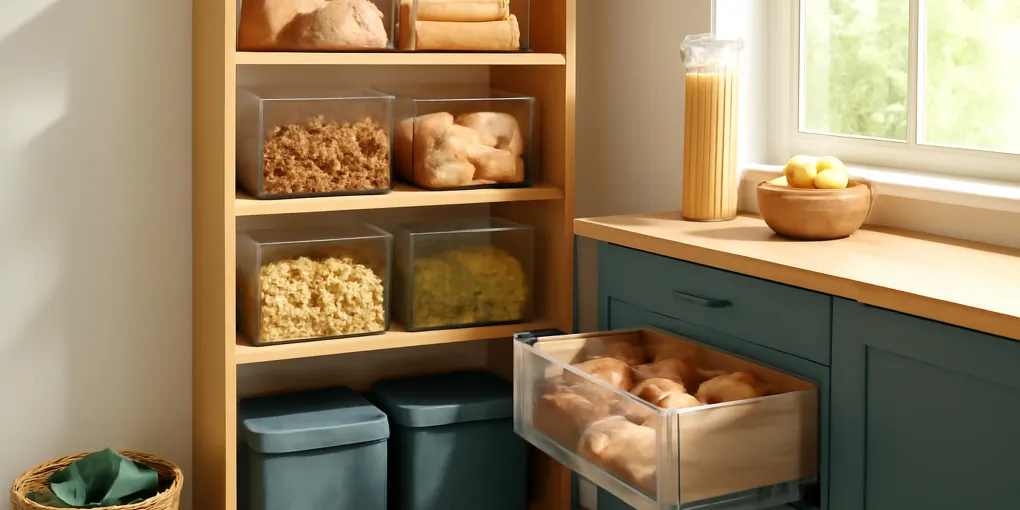
Clear bins are best understood as a household inventory tool. A transparent bin turns a messy shelf into a visible category: breakfast, baking, pasta night, lunch snacks, unopened backups, use-first items. That category-level visibility lowers the odds that food becomes out of sight, out of mind. It also makes the pre-grocery scan faster. If the pasta bin is half full, you do not need more pasta. If the snack bin has six loose bars and two open cracker sleeves, you can pause the warehouse-size snack order.
G6/CS composite score
ClutterScience uses the G6/CS composite to separate useful pantry interventions from decorative pantry makeovers. Clear pantry bins score well when they are used as targeted visibility tools, not when they become an expensive whole-shelf aesthetic project.
| Factor | Weight | What it means for clear pantry bins |
|---|---|---|
| Research | 30% | Household food waste research supports inventory, planning, storage, and visibility as relevant behaviors. |
| Evidence Quality | 25% | The strongest evidence is indirect: food waste audits, consumer behavior studies, date-label research, and agency guidance. |
| Value | 20% | A small number of bins can pay for themselves if they prevent duplicate purchases or stale dry goods. |
| User Signals | 15% | Clear bins create an immediate visual inventory, especially on deep shelves and in snack zones. |
| Transparency | 10% | The mechanism is inspectable: count duplicates, expired items, and wasted open packages before and after the change. |
The weighted read is favorable but conditional. Clear bins score well when used as targeted visibility tools. They score lower when used as a decorative reset that decants everything, hides date information, or creates containers that are harder to maintain than the original packaging.
Where clear bins are most likely to reduce waste
Deep shelves are the strongest use case. Deep shelves create a front row and a forgotten back row. A handled clear bin lets you pull the whole category forward instead of digging. This matters for oatmeal packets, broth cartons, sauce pouches, baking add-ins, seasoning packets, snack bars, and tea boxes.
Duplicate-prone staples are the second strong use case. Clear bins work well for foods that are repeatedly rebought because nobody remembers whether they are in stock: pasta, rice, canned tomatoes, broth, beans, oats, lunch snacks, cereal, flour, sugar, and peanut butter. For duplicates, choose open bins rather than sealed containers. You want a fast grocery-check view.
Open dry goods that go stale need a different product. For cereal, crackers, rice, oats, flour, sugar, pasta, and baking ingredients, clear airtight containers can reduce waste by protecting food after opening. This is different from simple visibility. Here the benefit is storage quality: less exposure to air, moisture, pests, and torn packaging.
A small clear bin labeled use first can be more effective than reorganizing the whole pantry. Put near-expiration items, open duplicates, single recipe leftovers, and snacks that need to be finished there. Review it before meal planning or grocery shopping. Most pantries are organized by type. Waste prevention also needs time order: what should be used next?
Product callout: clear stackable pantry bins
Clear stackable pantry bins are best for snack packets, breakfast items, sauce packets, tea, small baking supplies, lunchbox food, and deep shelves. Look for transparent sides with no heavy tint, straight walls that do not waste shelf width, handles if shelves are deeper than your forearm reach, and dimensions that match shelf depth without blocking the door.
Avoid buying a large matching set first. Pantry categories rarely need identical containers. A snack bin may need to be wide and low; a baking bin may need to be narrow and deep; a can bin may need more strength than a packet bin. Stackability is useful only if the upper bin can be removed easily. If stacking makes the bottom bin harder to check, it can increase waste rather than reduce it.
Shopping option: Search Amazon for clear stackable pantry bins.
Product callout: clear airtight food containers
Clear airtight food containers are best for opened dry goods that suffer from air exposure, torn packaging, moisture, or pests. Look for an airtight gasket or locking lid, a wide opening for scooping and cleaning, dishwasher-safe parts if your household will actually wash them, and sizes matched to the amount you buy.
Do not decant everything automatically. Some foods are easier to manage in their original packages because the package carries cooking directions, allergen statements, date labels, and nutrition information. If you decant, keep a label or photo of critical information. A clear container without a date can increase confusion when several white powders, grains, or baking mixes look similar.
Shopping option: Search Amazon for clear airtight food storage containers.
Product callout: pantry labels and date stickers
Pantry labels and date stickers are best for households that already have clear containers but still forget opening dates, expiration windows, or what needs to be used first. Look for removable labels that do not leave adhesive residue, writable date stickers, and labels large enough to read from the shelf edge.
Labels matter because clear does not always mean obvious. Flour, pancake mix, powdered sugar, and cornstarch can look similar. So can multiple grains. The label should answer what it is, when it was opened or decanted, and whether it belongs in the use-first zone. A marker-based system is often more durable than an app-only inventory routine because it works while someone is unloading groceries.
Shopping option: Search Amazon for pantry labels and date stickers.
A simple pantry-bin waste audit
Before buying anything, do a 15-minute audit. Pull out the foods that are expired, stale, duplicated, or forgotten. Sort them into four groups: hidden duplicates, open and stale items, date-confusion discards, and recipe leftovers. Each group points to a different fix. Hidden duplicates need clear category bins. Open and stale foods need airtight containers or clips. Date confusion needs labels. Recipe leftovers need a use-first bin and meal planning prompt.
Count the approximate value of what you discard. You do not need a perfect dollar amount. If you throw away a visible amount of stale snacks and duplicate staples during the audit, a targeted bin setup can be rational. If you throw away mostly fresh produce or restaurant leftovers, pantry bins are not the main intervention.
How to set up clear bins for less waste
Start with zones rather than products. A useful first layout is a breakfast bin, a lunch snack bin, a dinner base bin, a baking bin, and a use-first bin. Put older items at the front or top. Put new backups behind or below. This first-in-first-out habit is common in food service because it reduces the chance that older stock is forgotten. In a home pantry, the principle can be simple: new groceries go to the back of the category, open packages go to the front, and the use-first bin gets checked before shopping.
Keep some negative space. A bin that is packed to the top is not visible. If a category overflows every week, either the bin is too small or the household is buying more than it uses. The overflow is useful data. The point is not to make the pantry look empty; the point is to make decisions faster.
Common mistakes that make clear bins less effective
The first mistake is over-decanting. Decanted shelves look calm, but they can hide dates, cooking directions, allergen warnings, and quantity cues. Use airtight containers for foods that benefit from them, not for every box.
The second mistake is using too many narrow categories. If the pantry has 14 tiny bins, nobody will maintain it. Four to seven broad categories usually work better.
The third mistake is ignoring shelf measurements. A bin that is two inches too deep can keep the door from closing. A bin that is too tall can block the shelf above. A bin that is too shallow can create a second hidden row behind it.
The fourth mistake is not creating a use-first zone. Visibility alone does not establish priority. A use-first bin tells the household what should be eaten before new food is opened.
FAQ
Do clear pantry bins actually reduce food waste?
They can, especially when waste is caused by hidden duplicates, deep shelves, forgotten snacks, or open dry goods. The evidence supports the behaviors behind the bins: visibility, inventory checks, better storage, and using older food first. Bins alone will not fix overbuying or poor meal planning.
Are clear bins better than opaque baskets for food storage?
For waste reduction, clear bins usually have an advantage because they let you see contents without pulling everything out. Opaque baskets can still work if they are labeled clearly and used for broad categories, but they add one more step between the shopper and the inventory.
Should I decant all pantry food into clear containers?
No. Decant foods that benefit from airtight storage or easier pouring, such as flour, rice, oats, cereal, pasta, and sugar. Keep original packaging when you need cooking directions, allergen information, lot codes, or date labels. If you decant, transfer the food name and date to the container.
What pantry foods should go in a use-first bin?
Use the bin for open duplicates, near-date dry goods, recipe leftovers, single snack packs, partial pasta boxes, older cans, and anything you want the household to eat before opening new food. Put the bin at eye level if possible.
Can clear bins make food waste worse?
Yes, if they encourage overbuying, hide dates through decanting, waste shelf space, or create a system nobody maintains. Clear bins work best when they simplify decisions, not when they create a decorative maintenance project.
Final recommendation
Clear pantry bins can reduce food waste when they make hidden food visible, group duplicates, protect opened dry goods, and support a first-in-first-out routine. They are not a universal fix, and they are not automatically better than original packaging. The best approach is targeted: use clear open bins for categories that disappear, clear airtight containers for open dry goods that go stale, and labels for dates and use-first cues.
If you want the highest-return version, skip the full matching-container makeover. Build a snack bin, a dinner-staples bin, and a use-first bin. Add dates where food is decanted. Check those bins before grocery shopping. That small system is more likely to reduce waste than a beautiful pantry that hides the information you need.
Sources
- FDA, How to Cut Food Waste and Maintain Food Safety: https://www.fda.gov/food/consumers/how-cut-food-waste-and-maintain-food-safety
- FDA, Food Loss and Waste: https://www.fda.gov/food/consumers/food-loss-and-waste
- EPA, Sustainable Management of Food: https://www.epa.gov/sustainable-management-food
- Graham-Rowe, Jessop, and Sparks, Identifying motivations and barriers to minimising household food waste: https://doi.org/10.1016/j.resconrec.2013.12.005