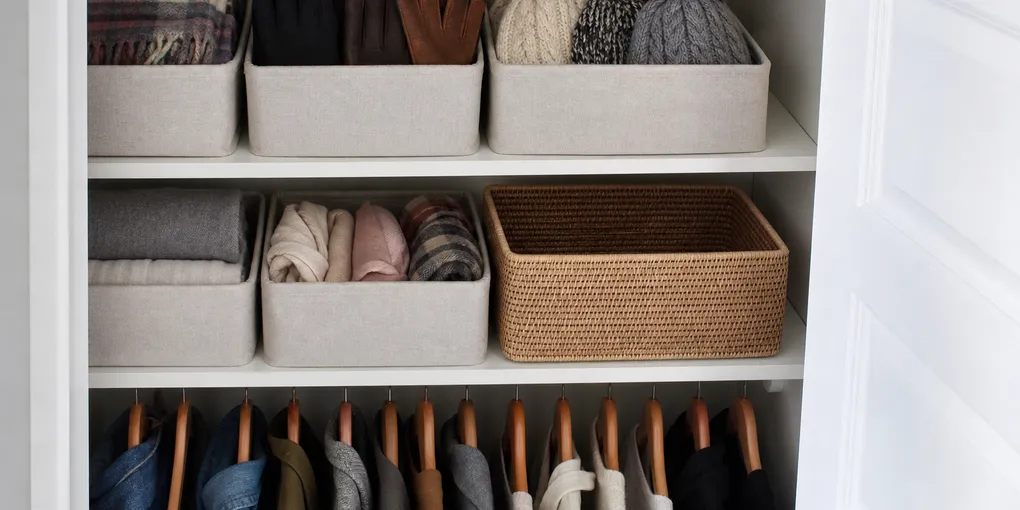
Small closets fail not because they are small, but because every season tries to live in the same line. Coats and summer pieces overlap with gift items, occasional bags, and display objects. The first signal of a resilient closet is not “everything fits.” It is the opposite: it is obvious which items are active this season, and which ones are storage-cycle items.
This protocol is a seasonal-accessory reset system. It is narrower than a full wardrobe rotation because the target is less storage volume and more retrieval clarity.
Why accessories crowd small closets early
Seasonal accessories are high-friction to decide and low-friction to leave in place. People keep an item “just in case,” then cannot find what they use each day.
For this reason, the reset starts with only five accessory categories:
- Shoes and seasonal footwear
- Scarves, gloves, and beanies
- Outerwear accessories (belts, hats, gloves sets)
- Travel/school-day bags
- Event or holiday-use decor and accessories
Everything else has a different home for now.
Decide a hard active set
Before touching bins, define an active set for the current season:
- What you used in the last 30 days.
- What you expect to use in the next 14 days.
- What must stay immediately retrievable.
Everything that does not meet this test becomes accessory-out-of-season storage.
If your active set is larger than your closet doorway, the closet has no rotation system; it has a storage problem.
Set up three visibility zones
Zone 1: Daily Access
Keep only active accessories in low shelves and top-level hooks. This zone is used first, every day, and should be impossible to miss.
Zone 2: Out-of-Season Holding
Use labeled bins for accessories that are seasonally parked but should return next year. Label by season, not by “general closet bin.”
Zone 3: Deferred Archive
One controlled location for uncertain items: gifts, seasonal décor accessories, and pieces that are out of service but not obviously donated.
Do not run Zone 3 as an emotional holding tank.
The 20-minute weekend reset
Use one fixed weekend block each quarter:
- Empty shelf one side to floor with category bins.
- Mark each item “active” or “deferred” in 30 seconds each.
- Move deferred accessories to a consistent bin line.
- Rebuild active shelves with only current-season essentials.
The block resets physical visibility and forces clear boundaries. If this step takes two hours, you are handling more than one problem at once.
Category-specific storage rules
Footwear and seasonal shoes
Store season-matched footwear in breathable containers near the closet floor, but not where they block a frequently used path. If shoes are stacked too deep, retrieval breaks within minutes.
Knitwear and soft accessories
Keep one layer in active view for quick use. Use vacuum compression for high-volume, low-issue items if space requires. Avoid compressing delicate outerwear.
Coats and outerwear components
Route collars, suspenders, and coat accessories into one shallow hang or shelf with one visual check point. Mixed storage causes repeated “where is it?” loops.
Bags and totes
Only keep the one set of active bags needed for near-term routines. Off-season bags should be in out-of-season storage with a fixed return date.
Decision checks before buying new storage
Do not buy bins just because shelves look neat. Check these thresholds first:
- Can every active accessory be found within 30 seconds?
- Does the active zone require opening more than two containers for routine departures?
- Do deferred items have a return date and a person assigned to inspect them?
If you fail multiple checks, add a physical container only after removing unused items.
Two common mistakes in seasonal resets
Mistake 1: Rotating once and forgetting follow-up
Most resets work for three days. The problem returns because no owner checks the active/deferred split again.
Mistake 2: Ignoring children’s access
If children cannot find their active seasonal items quickly, they will create their own overflow on desks and entrances.
Mistake 3: Letting “maybe someday” items stay in closet
One-time-use categories without usage data should leave. They either return for reuse by seasonal milestone or move to donation.
Minimal evidence checklist
This protocol is effective when:
- Active zone retrieval is fast.
- Out-of-season items have labeled bins and assigned owners.
- Deferred items do not block daily routines.
Track these three measures for two cycles; if they improve, the reset is stable.
Family workflow and seasonal deadlines
Most closets fail during transitions, so lock two calendars:
- A departure calendar for seasonal season changes.
- A donation calendar for out-of-season items after three months of nonuse.
Write owner and return-date on each zone label if household members are inconsistent. A family-level assignment is more effective than adding extra bins because it reduces decision disputes.
Avoid running this reset as a “once per year and forget” project. If summer pieces remain in winter zones for more than two weeks, the system is back to hidden storage.
Use an emergency pass when a closet door is blocked: remove one low-value item type immediately (often bags, novelty decor pieces, or low-use event items), then rebuild the active zone before adding replacements.
Store off-season accessories by category, label each container clearly, and leave room for the next weekly return.
Related Clutter Science support pages
Sources
- EPA or trusted home-storage references on moisture and material storage conditions where relevant.
- CPSC guidance for securing hanging and heavy closet hardware if used.
- Regional pest and fabric-storage best practices for seasonal storage cadence.
Frequently Asked Questions
- No. Start with the top five accessory types that block daily access: scarves, coats, shoes, bags, and bedding additions.
- Out-of-season accessories should be stored in a labeled, stable environment until the first month of the next season, then reviewed against actual use needs.
- Set a hard physical limit per bin and remove items with uncertain use at each review window. Unused items should be donated, not hidden.
- They help for bulky, low-use pieces. Avoid heavy compression for structured or sensitive pieces that lose shape with compression.