Why Mail Piles Hide Bills and How to Build a Two-Minute Sorting Station
Evidence ExplainerQuick picks
| Product | Key Specs |
|---|---|
| See price on Amazon |
|
| See price on Amazon |
|
| See price on Amazon |
|
Product availability, certifications, and retailer details can change; check the current Amazon page before buying.
Mail piles grow because the stack contains too many decisions at once. One envelope is trash, another is a bill, another has personal information, another needs a signature, and another might be useful someday. When those jobs share one pile, the pile becomes easier to ignore than to process.
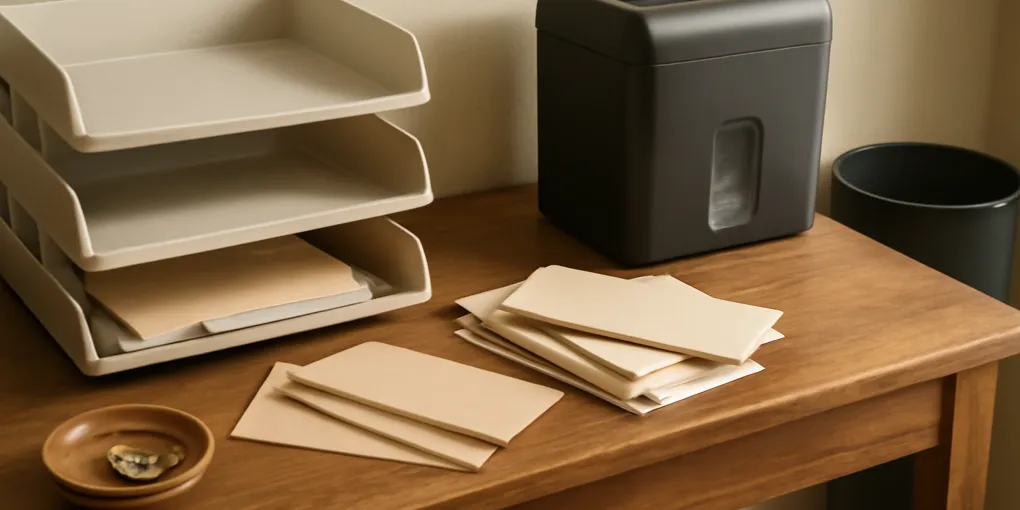
The fix is not a bigger basket. The fix is a two-minute sorting station with separate paths for action, shred, recycle, and file. If your entry table already catches keys and small essentials, connect the station to our entryway key hooks lost keys explainer so the drop zone does not become one mixed landing pad.
Product starting point
- Entry triage: Search Amazon for three-slot wall mail sorters
- Identity-risk paper: Search Amazon for small cross-cut shredders
- Bill visibility: Search Amazon for desktop mail action trays
Why the pile beats your memory
A mail pile is a mixed cue. The top envelope hides the next decision, and the whole stack gives no reliable signal about what is urgent. That is why people remember the pile exists but still miss the bill inside it.
The United States Postal Service offers Informed Delivery so households can preview incoming letter-size mail digitally (USPS Informed Delivery). That can help some people notice important mail, but it does not replace a physical decision path once envelopes enter the house.
The two-minute station
Use four destinations within arm’s reach of where mail enters the home:
- Recycle: obvious junk with no sensitive details.
- Shred: credit offers, account numbers, medical details, and personal identifiers.
- Action: bills, forms, invitations, school papers, and anything with a deadline.
- File: documents that truly need retention.
Do not add ten slots for every possible sender. The daily goal is fast separation, not perfect archiving. A three-slot wall sorter plus a shred/recycle container is usually enough.
Why shredding belongs near the mail path
Identity-risk mail is sticky clutter because it feels unsafe to toss but annoying to handle. The Federal Trade Commission recommends reducing identity-theft risk by protecting personal information and responding quickly when personal data is misused (FTC identity theft guidance). If the shredder is across the house, sensitive mail waits in the pile.
A small cross-cut shredder near the home office or mail station can shorten the loop. If you dislike owning a shredder, use a dedicated closed envelope for community shredding days. The key is that sensitive mail has a named path today.
Where bills should land
Bills should not live in the entryway sorter longer than one day. Move them to a visible action tray, bill-paying folder, or digital payment routine. The Consumer Financial Protection Bureau has bill-management resources for tracking due dates and payment obligations (CFPB bill resources). The home system should make the next bill action obvious before the due date.
One tray is better than several hidden folders if the problem is forgetting. Label it “pay or respond” if labels help, but do not let paid statements remain there as a paper archive.
Fit matrix
| Mail failure | Better product path | Avoid |
|---|---|---|
| Bills vanish under catalogs | Desktop action tray | Deep decorative basket |
| Sensitive mail waits for weeks | Small cross-cut shredder | Open pile marked “shred someday” |
| Entry table catches everything | Wall mail sorter | Oversized catch-all bin |
| Household members mix mail | Named slots or clips | One anonymous family stack |
| Receipts and coupons take over | Weekly recycle rule | Saving every offer just in case |
Placement details that decide whether it works
Put the mail station before the pile’s usual resting place, not after it. If everyone drops mail on the kitchen island, a wall sorter in a distant office will not be used. The shred path can be nearby rather than in the entryway, but it must be close enough that sensitive mail leaves the action pile the same day.
Choose containers that limit volume. A shallow action tray is useful because it looks full quickly. A deep basket hides the warning sign until bills, forms, and school papers are already mixed. If the station needs to look good in an entryway, use a slim wall sorter for triage and move the action tray to the desk where bills are actually paid.
The weekly reset
Choose one reset day. Empty the action tray, pay or schedule bills, file only documents with a real retention reason, and shred the sensitive stack. If the action tray is full every week, the issue is not the tray. It means too many decisions are bypassing the two-minute station.
For households with several adults, add names or initials only for mail that truly belongs to one person. Shared bills and school forms need a shared action path, not a private stack that nobody else checks.
Use the reset to shrink the station too. Recycle old catalogs, remove expired coupons, and file only documents that have a real future use.
Mail Pile FAQ
Is a mail basket ever useful?
Yes, if it is small and temporary. A deep basket that hides envelopes usually delays decisions instead of helping.
Should I scan all mail?
Scan documents only when you have a filing plan. Scanning everything can create digital clutter without solving payment, shredding, or recycling.
What should I do with coupons?
Keep only coupons tied to a planned purchase. Put them in a small dated pocket, not the bill action tray.
Sources
- USPS: Informed Delivery
- FTC: Identity theft guidance
- Consumer Financial Protection Bureau: Managing money and bills resources
Frequently Asked Questions
- Mail mixes decisions, trash, identity-risk paper, bills, and reminders in one stack, so the easiest short-term action is to postpone the whole pile.
- Use a small system with action, file, shred, and recycle paths. More categories usually slow the daily sort.
- Only briefly. Bills should move to a visible action tray or digital payment routine, not stay buried in the entryway stack.