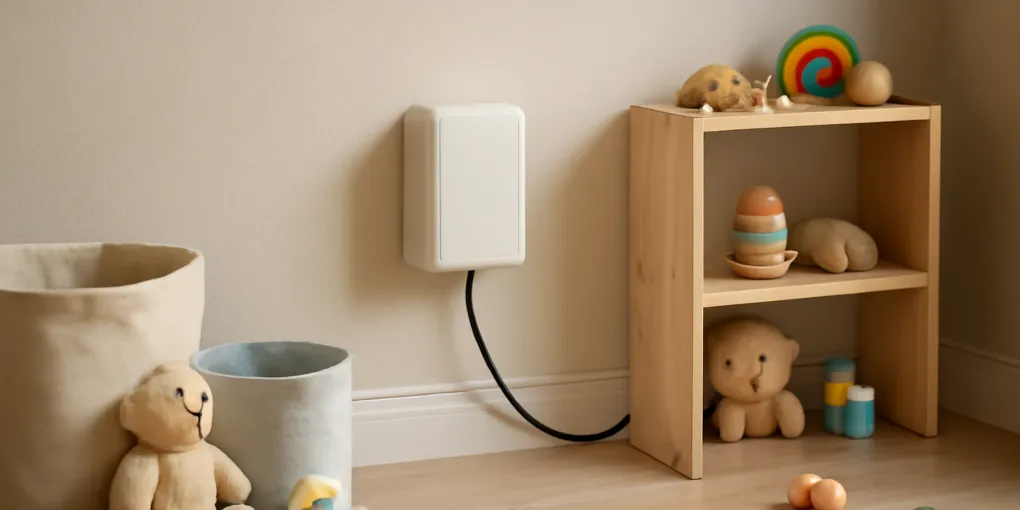
Best Outlet Cover Boxes for Playroom Cords: Child-Resistant Options That Do Not Create a Cord Nest
Buyer's GuideLectraLock-style extra-deep outlet cover box
Best for chunky plugsBest For: Night lights, monitor plugs, and adapters that need more depth than a flat cover
Quick picks
| Product | Key Specs |
|---|---|
| See price on Amazon |
|
| See price on Amazon |
|
| See price on Amazon |
|
Product availability, certifications, and retailer details can change; check the current Amazon page before buying.
Playroom cord clutter is different from desk cord clutter. The issue is not just how it looks. A cord loop near toys invites pulling, a chunky plug can keep furniture from sitting flat, and a low outlet can become part of the play area if it is not deliberately managed.
An outlet cover box can help when it solves a specific problem: a plugged-in baby monitor, sound machine, lamp, router, air purifier, or small device that must stay connected while keeping curious hands away from the plug. It is not a way to hide an overloaded power strip or make unsafe routing acceptable. For related resets, see our toy small parts quarantine bin protocol and best cable management boxes for home office desks.
Quick picks
- Best for deep plugs: Search Amazon for LectraLock deep outlet cover boxes
- Best for one cord with slack: Search Amazon for outlet covers with cord shorteners
- Best for utility-style setups: Search Amazon for in-use outlet covers
The right product depends on the plug, the cord path, and the child-access problem. If the outlet is behind a heavy bookcase that already blocks access, the cover box may be unnecessary. If the outlet sits beside a toy shelf with a dangling cord, the cover must be paired with cord routing and a shorter loop.
What an outlet cover box can and cannot do
The American Academy of Pediatrics recommends childproofing homes by looking at outlets, cords, small objects, furniture, and other hazards from a child’s point of view. Electrical Safety Foundation International safety materials also warn against misusing extension cords and overloaded power setups. A cover box sits inside that broader safety picture.
A good cover box can:
- Reduce direct access to the plug face.
- Keep one plug from being casually pulled out.
- Give a cord a cleaner exit path.
- Make the outlet zone look intentional enough that adults notice when it changes.
It cannot:
- Turn a damaged cord into a safe cord.
- Make an extension cord permanent wiring.
- Hide a power strip that should not be in a play zone.
- Fix furniture tip-over risk or a climbable shelf.
How to choose the box depth
Depth is the first buying filter. Many playroom devices use blocky adapters that stick out farther than a standard plug. Measure from the wall plate to the front of the plug while it is inserted. Add space for the cord bend. If the cord must kink sharply to fit the cover, choose a deeper box or move the device.
Extra-deep boxes are useful behind shelves, but they can also create a tempting bump on the wall. If the cover protrudes where toys, knees, or ride-on cars hit it, reroute the device instead of forcing a box into that location.
Cord exit and slack control matter more than the lid
A snapped cover looks reassuring, but the cord tail is what children see. The safest-looking installation can still leave a loop on the floor. Look for a cover with a smooth cord exit path and pair it with clips, a cord channel, or furniture placement that keeps the cord from becoming a handle.
For a single low-power device, a cover with a cord-shortening area can reduce slack. Do not stuff long coils into a tiny box. If there is too much cord, move the device, use a safer length where appropriate, or route the extra length high and out of play.
Product fit matrix
| Cover type | Best use | Watch-out |
|---|---|---|
| Extra-deep outlet box | Chunky adapters and always-plugged devices | Protrudes farther into the room |
| Outlet cover with cord shortener | One cord with moderate slack | Not for power strips or high-draw clusters |
| Sliding plate cover | Empty outlets near toys | Does not protect a plugged-in adapter |
| In-use style cover | Utility crossover setups | Must fit the room, outlet, and product rating |
Installation checks before you buy
Measure the actual outlet, not the empty wall space around it. Start with the wall plate style and whether the product replaces the plate screws or snaps over the existing plate. If the cover needs the center screw of a traditional duplex plate, it may not fit a decorator-style receptacle without a different model. If you rent, check whether replacing the wall plate is allowed and keep the original plate in a labeled bag.
Then measure the plug while it is inserted. A straight plug, right-angle plug, transformer block, USB adapter, and smart plug all occupy different depths. Add the bend radius of the cord, because a cover that technically closes while crushing the cord is the wrong cover. If the cord exits sideways, check whether the cover has a side channel. If it exits downward, make sure the channel does not aim the cord directly into a toy basket or walking path.
Finally, test the furniture layout. The cover should not become the thing that keeps a bookcase from sitting flat. It also should not be the only barrier between a child and an unstable shelf. If furniture is part of the safety plan, anchor it appropriately and keep climbable toys away from the outlet zone.
Product scenarios
A nursery sound machine usually needs a deep cover box and a short cord path behind furniture. A playroom lamp may be better moved to a switched wall outlet or higher shelf instead of protected at floor level. A router or mesh Wi-Fi puck should not be buried in a closed cover if the device needs ventilation or a clear signal path. A small air purifier may draw more power than a toy charger, so check the device manual and outlet load instead of assuming any cover is compatible.
For seasonal setups, such as a train table, projector, or holiday toy display, treat the cover as temporary cord control. Remove it when the device leaves. A permanent cover around a temporary cord often becomes forgotten clutter, and forgotten cord clutter is the setup children eventually tug.
What to avoid
Avoid covers that require a hard cord bend, leave a large finger gap, or depend on adhesive alone when the child can pull the cord. Avoid using an outlet cover box to conceal a daisy chain of extension cords. Avoid placing a covered outlet directly behind a climbable shelf without anchoring the furniture appropriately.
Also avoid buying by a vague “childproof” label without checking installation. Some covers replace the wall plate with screws. Others snap over an existing plate. Some are too shallow for transformer plugs. The boring measurements matter more than the product photo, especially in rooms where children play close to the floor.
Best fit by room layout
| Room layout | Better choice | Why |
|---|---|---|
| Outlet behind a crib, dresser, or bookcase | Move the device or use a deep screw-mounted cover only after checking clearance | Pressure from furniture can stress plugs and cords. |
| Outlet beside a toy shelf | Deep cover plus cord clips leading upward or behind furniture | The cord tail is usually the pull target. |
| Empty outlets in a crawling zone | Sliding plate or tamper-resistant outlet approach where appropriate | A plugged-in cover box is unnecessary for empty receptacles. |
| Temporary play table cord | Short-term routing and adult takedown after use | Temporary cords should not become permanent room wiring. |
This is also where a buyer should skip the purchase. If the room needs a power strip, multiple chargers, and extension cords to make the play setup work, the safer answer may be moving the electronics out of the play zone, adding a properly located outlet through a qualified electrician, or reducing the devices in the room.
How we evaluate outlet cover boxes
| Factor | Weight | What matters |
|---|---|---|
| Access reduction | 30% | The plug and receptacle are harder for a child to reach. |
| Cord routing | 25% | The cord exits cleanly without a pull loop. |
| Fit | 20% | The cover clears the actual plug and furniture. |
| Electrical restraint | 15% | The product is not used to hide overloads or damaged cords. |
| Cleanability | 10% | The cover does not become a dust-caked toy shelf corner. |
FAQ
Are outlet plugs enough for a playroom?
Outlet plugs can help with empty receptacles, but they do not solve a plugged-in cord. Use the product type that matches the actual hazard: empty outlet, plugged-in adapter, cord slack, or power strip location.
Can I use an outlet cover box behind a crib or toddler bed?
Check the room layout carefully. A cover that protrudes behind sleep furniture may create pressure, access, or cord-routing problems. Follow child-safety guidance and consider moving the device or outlet use instead.
What if the device must stay plugged in?
Use the shortest practical safe cord path, reduce slack, keep the plug inaccessible, and inspect the setup after play. If children can still pull the cord, the cover is not enough.
Sources
- HealthyChildren.org childproofing guidance: https://www.healthychildren.org/English/safety-prevention/at-home/Pages/Childproofing-Your-Home.aspx
- Electrical Safety Foundation International extension cord safety: https://www.esfi.org/extension-cord-safety-tips/