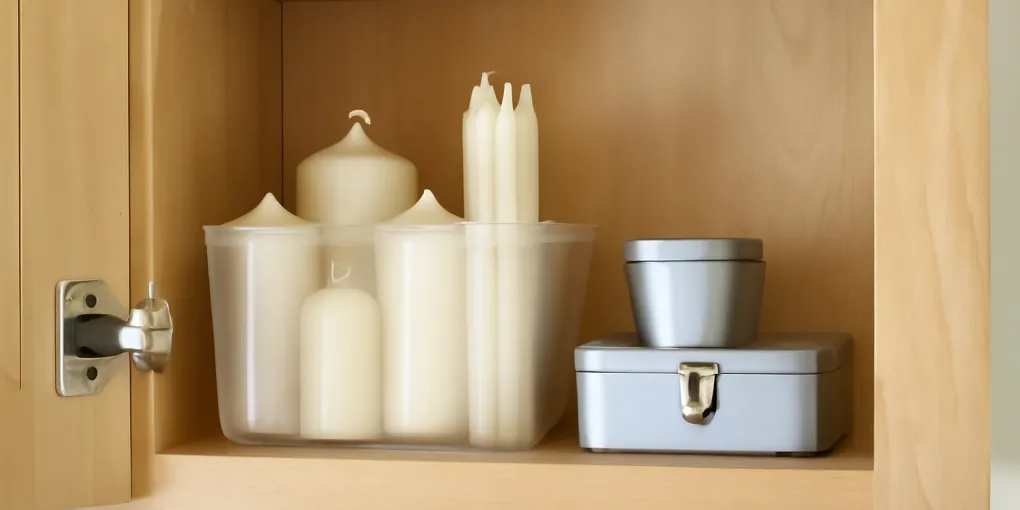
Candle and Match Storage: A Small Fire-Safety Reset for Cluttered Cabinets
Evidence ExplainerQuick picks
Lidded candle storage bin
★ Top pick Best for spare candles- Why consider it: Keeps tapers, votives, and seasonal candles grouped so they do not roll through linen or decor cabinets.
Metal match storage tin
Best for separating ignition sources- Why consider it: Gives matches a closed, dry home away from loose paper, children, and candle wax scraps.
High cabinet child-safety latch
Best for child-access control- Why consider it: Adds a barrier when matches, utility lighters, or scented candles are stored in a home with young children.
Candle clutter looks harmless because the objects are small and pretty. The risk is the mixed pile: matches, utility lighters, half-used jar candles, tissue wrap, holiday ribbon, spare tapers, and decorative holders all sharing one cabinet.
A safer candle zone separates fuel, flame, and clutter. Candles need stable storage. Matches and lighters need controlled access. Paper and textiles need to stop living in the same loose heap.
If your broader seasonal storage is chaotic, start with holiday decoration storage boxes or Christmas ornament storage. This reset is narrower: candles and ignition sources.
Quick picks for the candle zone
- Best spare-candle container: lidded candle storage bin for tapers, votives, and seasonal candles.
- Best ignition-source control: metal match storage tin or another closed dry container for matches.
- Best child-access layer: high-cabinet child-safety latch when young children visit or live in the home.
- Skip if: the container encourages you to store matches loose with paper napkins, ribbons, or holiday tissue.
Why candle clutter deserves a separate rule
The National Fire Protection Association reports that candles are involved in thousands of home structure fires, and its candle guidance emphasizes keeping candles away from anything that can burn and blowing them out before leaving a room. Storage is not the same as active burning, but storage affects whether the burning setup is safe later.
When candles live with paper decor, matches, and random lighters, the household gets used to treating flame supplies as ordinary clutter. That makes it easier to light a candle on a crowded shelf, lose the right lighter, or leave matches where a child can reach them.
Safe Kids Worldwide also warns that matches and lighters should be kept out of children’s reach. A candle organizer is therefore not just about visual order. It is about separating attractive flame tools from casual access.
The three-bin rule
Use three categories:
- Candles and holders.
- Ignition sources.
- Decor and paper.
Candles and holders may share a lidded bin if the bin is not overloaded. Search for lidded candle storage bin (check current options on Amazon) and choose one shallow enough that glass jars do not stack dangerously.
Matches and lighters need a separate closed container. Search for metal match storage tin (compare current options on Amazon) if loose matchbooks currently drift through drawers. Store the container high and dry.
Decor and paper should not share the ignition-source container. Tissue, ribbon, garland, and napkins belong in their own decor bin.
What to remove first
Remove cracked candle jars, candles that tunnel so badly they cannot burn evenly, broken holders, dried-out matchbooks, and novelty lighters that nobody can operate safely. Also remove scent duplicates you consistently avoid. A cabinet full of disliked scents is not preparedness; it is storage debt.
Check each jar for stability. If a jar is chipped, cracked, or too hot during normal use, do not keep it in the active candle zone. The storage reset should reduce the number of questionable items available for future use.
Child-access and guest-access check
If children live in or visit the home, matches and lighters should be out of reach and preferably behind a barrier. Search for cabinet child safety latch (browse current options on Amazon) if the current candle cabinet is low or easy to open.
Do not rely on a pretty box on a coffee table. Matches, lighters, and novelty candles are interesting objects. Store them where a curious child cannot casually handle them.
Guest access matters too. If guests are expected to light bathroom or dining candles, put one appropriate lighter in a known adult-access spot instead of making people search through a cluttered cabinet.
Fit matrix
| Storage problem | Better choice | Avoid |
|---|---|---|
| Tapers roll around a shelf | Shallow lidded bin | Tall mixed decor tote |
| Matchbooks scatter in drawers | Closed metal tin | Loose match pile |
| Young children visit | High storage plus latch | Coffee-table match display |
| Holiday candles mix with tissue | Separate candle and paper bins | One flammable decor heap |
| Half-used jars crowd the cabinet | Keep only stable favorites | Saving every wax stub |
The five-minute reset
- Pull every candle, lighter, matchbook, holder, and wax accessory into one workspace.
- Discard broken, unstable, or unwanted items.
- Separate candles from ignition sources.
- Move paper decor to a different bin.
- Put matches and lighters high, dry, and closed.
- Return only candles with stable containers and usable wicks.
- Put the active lighter in one adult-known place.
This small reset prevents the cabinet from becoming a flammable junk drawer.
Candle and match FAQ
Can I store candles in a linen closet?
You can store unused candles near linens only if ignition sources are separate and the candles are contained. Do not store matches, loose lighters, tissue, and wax scraps together in the linen closet.
Is a decorative match striker safe to leave out?
It depends on access. In a home with children, pets, or frequent visitors, a decorative striker can become an attractive ignition source. Store matches out of reach.
How many candles should I keep?
Keep the number you can store upright without stacking glass jars or burying matches. If the bin is full, use or donate safe unopened extras before buying more.
Sources
- NFPA candle safety — supports keeping candles away from burnable materials and using candle safety rules.
- Safe Kids Worldwide fire safety tips — supports storing matches and lighters out of children’s reach.
Reader test
A reader can separate candles, matches, and paper decor today; choose a lidded candle bin, metal match tin, or child-safety latch; and remove cracked jars or wax stubs. The article is specific to candle clutter because it addresses tapers, matchbooks, utility lighters, scent duplicates, wax scraps, and child-access ignition risk.
Frequently Asked Questions
- Store matches and lighters high, dry, and out of children's reach, preferably separated from loose paper, wax scraps, and crowded decor bins.
- They can live in the same general zone, but ignition sources should be in their own closed container so they are not loose among candles, tissue, ribbons, or linens.
- Keep only candles you will actually burn safely. Discard cracked glass, unstable jars, tiny wax stubs, and candles with damaged wicks.