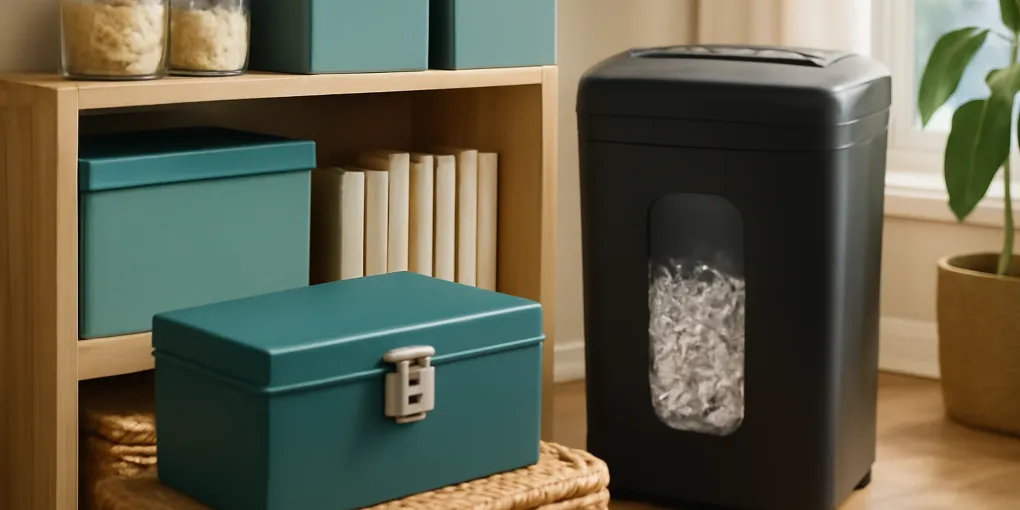
Paper Shredder Bin vs Locked Document Box: Which Stops Paper Piles?
Buyer's GuideCompact cross-cut shredder with pull-out bin
Best for weekly disposalBest For: Expired statements, junk mail with account details, and routine paper purge sessions
$45-120
Quick picks
| Product | Key Specs |
|---|---|
| See price on Amazon |
|
| See price on Amazon |
|
| See price on Amazon |
|
Product availability, certifications, and retailer details can change; check the current Amazon page before buying.
Paper piles often mix three very different jobs: papers to keep, papers to decide, and papers to destroy. A shredder, locked document box, and inbox tray are not competitors. They are stops on a paper route.
The problem is buying one tool and asking it to do all three jobs. A shredder cannot protect passports you still need. A locked document box becomes useless when it fills with pizza coupons. A desktop inbox becomes a paper swamp when nothing leaves it.
If your counter already has unsorted mail, pair this comparison with the mail triage station protocol. This guide focuses on which paper product should handle each risk.
Quick picks
- Best for routine disposal: Search Amazon for compact cross-cut shredders with a bin you can empty without spilling strips.
- Best for originals: Search Amazon for locked document boxes sized for folders, not loose stuffing.
- Best for decisions: Search Amazon for desktop paper inbox trays when the tray is cleared on a schedule.
The core difference
A paper shredder is an exit. It is for documents that should leave the house in unreadable form: old statements, expired insurance cards, credit-card offers, medical billing copies, and mail with account numbers. Choose a cross-cut model rather than a strip-cut model for ordinary home privacy because the pieces are harder to reconstruct.
A locked document box is a retention zone. It is for originals and records that need protection from casual access, loss, or a messy drawer. It should not be the first stop for daily mail. If everything goes into the box, important papers become harder to find.
A desktop inbox is a waiting room. It should hold only papers that need a near-term decision: pay, scan, sign, call, file, or shred. The inbox needs a weekly emptying rule or it becomes a decorative stack.
When to buy a shredder
Buy a compact cross-cut shredder if your paper pile includes account details, old medical paperwork, expired statements, or mail you hesitate to throw away intact. Search for compact cross-cut paper shredder pull-out bin (check current options on Amazon) and compare sheet capacity, run time, bin access, and safety features.
The pull-out bin matters more than people expect. If the shredder is messy to empty, shredded paper overflows, and the household stops using it. For small spaces, a lighter shredder that is easy to empty can beat a larger machine that never leaves the closet.
Do not use a shredder as a storage basket. If papers sit on top waiting for a “big shred day,” the disposal step is too hard. Put a small shred basket beside the machine and empty it weekly.
When to buy a locked document box
Buy a locked document box when your home lacks one protected spot for originals: passports, birth certificates, Social Security cards, titles, current insurance paperwork, estate documents, and tax records inside the retention window. Search for fire resistant locked document box (compare current options on Amazon) and check interior folder fit, lock type, weight, and whether the fire rating matches your expectations.
A document box is not a safe-deposit box, and a budget fire-resistant box is not magic. The point for clutter control is boundary setting. The box should hold documents you would be stressed to lose, not every school flyer or appliance manual.
If the box is heavy, store it low. If it is too small for folders, it will force papers into curled piles. If it uses a key, decide where the key lives before you need it.
When an inbox tray is enough
A desktop paper inbox works when the issue is decision delay rather than sensitive storage. Search for desktop paper inbox tray mail organizer (browse current options on Amazon) and choose a tray that holds one week of paper, not three months.
The tray needs a rule printed in your head: empty every Friday, or when the tray reaches the top rail, whichever comes first. If the tray is allowed to stack indefinitely, it simply makes paper piles look intentional.
Fit matrix
| Paper problem | Best tool | Avoid |
|---|---|---|
| Old statements with account numbers | Cross-cut shredder | Recycling intact |
| Passport or birth certificate | Locked document box | Shredder or desktop pile |
| Mail waiting for a bill decision | Inbox tray | Permanent archive box |
| Tax support documents in retention period | Labeled folder in locked box | Loose shred pile |
| Coupons and envelopes with no sensitive data | Recycling bin | Document box clutter |
Security and safety notes
The Federal Trade Commission recommends protecting personal information because identity thieves can use data from mail, accounts, and records. For a home paper system, that means separating documents with account, identity, medical, tax, or financial details from ordinary recycling.
Keep shredders away from children, pets, loose clothing, and long hair. Empty the bin before it jams. Follow the manufacturer’s run-time limits; overheated small shredders are common when a household saves months of paper for one session.
Buying criteria that matter
For a shredder, check four details before buying. First, choose cross-cut or micro-cut rather than strip-cut if the papers contain account details. Second, check the bin style. A pull-out bin is usually cleaner than a lift-off shredder head because you are not balancing a heavy motor over loose paper strips. Third, check run time and cooldown time. A small shredder that runs for a few minutes is fine for weekly mail, but frustrating for a neglected file cabinet. Fourth, check whether it can handle staples, credit cards, or envelopes only if those are part of your real paper stream.
For a locked document box, measure folders, not just outside dimensions. A box that cannot hold letter-size folders flat will turn originals into curled stacks. If the box claims fire resistance, read the rating carefully and decide whether you are buying organization, casual access control, or disaster protection. Those are different expectations.
For an inbox tray, capacity should be deliberately limited. A tall stacker with five trays often creates five paper piles: bills, school, medical, tax, and mystery. One current-action tray plus labeled archive folders is easier to maintain.
What each tool should never hold
A shredder should never hold documents you might need to prove identity, ownership, insurance, or tax history. When in doubt, put the paper in a temporary review folder and decide during the weekly paper route.
A locked document box should never hold daily coupons, old envelopes, appliance manuals you can find online, or every receipt from the month. Those papers make the box bulky and train you to avoid opening it.
An inbox tray should never hold sentimental papers, tax archives, or months of medical claims. If it takes more than one short session to clear, it is no longer an inbox; it is an unsorted archive.
Placement in a real room
Put the shredder close enough to the mail zone that a sensitive envelope can be destroyed during the same session, but not in a hallway where the open bin becomes a trip hazard. Put the document box on a low shelf if it is heavy. Put the inbox tray at the point where mail enters the home, not in a back office nobody visits. The route should match the paper path: enter, decide, retain, destroy, or recycle.
If two adults manage papers, assign one shared weekly clear-out time. Duplicate trays often create duplicate uncertainty.
A 15-minute paper route
- Put the shredder, inbox, and document box in or near the same paper zone.
- Open mail over recycling.
- Recycle envelopes and inserts that contain no sensitive information.
- Put decision papers in the inbox.
- Put originals and keep-records in labeled folders inside the locked box.
- Put destroy papers into the shred basket.
- Shred the basket before it exceeds the shredder’s comfortable capacity.
This route pairs well with the paperwork command center protocol if multiple people add papers to the same counter.
Paper security FAQ
Do I need a micro-cut shredder?
Micro-cut shredders make smaller pieces, but they usually cost more and can be slower. For many homes, a reliable cross-cut shredder used consistently is more useful than a high-security model that is annoying to empty.
Should receipts go in the locked box?
Only receipts tied to taxes, warranties, returns, or insurance claims need short-term retention. Everyday receipts should not live in the locked box indefinitely.
Can I keep documents in a plastic bin instead?
A plastic bin can organize folders, but it does not provide the same casual-access barrier as a locked box. Use it only for non-sensitive archive categories.
Sources
- FTC, What to know about identity theft — supports protecting personal information and reducing identity-theft exposure.
- IRS, How long should I keep records? — supports separating tax records that should be retained from papers ready to destroy.
Reader test
A reader can choose a shredder for sensitive disposal, a locked box for originals, and an inbox tray for short decisions. This article is specific to paper security because it separates passports, tax records, account-number mail, cross-cut shredding, retention folders, and weekly shred capacity.
Frequently Asked Questions
- A shredder is better for papers you no longer need but should not toss intact. A locked document box is better for originals and records you must keep. Most homes need clear rules for both.
- Do not shred originals you may need later, such as passports, birth certificates, vehicle titles, current insurance policies, and active tax support documents. Store those in a labeled secure box.
- Put it near the mail triage area or home office, close enough to use weekly but not where kids can treat it like a toy or where the bin blocks a walkway.