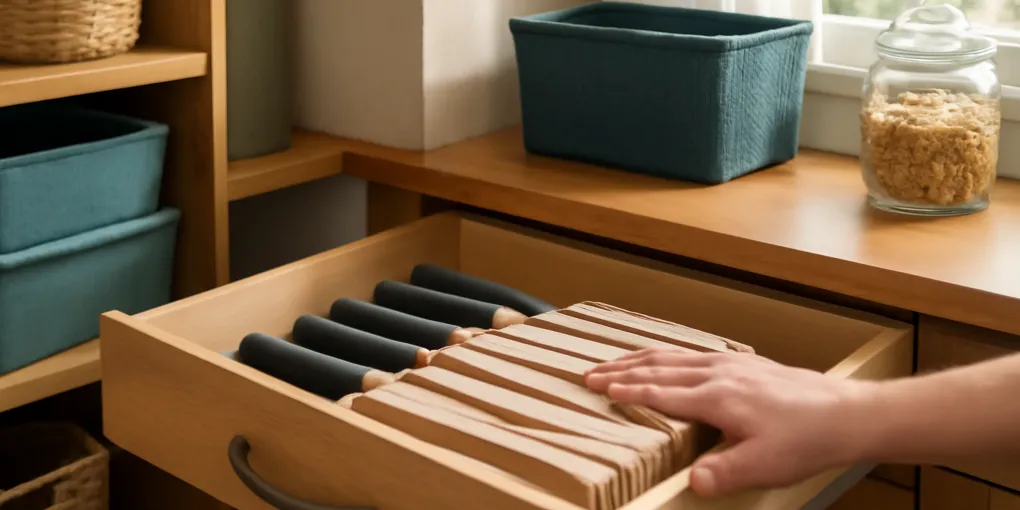
Drawer Knife Block Safety Protocol: Store Sharp Knives Without a Counter Block
ProtocolQuick picks
In-drawer bamboo knife block
★ Top pick Best counter-clearing option- Best For: Households moving knives off the counter while keeping blades separated
- Caveat: Measure drawer depth and handle height before buying
Individual knife blade guards
Best flexible option- Best For: Odd-size knives, renters, or drawers that cannot fit a block
- Caveat: Guards must fit snugly and still be easy to remove safely
Drawer child-safety latch
Best access control- Best For: Homes with children or frequent visiting children
- Caveat: A latch reduces access; it does not make loose blades safe
A drawer knife block can reclaim counter space, but it has to be treated as a sharp-tool system, not just a pretty insert. The protocol is simple: separate the blades, control the drawer, and make the knife you use most often easy to remove without reaching over another edge.
For broader kitchen reset work, see our nightly kitchen counter reset. This article focuses on the sharper problem: knives that should not rattle in a drawer or sit in a bulky counter block by default.
Quick picks
- Main storage: Search Amazon for in-drawer bamboo knife blocks when one drawer has enough depth and handle clearance.
- Odd knives: Search Amazon for knife blade guard sets when a block cannot fit every blade.
- Access control: Search Amazon for kitchen drawer safety latches when children can reach the drawer.
Do not move knives into a drawer until each blade has a slot, sheath, or guard.
Step 1: choose the right drawer
Pick a drawer that opens fully, does not wobble under weight, and is not the default junk drawer. A knife drawer should not share space with loose peelers, scissors, birthday candles, tape, or takeout packets. Mixed drawers teach hands to rummage. Knife drawers should teach hands to look first.
Measure interior width, depth, and height. Height matters because knife handles can catch the drawer frame even when the block itself fits. Put the tallest knife in the proposed slot, then close the drawer slowly before committing.
Step 2: separate every cutting edge
A safe drawer setup keeps blades from touching hands, other blades, or loose utensils. An in-drawer block is the cleanest option when the knife set is predictable. Blade guards are better when you own a few odd knives or need a flexible renter setup.
Avoid loose knives wrapped in towels or pushed into a plastic bin. Towels hide edges, bins let knives shift, and both systems break down when someone unloads the dishwasher quickly.
Step 3: set the access rule
HealthyChildren kitchen-safety guidance recommends keeping sharp objects out of children’s reach. For many homes, that means the knife drawer needs either a higher location, a drawer latch, or a rule that knives stay in a controlled adult-use zone.
A latch is not a substitute for covered blades. It is an access layer. The blade layer still has to work when an adult opens the drawer half-asleep, while cooking, or while someone else is talking nearby.
Fit checks that matter
Compare this protocol by fit, evidence, value, owner friction, and clear product limits.
| Fit check | Buyer question | Knife-drawer interpretation | |---|---| | Fit and safety | Strong when the layout reduces rummaging and keeps sharp tools assigned to one controlled zone. | | Verifiable details | Kitchen-safety guidance directly supports separating sharp objects and controlling child access. | | Value and capacity | High when a modest insert clears a counter block without making the drawer riskier. | | Daily friction | Common failures are handles that catch, slots that fit only short knives, and blocks that slide. | | Listing clarity | Product pages should show slot count, maximum blade length, drawer dimensions, and material finish. |
Step 4: load by handle visibility
Put the most-used chef’s knife, paring knife, and serrated knife where their handles are easiest to see. Do not bury the small sharp knife behind steak knives just because the slot pattern suggests it.
Keep handles aligned in one direction. Mixed handle directions slow removal and make it easier to brush against another blade. If a knife does not fit a slot without forcing, use an individual guard or store it elsewhere.
Step 5: keep the drawer dry and inspectable
Dry knives before returning them to a wooden or bamboo insert. Moisture can stain the insert, swell unfinished wood, and make residue harder to clean. Remove crumbs and drawer dust monthly so the slots do not become a hidden debris trap.
If the drawer gets sticky or cluttered, reset it immediately. A knife drawer should have fewer categories than almost any other kitchen drawer.
When a drawer block is the wrong answer
Skip the drawer block if your only available drawer is low and reachable by young children, if the drawer glides are weak, or if the drawer already holds too many cooking tools. A magnetic strip, locked storage, or a smaller knife set may be safer than forcing a block into the wrong location.
Also skip it if your knives are too long for the slot depth. A blade tip pressing against wood or a drawer back is a fit problem, not a minor inconvenience.
Knife-drawer safety questions
Can steak knives go in the same drawer block?
Yes, if they have dedicated slots and do not crowd the main prep knives. If steak knives make the insert cramped, use a separate covered tray or blade guards.
Is a bamboo drawer block safer than plastic?
Material matters less than fit, stability, and blade separation. Bamboo can look better and feel rigid, but a plastic tray with correct slots is safer than a loose bamboo block that slides.
Do blade guards replace a drawer latch?
No. Blade guards cover edges; a latch controls access. Homes with children may need both, or a higher storage location.
Sources and safety notes
- HealthyChildren kitchen safety guidance includes keeping knives and sharp objects out of reach: https://www.healthychildren.org/English/safety-prevention/at-home/Pages/Kitchen-Safety.aspx
- This protocol emphasizes visible handles, covered blades, and drawer access control because knife storage fails when users have to rummage around hidden edges.