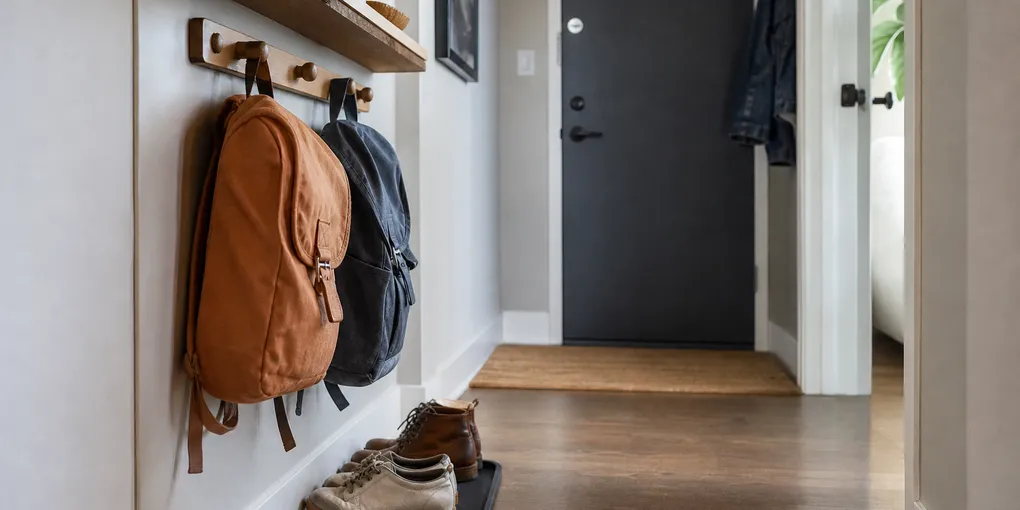
Entryway Backpack Landing Zone Protocol for Small Homes
ProtocolAn entryway can hold a lot of routines. It cannot hold unlimited “quick return” behavior. Backpacks and daily carry items are a perfect example: every family wants one place to dump them, but every home has different route pressure.
This protocol is for small entryways where every square foot must be explicit.
The rule for small entryways
If a bag in the morning requires two extra actions to come back from the floor, your lane has failed.
The lane has three obligations:
- Keep the walking path clear.
- Keep each family member’s return action obvious.
- Keep overnight food, water bottles, and paper separate from bags that need emptying.
You can add more products only after these three obligations hold for one full week.
Build the lane in one pass
1) Assign landing points before buying
Pick three landing points only:
- Bags (daily use): one wall point per core user.
- Footwear transition: tray or shallow rack.
- Food or liquid overflow: a temporary holding point near kitchen access.
If you add a storage bin before these three points, the system becomes decorative and collapses into overload.
2) Match heights to users
Hooks and racks are often set for adults, but the highest friction point is usually the child who owns the bag. If a child cannot return their bag cleanly, the bag lands on floor tiles and enters the lane.
Use one hook height that each primary user can use without stepping back. If adults have much larger bags, use a second level only if path width remains clear.
3) Route food and liquids out of bag zones
Lunch bags, sports bottles, and snacks should move to a visible but separate lane within minutes of arrival. A bag without immediate separation is now both carrier and clutter hub.
Use a washable bin near kitchen entry for food items, then return to a shelf or bin.
Daily reset flow
Use this three-step flow:
- Unload all bags from the floor immediately and send lunch containers and paper documents to separate lanes.
- Put each bag on its assigned hook/slot before shoes or coats are touched.
- Remove all daytime carry leftovers from shoes, hooks, and trays before the home office or kitchen window.
Repeat this flow at least once each evening. Without repetition, the system only looks right in photos.
Why this matters for small households
In compact homes, the entry is frequently the final transfer node for mail, bags, packages, shoes, and quick departures. Any object that blocks this node blocks the house.
The protocol works because it makes one behavior default:
- Bags return to hooks, not floor.
- Food exits bag zone the same day.
- Sport/seasonal bulky gear goes to a separate room.
That creates a stable daily rhythm even in rushed mornings.
Common lane failures
Failure mode 1: The “shared all-purpose basket”
Large shared baskets absorb every item. They solve visibility for three minutes and produce floor congestion the rest of the day.
Failure mode 2: Hook count inflation
If you add a hook for every possible bag, you have likely widened the system beyond actual daily use. Use one per active bag and one exception slot for guests.
Failure mode 3: Wrong height and wrong direction
High hooks or doorside routes require stepping, pulling, and holding multiple objects. In a narrow space, the user will choose the floor.
Measurement before replacement
Before you replace furniture, measure:
- Walking width from wall to open door.
- Hook-to-wall clearance for opening a front door.
- Number of bags arriving by 7:30 AM.
If the measured flow exceeds your current lane width, route one category elsewhere first rather than buying a larger fixture.
Two-week no-buy validation
For 14 days, only keep:
- Hooks or one lightweight rail
- One narrow shoe tray
- One food carry-out point
Track how many times items leave the lane before being put on the path. If it remains frequent after two weeks, the route—not the storage—is the issue. Adjust locations, not inventory.
What this looks like after one month
After a month, a stable landing protocol has two clear benefits:
- One predictable morning startup where entryway load is visible in under one minute.
- One predictable evening end where no bag remains in the lane after the clean-out step.
If bags still stack on the floor, run a micro-reset with one question:
- Which one user is using a different route from everyone else?
- Is your food return path too long?
- Is one sports or holiday item category quietly overfilling the lane?
If one answer repeats for three days, change that one variable first.
Real-world adjustment example
A busy household may have one week where one user carries two large bags and one child has a snack bag. If the snack bag becomes the overflow point, test this 24-hour adjustment:
- Keep the snack bag in the kitchen lane for the day.
- Use one dedicated hook slot for active school bags only.
- Move non-daily bags to a secondary zone in the garage or utility closet before arrival.
This is not failure; it is a volume test. If that test repeats during ordinary weeks, shrink the daily active target, not the lane shape.
Related reading and support links
- Why backpack drop zones become trip hazards
- Entryway drop zone small apartment setup
- Entryway drop-zone system
Sources
- CDC fall prevention guidance on home trip and slip risk.
- Safe Kids and child-height access standards for household routines.
- U.S. Consumer Product Safety Commission advice around home fixture installation and load requirements.
Frequently Asked Questions
- Usually because the first legal landing point is not obvious, too low, too high, or too far. If returning the backpack is one extra step, floor landings become the default.
- Use a bench only when it does not reduce the walking lane. In narrow entries, wall hooks or a slim hook rail is often safer.
- Keep sports and heavy gear out of the daily entry lane and route it to a garage, closet, or secondary station. The entryway should only hold today's carry and immediate departure tools.
- Ideally at the point of entry from the backpack lane, so food remains out of sleeping, school, and storage zones.