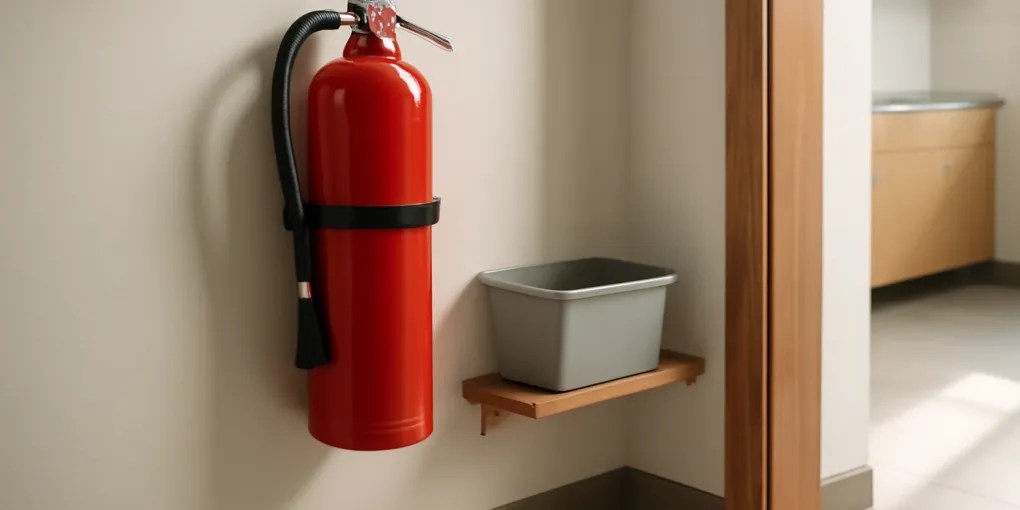
Fire Extinguisher Storage Station Protocol for Kitchens and Garages
ProtocolQuick picks
Home fire extinguisher wall bracket
★ Top pick Best visibility tool- Note: Use a bracket that fits the extinguisher model and keeps it visible near an exit path.
Small utility inspection bin
Best maintenance aid- Note: Store the flashlight, replacement batteries, and maintenance card near the safety zone, not in front of the extinguisher.
A fire extinguisher is one of the few home safety items that gets worse when it is neatly hidden. A closed cabinet can look organized while still forcing an adult to move spray bottles, grocery bags, pet food, or garage tools before reaching the extinguisher. The storage goal is not decoration. The goal is fast access, a clear exit path, and a monthly glance that confirms the extinguisher is still present and unobstructed.
This protocol is for kitchens, attached garages, laundry rooms, and utility areas where a real extinguisher already exists or belongs. It pairs the extinguisher with a simple station: a mount, a clear keep-out zone, and a small maintenance habit. For chemical separation under the sink, use the separate under-sink cleaning product separation protocol. For cords and charging clutter, see why charging drawers become fire-risk clutter.
Quick picks for a reachable station
- Mounting fix: Search Amazon for fire extinguisher wall brackets. Match the bracket to the extinguisher diameter and weight.
- Cabinet alternative: Search Amazon for fire extinguisher cabinets for home. Use only if the door stays obvious and easy to open.
- Maintenance helper: Search Amazon for small utility inspection bins. Keep inspection supplies nearby without blocking the extinguisher.
Why visibility matters more than a tidy cabinet
The National Fire Protection Association explains that portable fire extinguishers are for small fires and only when the user has a clear escape route (NFPA fire extinguisher safety). That escape-route condition changes the storage decision. An extinguisher buried at the back of the hazard zone asks someone to move toward the problem and rummage under stress.
A good station keeps the extinguisher between the adult and the exit path, not behind the likely fire source. In a kitchen, that often means near the room exit rather than directly beside the stove. In a garage, it means not hidden behind gasoline cans, cardboard, paint, or a wall of sports gear. The best station is boring, visible, and not competing with daily storage.
Step 1: choose the zone before choosing a holder
Stand in the room and identify the exit route first. The extinguisher should be reachable as you move out, not after you step deeper into the room. Avoid spots that require opening a crowded base cabinet, reaching over a hot appliance, or moving a parked stroller, laundry basket, or shop vacuum.
Use this zone test:
- Can an adult see the extinguisher without opening three things?
- Can the adult grab it with one hand while backing toward an exit?
- Does the storage spot stay dry and away from stove heat or garage damage?
- Will children be discouraged from handling it while adults can still reach it?
- Is there enough wall or cabinet clearance for the gauge and handle to remain visible?
If the answer is no, move the station before buying more organizing products.
Step 2: create a no-stack boundary
A fire extinguisher station needs empty space around it. Mark the shelf, wall, or cabinet zone with a simple rule: nothing in front of the extinguisher and nothing hanging from its bracket. Do not use the station as a hook for aprons, bags, extension cords, or reusable grocery sacks.
The clutter pattern is predictable. A bracket becomes a nearby surface. A cabinet front becomes the place for extra trash bags. A garage corner slowly grows rags and boxes. The station should reject those categories. If something is not the extinguisher or a tiny maintenance item, it does not live there.
Step 3: use the right holder for the room
A wall bracket is usually the clearest choice when the extinguisher can be mounted on a stud, solid backing, or manufacturer-approved surface. It keeps the cylinder upright and visible. A cabinet can work in a finished kitchen, but only if the door does not hide the item so well that guests and occasional caregivers cannot find it.
Under-sink storage is the most common failure. It may be acceptable for some households, but only when the extinguisher sits at the front, upright, and unblocked by cleaners. If a pull-out tray, trash bags, dishwasher pods, or plumbing items crowd the area, move the extinguisher to a clearer station.
Step 4: separate it from flammables and confusion items
Do not place the extinguisher in the same bin as matches, candles, lighters, aerosol cans, oily rags, paint products, or fuel containers. Those items may need their own safety storage, but they should not hide the one tool an adult may need quickly.
In homes with children, also avoid placing attractive small items at the station. HealthyChildren recommends childproofing homes by keeping hazardous items out of reach and using locked storage where needed (HealthyChildren childproofing guidance). That principle applies here: adult access should be quick, but the surrounding station should not invite play.
Fit matrix
| Room | Best station style | Avoid |
|---|---|---|
| Kitchen | Wall bracket near an exit path | Back of a crowded under-sink cabinet |
| Attached garage | Visible bracket near the house door | Behind boxes, rags, or fuel containers |
| Laundry area | Shallow wall mount outside the machine gap | On top of the dryer or behind detergent |
| Utility closet | Front-facing bracket on the inside wall | Deep shelf behind tools and bulbs |
Monthly 60-second check
Once a month, do a fast station check. Confirm the extinguisher is present, visible, upright, and not blocked. Look at the gauge if the model has one and follow the manufacturer’s inspection directions. Move any new clutter immediately. If the extinguisher has been used, damaged, recalled, or is past its service guidance, replace or service it according to the label and local fire-safety advice.
The maintenance item is not a long checklist. It is a visibility habit. A station that fails the monthly glance will also fail during a stressful moment.
Fire Extinguisher Storage FAQ
Is the kitchen the only place that needs an extinguisher?
No. Kitchens are common, but attached garages, workshops, laundry rooms, and utility areas can also justify a visible extinguisher. The exact placement should follow exit access and local safety guidance.
Should I buy a decorative extinguisher cover?
Only if it does not slow recognition or retrieval. A cover that makes the extinguisher blend into a cabinet may solve visual clutter while creating access clutter.
Can I store other safety gear in the same station?
A small flashlight or inspection card can live nearby, but do not turn the station into a general emergency bin. The extinguisher must remain the obvious object.
Sources
- National Fire Protection Association, Fire Extinguishers: https://www.nfpa.org/education-and-research/home-fire-safety/fire-extinguishers
- American Academy of Pediatrics HealthyChildren, Childproofing Your Home: https://www.healthychildren.org/English/safety-prevention/at-home/Pages/Childproofing-Your-Home.aspx
Frequently Asked Questions
- Store it where adults can reach it quickly, near an exit path and not behind cleaning products, coats, sports gear, or garage piles.
- Only if it remains visible, upright, and instantly reachable. In many homes, under-sink clutter makes a wall bracket or shallow front cabinet safer.
- Do not bury it behind flammables, aerosols, cardboard, rags, cords, or bulky bins that slow retrieval.