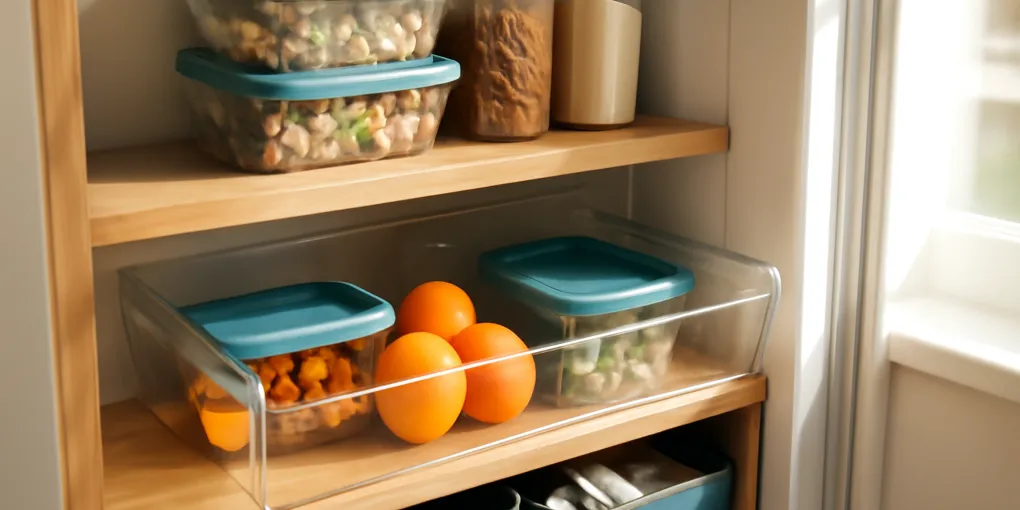
Fridge Leftover Bin Reset Protocol: Stop Losing Food Behind Better Intentions
ProtocolQuick picks
Clear Fridge Bin for Leftovers
★ Top pick Best starting point- Best For: Keeping cooked leftovers visible and front-loaded
- Caveat: Must be shallow enough that containers do not hide in a second layer
Freezer-Safe Date Labels
Best supporting tool- Best For: Marking cooked date and eat-by decisions
- Caveat: Adhesive varies on damp container lids
Leftovers usually begin as a good intention. They become clutter when every container receives a different hiding place: soup behind milk, rice under lettuce, pasta behind condiments, half an onion wherever it fits. The fridge leftover bin reset protocol gives leftovers one visible address and one weekly decision point.
The simple version is this: put one shallow clear bin near the front of the fridge, label leftovers with the cooked date, and clear the bin before grocery shopping. The bin is not for every refrigerated item. It is a short-term runway for food that is already cooked and needs to be eaten, frozen, or discarded.
For pantry overflow, use a different system such as our how to organize a deep pantry guide. A leftover bin works because it narrows attention inside the fridge.
Quick picks for a visible leftover zone
- Main bin: Search Amazon for clear fridge leftover bins. Choose a shallow clear bin when leftovers disappear behind condiments or raw ingredients.
- Label support: Search Amazon for food date labels. Choose removable date labels when tape, marker, or memory keeps failing.
Quick setup: the one-bin leftover rule
Start with one clear bin or tray. Search Amazon for clear fridge leftover bins if you need a washable container that fits your shelf depth. Add search Amazon for freezer-safe food date labels only if marker on tape keeps failing.
The bin should hold normal containers in a single layer. If containers stack two deep, the back row becomes invisible. If the bin is opaque, it hides the exact problem it is supposed to solve.
Measure the usable shelf depth before buying. Many refrigerator bins are sized for cans, produce packets, or narrow condiment rows; those can be too long or too tall for leftover containers. Leave enough front clearance that the bin can slide out without knocking into the door shelf. If your fridge has adjustable shelves, set the leftover shelf around the containers you actually use rather than buying a bin and forcing every container to fit it.
The 20-minute fridge reset protocol
- Pull out all cooked leftovers.
- Discard anything clearly spoiled or outside your household safety rule.
- Combine duplicates only when they are the same food and date.
- Label each keeper with the cooked date.
- Put keepers in the clear bin near the front.
- Move raw ingredients, condiments, and unopened items out of the bin.
- Set one weekly review time before grocery shopping or trash pickup.
Do not turn the leftover bin into a general fridge organizer. It has one job: make cooked food visible before it becomes waste.
Clear fridge leftover bin
A clear fridge bin helps because it creates a boundary without hiding contents. Choose a shallow rectangle that can be pulled forward with one hand. Tall walls are useful for jars and bottles, but leftover containers need visibility more than containment.
The best fit is a bin that matches your most common container footprint. If you use square glass containers, choose a bin wide enough for two side by side. If you use round deli containers, choose a bin that prevents them from rolling but does not force stacking.
Shopping option: Search Amazon for clear fridge leftover bins.
Food date labels
Date labels are not about perfection. They remove the tiny argument that happens when nobody remembers whether the chili is from Tuesday or last weekend. A removable label on the lid is easier to see than a note on the side, especially when containers sit in a low shelf.
Look for labels that write cleanly with your normal marker and remove without leaving paper scraps. Freezer-safe labels are useful if your reset rule includes freezing leftovers before they age out.
Shopping option: Search Amazon for food date labels.
Fit checks that matter
For leftover-bin protocols, the useful checks are visibility, food-safety fit, cleanability, date labeling, shelf clearance, and whether old food gets seen before it becomes waste.
This leftover-bin protocol scores well on value because it uses one low-cost boundary instead of a full refrigerator overhaul. Evidence Quality comes from food-safety guidance that emphasizes time, temperature, and cleanliness; the bin does not make food safe by itself. User Signals focus on whether household members actually see and eat the food. Transparency means the system makes age and location visible instead of relying on memory.
Safety notes for leftovers
The bin is not a safety guarantee. Keep the refrigerator at a safe temperature, cool cooked food promptly, and follow food-safety guidance for storage time. If a food looks or smells questionable, do not use the bin rule as an excuse to keep it.
Avoid placing raw meat or leaking packages in the leftover bin. Raw items need separate containment to prevent cross-contamination. The leftover bin is for cooked foods and ready-to-eat items only.
Leftover-bin reset questions
Should the leftover bin have a lid?
Usually no. A lidded bin adds friction and can hide the containers inside. Use lids on the food containers themselves, then keep the bin open for visibility.
What day should I reset the bin?
Pick the day before grocery shopping or trash pickup. That timing turns the reset into a decision point: eat tonight, freeze, or discard before new food arrives.
Can kids use the leftover bin?
Yes, if it is placed where they can see it safely. Put ready-to-eat leftovers in the front and avoid heavy glass containers on high shelves.
What if leftovers still do not get eaten?
Make the bin smaller. A smaller bin forces earlier decisions and exposes the pattern: the household may be cooking too much, saving foods nobody wants, or hiding leftovers behind new meals.
Sources
- U.S. Food and Drug Administration. Safe food handling: https://www.fda.gov/food/buy-store-serve-safe-food/safe-food-handling.
- U.S. Food and Drug Administration. Refrigerator thermometers: cold facts about food safety: https://www.fda.gov/food/buy-store-serve-safe-food/refrigerator-thermometers-cold-facts-about-food-safety.
Frequently Asked Questions
- Place it on a middle or upper front shelf where it is visible before snacks, condiments, and raw ingredients. Hidden leftover bins become another forgotten zone.
- Choose a shallow clear bin that holds two to four normal leftover containers in one layer. If it allows a second hidden layer, it is too deep for this job.
- Date labels help because memory is unreliable once similar containers stack up. Use the cooked date or discard-by date consistently.
- Use one front-left shelf zone with a washable mat or tray instead. The rule is one visible leftover zone, not necessarily a plastic bin.