OXO Good Grips Expandable Utensil Organizer Review: Worth It for Crowded Kitchen Drawers?
ReviewOXO Good Grips Expandable Utensil Organizer
Best for mixed utensil drawersBest For: Standard utensils plus a few serving tools in one drawer
$18-30
Quick picks
OXO Good Grips Expandable Utensil Organizer
★ Top pick Best for mixed utensil drawers- Best For: Standard utensils plus a few serving tools in one drawer
- Caveat: Expandable side wings need enough drawer width to be useful
Bamboo Expandable Utensil Tray
Best warm-material alternative- Best For: Wide drawers where appearance matters
- Caveat: Needs more care around moisture and crumbs
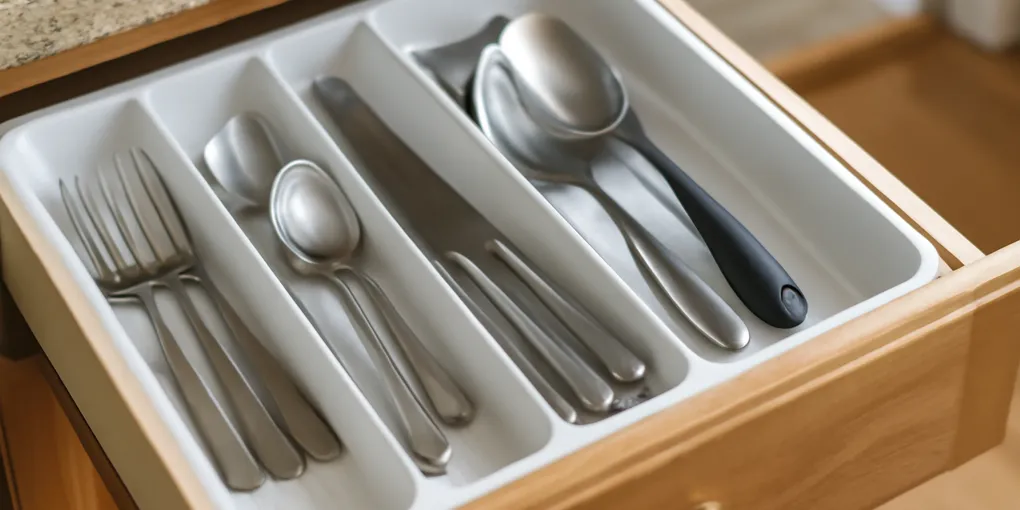
The OXO Good Grips Expandable Utensil Organizer is a practical upgrade for a kitchen drawer that almost works. It is not a miracle fix for every spatula, measuring cup, and takeout chopstick. Its real strength is simpler: it gives forks, spoons, knives, and a few longer tools visible lanes inside one drawer.
For most crowded utensil drawers, the OXO organizer is worth considering if your drawer has extra width and you want a washable plastic tray. Search current listings here: Search Amazon for the OXO Good Grips Expandable Utensil Organizer. If you prefer a warmer look and have a dry, wide drawer, compare current bamboo expandable utensil tray options on Amazon before buying.
Use this review with our broader best drawer dividers for deep kitchen drawers if your issue is not just utensils but an entire drawer stack that has lost its categories.
Quick picks for utensil drawer fixes
Buy the OXO expandable utensil organizer if your drawer has a standard utensil pile plus a few awkward extras. Skip it if your drawer is narrow, shallow, or mostly full of bulky cooking tools that need deeper dividers.
Best fit:
- Forks, spoons, and table knives used daily.
- A few serving spoons or chopsticks in the expandable side lane.
- Households that want easy wipe-down cleaning.
- Renters who cannot modify drawer interiors.
Poor fit:
- Very narrow drawers with no room for the expandable wings.
- Deep gadget drawers full of peelers, whisks, and spatulas.
- Households that want a decorative wood interior more than washable plastic.
- Drawers where the front-to-back depth is too short for the tray.
OXO Good Grips Expandable Utensil Organizer
The OXO organizer uses a familiar tray format with an expandable section that can widen to claim unused drawer space. That matters because many utensil drawers have a dead side gap: too wide for the tray to fit snugly, too narrow to hold loose tools neatly. The expandable section turns that gap into an assigned lane.
The plastic construction is a strength in a real kitchen. Utensil drawers collect crumbs, water spots from imperfectly dried silverware, and the occasional sticky handle. A plastic tray can be removed and wiped more easily than an unfinished wood organizer. Non-slip details also help keep the tray from shifting when the drawer opens.
The limitation is category creep. The expandable side lane looks like bonus storage, so it can attract measuring spoons, straws, sauce packets, birthday candles, and mystery clips. Assign that lane before use. Good assignments include serving spoons, chopsticks, steak knives in sleeves, or kids’ utensils.
Shopping option: Search Amazon for the OXO Good Grips Expandable Utensil Organizer.
Measure before buying
Measure the drawer interior, not the drawer front. You need three numbers: width, front-to-back depth, and usable height with the drawer closed. Then compare those numbers with the current listing because product dimensions can vary by version and seller.
Pay special attention to the expanded width. If your drawer only fits the tray at its narrow setting, you may be paying for a feature you cannot use. If your drawer is wide enough, decide what the side lane will hold before expanding it. Empty space without a category becomes a clutter invitation.
Also check depth. A tray that is slightly too long can stop the drawer from closing or crush items near the back. A tray that is much shorter than the drawer may leave a hidden rear pocket where loose items accumulate.
OXO vs bamboo expandable trays
Bamboo expandable trays look better in many kitchens. They can make an ordinary drawer feel built-in, and the compartments often have a warmer visual tone. If the drawer is dry, wide, and used by adults who reset it consistently, bamboo can be a good alternative.
Plastic wins on cleaning and forgiveness. If kids unload the dishwasher, if utensils sometimes go away damp, or if the drawer collects crumbs, a washable plastic tray is easier to maintain. Plastic also tends to be lighter when you remove the whole organizer for cleaning.
The choice is not plastic versus beautiful. It is maintenance style. Choose the material that will still look and function well after two months of normal dishwashing, not the material that looks best in an empty drawer.
Fit checks that matter
For product reviews, the useful checks are exact drawer fit, cleanability, day-to-day retrieval, long-term friction, and whether the listing makes the limits easy to verify.
For this OXO utensil organizer review, Research rewards fit across common drawer layouts and whether the design solves a specific utensil problem. Evidence Quality emphasizes observable traits: tray dimensions, expandable mechanics, cleanability, compartment shape, and anti-slip behavior. Value considers whether the organizer uses existing drawer space better than a cheaper fixed tray. User Signals focus on long-term household friction: shifting, crumbs, awkward utensil lengths, and whether the expanded lane becomes a junk strip. Transparency rewards clear dimensions, material information, and product photos that show both narrow and expanded configurations.
On that model, the OXO organizer is strongest for washable daily use and mixed utensil drawers. It loses points when the expandable side is used without a category or when the drawer is too narrow for the feature.
Setup protocol after delivery
- Empty the drawer completely.
- Remove duplicate utensils, takeout cutlery, broken measuring spoons, and tools that belong near the stove.
- Place the organizer in the drawer before loading it.
- Assign the main channels to forks, spoons, and knives.
- Assign the expandable lane to one category only.
- Close the drawer slowly and check for scraping.
- After one week, remove anything that landed in the wrong lane more than twice.
The one-week check is important. Utensil drawer organizers fail less because of bad compartments and more because the household keeps too many categories in one drawer.
When to skip this organizer
Skip the OXO tray if your real problem is cooking tools, not eating utensils. Spatulas, tongs, whisks, peelers, and measuring cups usually need deeper adjustable dividers or a separate cooking-tool drawer. A utensil tray can make those items look worse because long handles cross compartments and block the drawer.
Skip it if the drawer is already too shallow. If utensils scrape the counter above or the tray raises them too high, choose a lower-profile fixed tray or in-drawer dividers.
Skip it if you want every item hidden. This tray creates visible order inside the drawer; it does not conceal a large mixed inventory.
Drawer layouts that fit the OXO tray
A narrow apartment drawer should use the tray at its smallest width and treat the expandable feature as optional. If the side wing cannot open, the organizer may still work as a clean utensil tray, but it should be compared with cheaper fixed trays before purchase.
A wide builder-grade kitchen drawer is the best match. The OXO tray can hold the main utensil categories while the expanded side lane takes serving spoons, chopsticks, or measuring spoons. Keep cooking tools such as tongs and whisks out of this drawer unless the drawer is unusually deep.
A family drawer with kids’ utensils needs a dedicated child lane. Small forks and spoons disappear under adult utensils if they share the same channel. Use the expandable side or a front compartment for kids’ pieces so unloading the dishwasher does not require sorting through every adult utensil first.
OXO utensil organizer questions
Does the OXO organizer stop utensils from sliding?
It can reduce sliding when the tray fits the drawer and has non-slip contact, but any tray can shift if the drawer is much wider than the organizer. Use the expanded side or a small spacer to reduce dead space.
Can it hold long serving spoons?
Some longer serving spoons can fit in the expandable lane or a long compartment, but very long tools may need a separate drawer. Measure your longest tool before buying.
Is this a good organizer for renters?
Yes, it is renter-friendly because it does not require drilling, adhesive, or drawer modifications. You can remove it for cleaning or take it when you move.
What should I do with extra takeout utensils?
Keep a small limit if you genuinely use them, then recycle or discard the overflow according to local rules. Takeout cutlery should not displace the utensils you use every day.
Sources
- Current seller dimensions should be checked before purchase: https://www.amazon.com/s?k=OXO+Good+Grips+Expandable+Utensil+Organizer&tag=clutterscience-20.
- McMains, S. A., and Kastner, S. (2011). Interactions of top-down and bottom-up mechanisms in human visual cortex. DOI: 10.1523/JNEUROSCI.3766-10.2011.
- U.S. Food and Drug Administration. Safe food handling: https://www.fda.gov/food/buy-store-serve-safe-food/safe-food-handling. Use washable organizers and clean utensil drawers periodically.
Frequently Asked Questions
- It can work in standard drawers, but the expandable sections only help if the drawer has spare width. Measure interior width, depth, and height before buying.
- It is best for forks, spoons, table knives, and a few longer serving tools. Very bulky gadgets may need a separate drawer divider or crock.
- Plastic is easier to wipe and usually handles dishwasher moisture better. Bamboo looks warmer but needs more attention to drying and crumbs.
- The expandable wings can become catch-all zones if they are not assigned to specific tools such as serving spoons, chopsticks, or measuring spoons.