Why Entryway Shoe Piles Grow: The Friction Behind the Front-Door Mess
Evidence ExplainerQuick picks
| Product | Key Specs | Pros / Cons |
|---|---|---|
| See price on Amazon |
|
|
| See price on Amazon |
|
|
Product availability, certifications, and retailer details can change; check the current Amazon page before buying.
Entryway shoe piles grow because the front door is a high-speed transition point. People arrive carrying bags, mail, groceries, gym gear, a leash, a child’s backpack, or a wet umbrella. The shoe decision happens at the moment when attention is already divided.
Use this why entryway shoe piles grow product comparison as the shopping shortlist, then check the measurements, mounting limits, cleaning friction, and return terms against the room or cabinet described below.
That is why a shoe pile can survive even in a home with a perfectly good closet ten feet away. The closet may be reasonable in theory, but the floor by the door is easier in the moment. The fix is not a prettier lecture. It is a lower-friction landing zone with a clear limit.
Quick fix options
- For dry everyday shoes: two-tier entryway shoe rack (See current two-tier shoe rack prices).
- For wet shoes, boots, and mud: rubber boot tray (See current rubber boot tray prices).
- For narrow halls: slim vertical shoe rack (Browse slim shoe racks).
Measure the door swing, walking path, and deepest shoe before buying. An organizer that narrows the path too much will be avoided or kicked out of alignment.
The behavior problem is friction
A shoe pile forms when the easiest action is also the messiest action. Removing shoes at the door is convenient. Carrying them to a closet is a second task. Opening the closet, making space, and placing shoes neatly is a third task.
Human-factors design often treats these small action costs as meaningful. A system used during a transition has to be visible, reachable, and obvious. If a person has to bend, open a door, move another pair, or remember a rule, the system loses to the floor.
This is similar to the pattern in why flat surfaces become clutter magnets: the first available surface wins unless a better landing zone is easier.
Why closets lose to the floor
Closets are storage zones. Entryways are landing zones. Those are different jobs.
A storage zone can hold seasonal boots, formal shoes, sports footwear, and backups. A landing zone should hold only the pairs in active rotation. When the closet is treated as the only acceptable shoe location, daily behavior has to be perfect every time. It usually will not be.
The better rule is: daily shoes get a tiny legal home near the door; all other shoes leave the entryway.
Two-tier entryway shoe racks for daily pairs
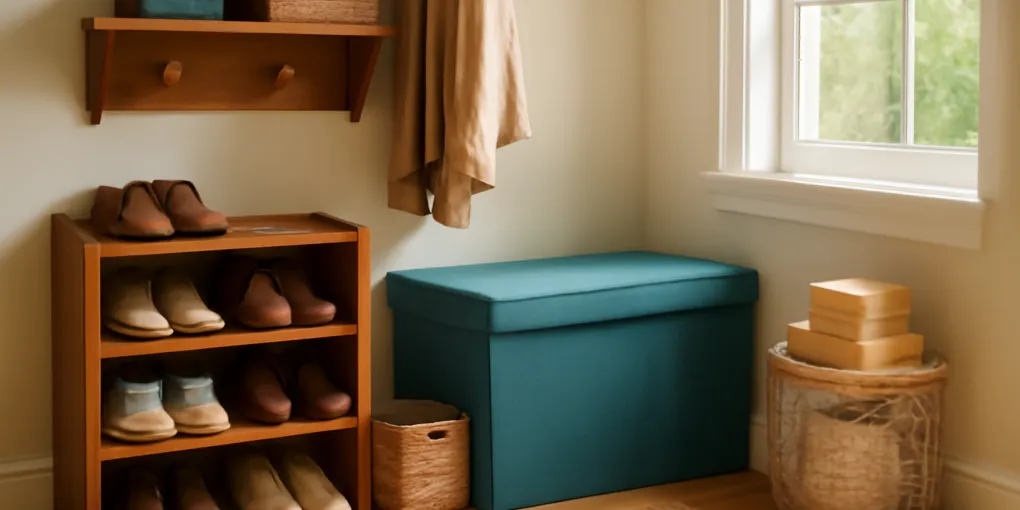
A two-tier rack is the best first fix when dry shoes are the main problem. It creates a visible landing zone and doubles the capacity without making the floor footprint much larger.
Best use: one to three people’s daily shoes, especially sneakers, flats, sandals, and slippers.
Caveat: measure depth. If the rack sticks into the walking path, people will avoid it or knock shoes off the front edge.
Current options: Search two-tier entryway shoe racks on Amazon.
Rubber boot trays for wet shoes and mud
A boot tray is not a full shoe-storage system. It is a wet-shoe quarantine zone. That distinction matters because trays work best when they hold a few dirty pairs temporarily.
Best use: rainy climates, snow, gardening shoes, kids’ muddy sneakers, and pet-walk shoes.
Caveat: a tray without a pair limit becomes a shallow shoe pile. Use it for wet pairs only, then move dry shoes to the rack or closet.
Current options: Compare rubber boot trays on Amazon.
The one-pair rule that actually works
Strict rules fail when they do not match real exits. A better starting rule is one daily pair per person in the entry zone. If the household has school shoes, work shoes, gym shoes, and dog-walk shoes, the rule may be two pairs per person, but the number must fit the rack or tray.
Overflow is feedback. If the legal landing zone is full, the answer is not to add a second pile. Move inactive pairs to the closet or bedroom storage.
For families, make the rule physical. A child gets one slot, not an abstract instruction to be tidy. Adults need the same kind of boundary.
Safety and path clearance
Shoe piles are not just visual clutter. They can narrow the walking path, catch toes, and create a trip risk near a door where people may be carrying items or moving quickly. Entry organizers should improve path clearance, not create a new obstacle.
The National Safety Council and CDC both emphasize that household falls often involve environmental hazards. A small rack that keeps shoes out of the path is more useful than a large bench that looks attractive but forces people to sidestep around it.
Entryway shoe-system checks
Shoe piles grow when the storage tool ignores the first thirty seconds after someone enters. Check:
- Drop speed: daily shoes need open access, not a lidded box or far closet.
- Pair limit: give each person a small number of visible slots.
- Wet-shoe plan: boots and rain shoes need a mat or tray so they do not contaminate the whole doorway.
Entryway shoe-pile questions
What if the entryway is too narrow for a rack?
Use a slim vertical rack, a wall-mounted shoe holder, or a boot tray placed outside the main walking line. Do not buy a deep bench if it blocks the path.
Should kids’ shoes go in a separate bin?
A bin can work for very young children, but pairs get buried quickly. A low rack or labeled slots usually makes matching shoes easier.
Do entry benches solve shoe piles?
Only if the bench includes a clear shoe zone underneath and does not become a bag-and-mail surface. A bench without limits can become another clutter magnet.
Sources
- CDC. “Check for Safety: A Home Fall Prevention Checklist for Older Adults.” https://www.cdc.gov/steadi/pdf/STEADI-Brochure-CheckForSafety-508.pdf
- CDC. “Older Adult Fall Prevention.” https://www.cdc.gov/falls/
- Nielsen Norman Group. “Recognition Rather Than Recall.” https://www.nngroup.com/articles/recognition-and-recall/
Frequently Asked Questions
- The closet usually has more friction than dropping shoes by the door: a door to open, shelves to access, and no immediate cue. Daily shoes follow the lowest-effort path.
- Use a rack for dry daily shoes and a tray for wet or dirty pairs. If there is room for only one, choose the one that matches the local failure: overflow or moisture.
- Most homes need one or two active pairs per person near the entry, plus a temporary wet-shoe spot. Extra seasonal or special-use shoes should move away from the landing zone.