Why Hardware Screws Take Over Junk Drawers and How to Sort Them
Evidence ExplainerQuick picks
Adjustable small-parts organizer box
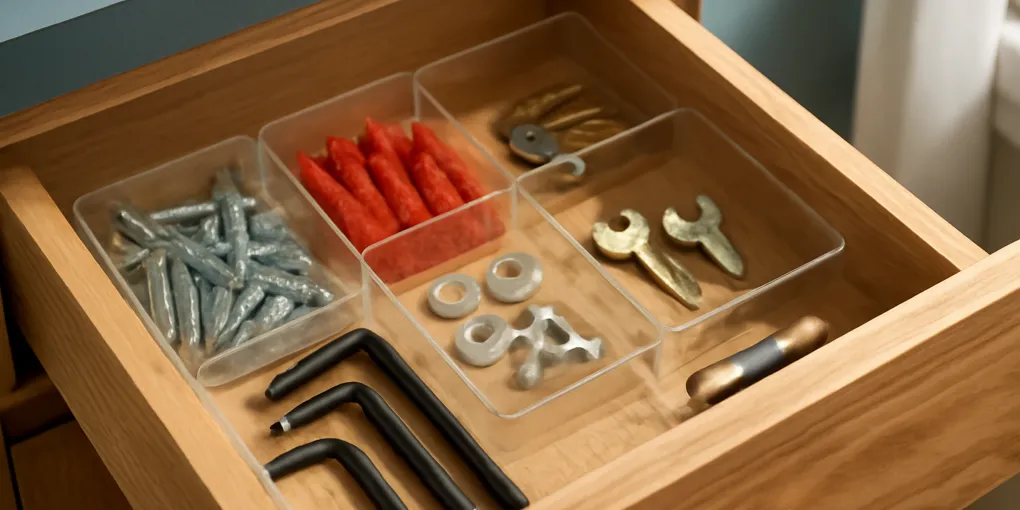
★ Top pick Best for mixed screws- Why consider it: Creates compartments for screws, anchors, furniture hardware, and Allen keys without mixing them with batteries or keys.
Mini zip bags with label area
Best for project leftovers- Why consider it: Keeps leftover crib, shelf, and furniture hardware tied to the item it came from.
Magnetic parts tray
Best during repairs- Why consider it: Prevents active repair screws from rolling across counters before they go into permanent storage.
Loose screws have a strange power over a junk drawer. They look useful, they are hard to identify, and throwing them away feels risky. So the drawer absorbs shelf pins, Allen keys, wall anchors, washer parts, picture-hanging nails, crib bolts, and mystery plastic spacers until no one can find the actual tape measure.
This is not just a storage-volume problem. It is a decision problem. Every piece of hardware needs one of three labels: belongs to a known item, belongs to a general fastener kit, or does not have a safe future use. Without those labels, the junk drawer becomes a metal compost pile.
If the drawer also contains batteries, start with the utility drawer battery storage protocol so loose metal parts and battery clutter do not share the same space.
Quick comparison
| Need | Better choice | Why it fits |
|---|---|---|
| Mixed generic screws | Adjustable small-parts organizer box | Separates anchors, washers, nuts, and screws by visible compartment |
| Furniture leftovers | Mini zip bags with label area | Keeps hardware tied to a named bed, shelf, desk, or mount |
| Active repair | Magnetic parts tray | Stops screws from rolling away before final storage |
What is happening in the drawer
Hardware clutter grows because the pieces arrive after a project, not before one. A shelf comes with extra anchors. A flat-pack desk leaves behind an Allen key. A curtain rod includes two extra screws. The project ends, but the leftover pieces still feel important.
The brain treats those parts as insurance. The problem is that unlabeled insurance is almost never usable later. A screw without the item name, size, or location is not a spare part. It is a tiny question that gets asked again every time the drawer opens.
The useful sorting rule
Sort hardware by future use, not by how it arrived.
- Known-item hardware: spare screws for a crib, shelf, bed frame, cabinet, appliance panel, or furniture kit.
- Generic fasteners: common screws, wall anchors, washers, nuts, and picture-hanging pieces you can identify.
- Active-project parts: screws needed for a current repair that should not be put away yet.
- No-future pieces: bent, rusty, stripped, single-use, or unidentifiable hardware.
Only the first two groups deserve permanent storage. Active-project parts need a temporary tray. No-future pieces should leave the drawer.
Product-led reset
For mixed household fasteners, search for adjustable small-parts organizer screws (check current options on Amazon). Choose a box with removable dividers, a latch that stays closed, and compartments shallow enough that you can see what is inside.
For furniture and appliance leftovers, use mini zip bags with a label area. Search for mini zip bags label hardware screws (compare current options on Amazon) and write the item name before the bag goes into storage: “guest bed extra bolts,” “TV mount spacers,” or “IKEA shelf pins.” A bag that says only “screws” is not much better than a pile.
For active repairs, use a magnetic tray. Search for magnetic parts tray home repair (browse current options on Amazon) if screws roll off the counter during appliance panels, doorknobs, or hinge repairs. The tray is temporary capture, not the final home.
The 20-minute reset
- Empty the drawer section that contains metal parts.
- Remove batteries, keys, food items, cords, receipts, and anything sharp that does not belong with hardware.
- Put known furniture or appliance hardware into labeled mini bags.
- Put generic fasteners into a small-parts organizer by type.
- Put active-project pieces into a magnetic tray or temporary cup with the project name.
- Discard rusty, bent, stripped, or mystery parts you cannot identify.
- Put the small-parts box somewhere close to tools, not back under mail.
This reset works because it removes the emotional question. You are not deciding whether every screw could possibly matter. You are deciding whether it has a known future use.
Safety and small-object notes
Loose hardware is not the same as paper clutter. Screws and wall anchors can be sharp, choking-sized, or easy for children to scatter. HealthyChildren’s home childproofing guidance emphasizes keeping small hazardous household items out of children’s reach. That supports a closed, latched storage box over an open junk drawer in homes with young kids.
Also keep loose hardware away from batteries. Metal parts in the same drawer as loose batteries can create confusion and damage. The safer habit is simple: batteries in a battery case, fasteners in a parts box, keys in a key tray.
Fit matrix
| Drawer problem | Better storage choice | Avoid |
|---|---|---|
| Furniture leftovers | Labeled mini zip bag | Loose bolts in junk drawer |
| Mixed generic screws | Adjustable parts box | One jar of everything |
| Current repair | Magnetic tray | Screws on counter edge |
| Kids can reach drawer | Latched box on high shelf | Open divider tray |
| Batteries mixed with hardware | Separate battery case and parts box | Loose metal and batteries together |
Hardware clutter FAQ
Should I keep Allen keys from furniture kits?
Keep one or two common sizes if you actually use them. Label any special wrench that belongs to a specific bed, crib, or desk. Discard duplicates that have no known item.
What about wall anchors from old projects?
Keep anchors only if you know the size and they are undamaged. Unknown anchors are easy to misuse, and the wrong anchor can make a wall-mounted item insecure.
Can a drawer divider solve this?
A divider helps only after the hardware is labeled and separated from non-hardware clutter. Otherwise each compartment becomes a smaller junk drawer.
Sources
- HealthyChildren childproofing guidance supports keeping small household hazards out of children’s reach.
- ESFI battery safety guidance supports keeping batteries protected from damage and unsafe contact, which is relevant when batteries share drawers with metal clutter.
Reader test
A reader can separate known-item hardware, generic screws, active-project parts, and discards today. This article is specific to hardware clutter because it addresses wall anchors, Allen keys, shelf pins, furniture bolts, magnetic trays, stripped screws, and the risk of mixing metal parts with batteries.
Frequently Asked Questions
- They arrive without a decision: keep for a known item, sort by type, or discard. The junk drawer becomes the default because the screw feels potentially useful.
- Keep hardware for known furniture in labeled mini bags, sort generic fasteners into a small-parts box, and discard rusty or unidentifiable pieces that cannot be safely matched.
- Active repair fasteners can live near tools, but random household screws should not share a drawer with batteries, keys, receipts, or food clips.