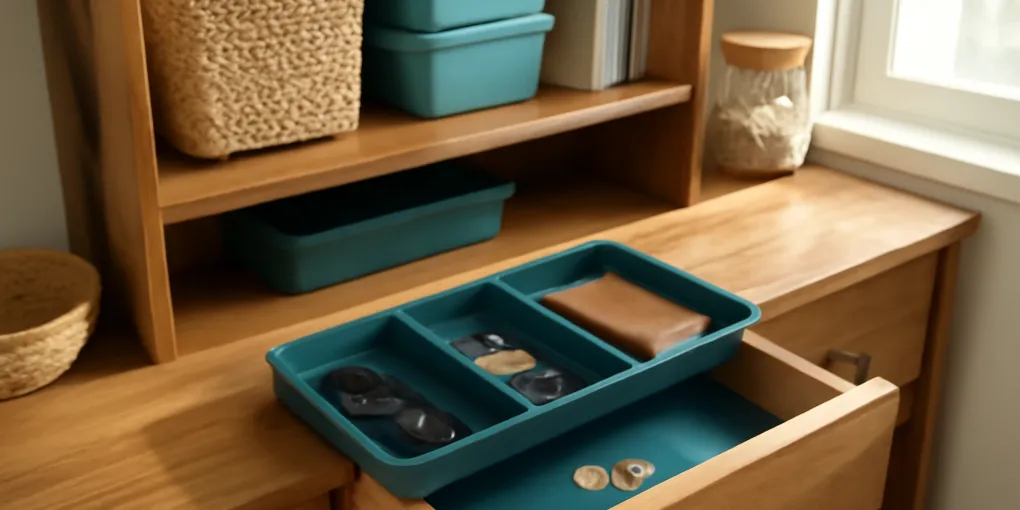
Best Shallow Drawer Bins for Entryway Keys, Wallets, and Small Everyday Carry
Buyer's GuideModular shallow drawer bins
Best overallBest For: Keys, badges, sunglasses, small flashlight, wallet, and transit cards
$12-28
Quick picks
| Product | Key Specs |
|---|---|
| See price on Amazon |
|
| See price on Amazon |
|
| See price on Amazon |
|
Product availability, certifications, and retailer details can change; check the current Amazon page before buying.
A shallow entryway drawer can be useful or it can become a junk drawer with a nicer location. The difference is whether the drawer has assigned landing spaces for the items people actually carry every day: keys, wallet, sunglasses, badge, transit card, earbuds, small flashlight, and maybe one garage opener.
If your problem is mail, use a dedicated paper inbox protocol instead. If the problem is shoes and bags, our entryway drop-zone system is the better starting point. This guide is for the tiny objects that make people late because they disappear under receipts.
Quick picks
- Most flexible: Search Amazon for modular shallow drawer bins when several people share one drawer.
- Softest landing: Search Amazon for drawer valet tray inserts for glasses, watches, and wallets.
- Wider furniture: Search Amazon for expandable bamboo drawer organizers for console tables.
Measure the drawer before choosing bins
Entryway drawers are often shallower than kitchen drawers. Measure interior width, depth, and height. Height matters because a bin that technically fits may scrape when the drawer closes or make it hard to grab keys.
Leave finger room. A perfect grid of tiny compartments looks tidy in a product photo, but daily items need space around them. Keys with fobs, sunglasses cases, and wallets are bulky. Use fewer, larger compartments for active items and reserve tiny cups for coins or transit tokens only if those items are truly used.
Match the material to the item
Clear plastic bins are easy to wipe and make it obvious when receipts or batteries sneak in. Felt and silicone valet trays are quieter and gentler for glasses, watches, and phones. Bamboo organizers look warmer in an open console, but crumbs and grit show less clearly, so they need scheduled cleaning.
If the drawer sits near a wet entry, avoid fabric compartments for umbrellas, damp gloves, or pet gear. Moisture belongs on a mat, hook, or drying station, not inside the key drawer.
Use one compartment per job
Assign the drawer by job rather than by person if the household is small: keys, wallets, glasses, badges, and backup small items. In a larger household, give each person one rectangular zone and keep shared items in the front. The point is instant retrieval, not a museum display.
Do not let paper enter the drawer. Receipts, school forms, coupons, and mail flatten into a layer that hides keys. Put a vertical sorter or tray nearby if paper must land at the entry, but keep the drawer for hard everyday-carry objects.
Safety and small-item checks
Entry drawers often collect button batteries, old key fobs, loose medication, pocket knives, and lighters because those items arrive in pockets. That is a different risk category than keys. HealthyChildren guidance on childproofing emphasizes keeping hazardous small objects and household hazards out of children’s reach. If children visit or live in the home, do not treat an entry drawer as secure storage.
Set a monthly sweep for loose batteries, unknown keys, expired badges, and broken key rings. Unknown keys are a major clutter source because people fear discarding them. Put unknown keys in a dated envelope elsewhere for one month, then discard or label if no one identifies them.
Fit checklist before buying
Choose bins that create a visible bottom. If items stack more than two deep, the bin is too small or the category is too broad. Choose low lips for fast grab items and higher walls only for rolling objects.
Check drawer slide clearance with the tallest expected item in place. Sunglasses cases, garage remotes, and bulky car fobs can be taller than the bin. If the drawer rubs, people will stop using it.
Best layouts for common drawer sizes
For a narrow console drawer, use three zones: one long zone for wallets and glasses, one small zone for keys, and one small zone for cards or badges. Resist the urge to fill the entire drawer with little cups. A narrow drawer needs open grab space more than maximum compartment count.
For a wide hall-table drawer, use modular bins across the front row for daily items and leave the back row for less frequent objects such as a spare flashlight or garage remote. If paper enters the back row, add a separate vertical paper sorter outside the drawer. Horizontal paper always wins against small objects because it covers them.
For a family drawer, give each person one clearly bounded rectangle. Shared keys, dog bags, or transit cards can sit in a front-center tray. Labeling can help for a week, but shape and location matter more. If a child or partner cannot identify their compartment without reading a label, simplify the layout.
Product material tradeoffs
Plastic modular bins are the easiest to reconfigure. They are also the easiest to wash when grit, candy wrappers, or pocket lint appear. Choose them if the drawer is near an exterior door, pet leash station, or school drop zone. Clear plastic is especially helpful because clutter is visible before the drawer is full.
Felt and silicone valet trays are better for scratch-prone items. They make a key drop quieter and protect glasses from sliding. They are less useful for loose coins, damp items, or anything dirty from a pocket. If a felt tray looks dusty, remove it and vacuum the drawer rather than shaking debris into the compartments.
Bamboo expandable organizers work well in furniture-style console tables. They look intentional, and the expandable sides can fill awkward widths. The tradeoff is that bamboo compartments often run larger, so you need stricter category boundaries. A large empty rectangle can become a receipt pile unless it has one named job.
The no-junk-drawer rule
The drawer should answer one question: what do I need when I leave or come home? If an item does not answer that question, it needs another home. Tape measures, spare screws, coupons, dead batteries, medication, and mystery keys do not belong in the daily-carry drawer just because the drawer is near the door.
Use a monthly five-minute audit. Remove trash, identify unknown keys, test small flashlights, and relocate objects that were dropped there during a busy week. If the same object returns repeatedly, either give it a real compartment or move the drawer closer to the place where the object is used.
How to prevent receipt creep
Receipt creep is the reason many key drawers fail. A receipt feels too small to file, too possibly important to throw away, and too urgent to carry farther into the house. Once a few receipts cover the drawer bottom, keys and badges land on top of paper instead of inside their compartments.
Give receipts a separate rule. If they are needed for returns, they go to a returns envelope or the home returns station. If they are needed for taxes or reimbursements, they go to a paperwork inbox. If they are ordinary grocery or coffee receipts, they leave during the nightly reset. The drawer should not be the court of last appeal for every paper scrap.
Household-specific layouts
For one adult, a valet tray insert may be enough. Put the most-used keys in the front-right or front-left corner based on the hand you naturally use. Put wallet and sunglasses behind them. Leave one empty compartment for the item you carry only some days, such as a work badge or transit pass.
For couples, mirror the layout so each person has a side. Shared items go in the middle, not on top of one person’s space. For families with kids, avoid putting small hazardous items in a low drawer. Backpacks and school papers need a separate command center; the key drawer should not become a child-accessible hardware drawer.
For a rental or temporary home, use removable bins rather than custom inserts. You can lift the whole system during a move, wash the drawer, and reuse the bins in a desk or nightstand if the next entryway has different furniture.
Last fit check before ordering
Before ordering, sketch the drawer on paper and write the item assigned to each compartment. If you cannot name the job for a bin, do not buy that bin yet. Empty drawer space is useful when it keeps daily objects visible and easy to grab.
Frequently Asked Questions
Should chargers go in the key drawer?
Only if the drawer is storage, not active charging. For charging, use an open-air station like the setup described in our charging drawer safety explainer.
What if people still drop keys on the table?
Move the easiest target closer to the behavior. A shallow tray on top of the console may be better than a drawer if no one opens the drawer consistently. Use the drawer for backup cards and less frequent items.
How many backup keys belong in the drawer?
Usually none or one clearly labeled backup. Extra keys should live in a labeled home file, lock box, or utility area. A drawer full of mystery keys will eventually hide the daily keys.
Sources and safety notes
- HealthyChildren household childproofing guidance for small-object and hazard access: https://www.healthychildren.org/English/safety-prevention/at-home/Pages/Childproofing-Your-Home.aspx
- CDC falls prevention guidance for keeping home pathways clear of obstacles and trip hazards: https://www.cdc.gov/falls/prevention/index.html