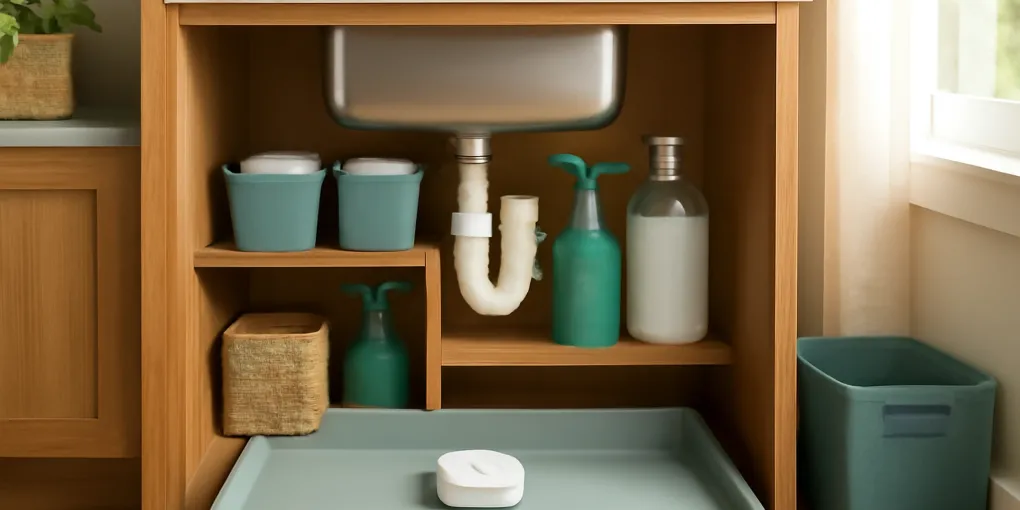
Best Under-Sink Leak Sensors and Cabinet Trays for Catching Small Plumbing Problems
Buyer's GuideGovee WiFi Water Sensor Set
Best app-alert sensor setBest fit: Good when you want phone alerts for multiple risk zones and are willing to set up a gateway/app.
Quick picks
| Product | Key Specs |
|---|---|
| See price on Amazon |
|
| See price on Amazon |
|
| See price on Amazon |
|
| See price on Amazon |
|
Product availability, certifications, and retailer details can change; check the current Amazon page before buying.
Named Sensor and Tray Picks
Under-sink protection works best as a sensor plus a visible tray or mat. A sensor tells you something is wet; a tray or mat makes slow drips easier to see before cabinet flooring swells.
Use the links below as named-product searches, then confirm the current dimensions, included hardware, return terms, and seller details before ordering.
For the adjacent setup decision, see our under-sink leak trays guide.
- Best app-alert sensor set: Search Amazon for Govee WiFi water sensor sets. Good when you want phone alerts for multiple risk zones and are willing to set up a gateway/app.
- Best simple local alarm: Search Amazon for Zircon Leak Alert detectors. A low-friction local alarm for one cabinet when remote alerts are not needed.
- Best raised-edge tray mat: Search Amazon for Xtreme Mats under-sink cabinet mats. Best when cabinet-floor protection and visible containment matter. Fit depends on cabinet dimensions.
- Best trimmable budget mat: Search Amazon for Drymate under-sink mats. A simpler absorbent mat for cleaner-storage zones where frequent inspection is realistic.
What to compare before buying
- Remote alert versus local alarm needs.
- Sensor placement near valves, trap, disposal, or filter housing.
- Cabinet base dimensions for mats or trays.
- Battery-check routine.
- Avoiding bottles or bins that hide the sensor.
A tidy sink cabinet can hide one of the least forgiving kinds of clutter: bottles, rolls, sponges, and bags packed around plumbing. That makes a slow drip harder to see until the cabinet floor has swollen, the toe kick smells musty, or a stack of cleaners is sitting in dirty water.
The best under-sink leak setup is usually not one product. It is a low water sensor placed where water would first travel, plus a tray or mat that keeps small drips visible instead of soaking into particleboard. If you only buy one thing, choose the alert. If you already have stained cabinet flooring, add containment.
Quick picks
- Best app alerts: Search Amazon for Govee WiFi water sensor 3-pack
- Best no-hub alarm: Search Amazon for Zircon Leak Alert water detector
- Best raised-edge tray: Search Amazon for Xtreme Mats under sink cabinet mat
- Best trim-to-fit mat: Search Amazon for Drymate under sink mat
Pick the sensor by alert style and the tray by exact cabinet floor dimensions. Do not let a pretty liner replace a sensor in a cabinet with an active water line.
What actually needs protection under a sink
Under-sink storage is risky because it mixes water, dark corners, and objects that get moved only when something spills. The highest-risk spots are the P-trap, garbage-disposal connection, supply valves, dishwasher hose entry, water-filter housing, and the back seam of the cabinet floor.
The U.S. Environmental Protection Agency recommends checking plumbing fixtures for leaks because small household leaks can waste significant water over time. That advice applies here in a practical way: if the cabinet is too crowded to inspect, a leak can become an organizing problem, a moisture problem, and a repair bill at once. Source: EPA WaterSense leak guidance.
Insurance and disaster-prevention groups also emphasize leak detection in hidden areas. The Insurance Institute for Business & Home Safety notes that plumbing failures and appliance leaks are common water-damage sources and that early detection can reduce damage. Source: IBHS water damage guidance.
How to choose the right setup
Use this order:
- Put an alert sensor at the first likely water path.
- Add a tray or mat under stored products.
- Remove products that block valves or the trap.
- Label the shutoff valves if multiple people use the kitchen.
- Recheck batteries and cabinet corners on a calendar.
A sensor without access is weak. A tray without an alert is quiet. A cabinet full of cleaners stacked over the sensor defeats both.
Sensor types that make sense
A simple local alarm is enough when someone is usually home and the cabinet is easy to hear. The Zircon-style detector works for rentals, utility sinks, and guest-bath vanities where a loud beep is the main need.
A WiFi or gateway sensor makes more sense when the leak zone is hidden, you travel, or the sink is above finished space. Govee-style multi-sensor kits are useful because one purchase can cover the kitchen sink, laundry area, water heater pan, and a refrigerator water line.
Smart-home compatibility is less important than placement, battery access, and alert reliability. A sensor hidden behind trash bags is easy to miss during a cabinet check, so a simpler unit placed at the front edge can be more useful than an app-connected unit buried near the back wall.
Tray and mat fit rules
Measure the cabinet floor width, depth, and obstructions before buying. Include the space around pipes, disposal bodies, and center stiles. A raised-edge tray can catch small drips, but only if it lies flat and does not tip around plumbing cutouts.
Choose a rigid or raised-edge tray when the cabinet base is already damaged or hard to replace. Choose a trim-to-fit absorbent mat when you mainly need a cleanable surface under bottles. Avoid plush liners under active plumbing because they can hold moisture and hide discoloration.
What to avoid
Avoid shelf paper as your only protection. It can make the floor look cleaner while hiding water underneath.
Avoid putting the sensor on top of a tray lip, bottle, or plastic bag. The metal contacts need to touch the cabinet floor or the lowest likely water path.
Avoid blocking the shutoff valves with a product caddy. In a real leak, the fastest useful action is turning water off. A cabinet organizer that slows that down is the wrong organizer.
Product-by-product fit notes
The Govee-style WiFi sensor set is the strongest choice when the sink is only one of several water-risk zones. Put one sensor under the kitchen sink, one near the washing machine or water heater, and one under a refrigerator water line if that line is accessible. The gateway is worth the setup only if phone alerts change what happens when nobody is standing nearby. Before buying, check whether the kit needs a dedicated outlet for the gateway and whether replacement batteries are easy to source.
The Zircon-style local alarm is better for people who want no app, no hub, and no account. It is especially sensible in a rental bathroom vanity, utility sink, or guest space where a loud alarm will be heard. The tradeoff is obvious: if the house is empty, the alarm cannot call you. Use it where someone is usually home or where the main goal is catching a drip during daily routines.
A fitted tray such as an Xtreme Mats-style cabinet mat is a cabinet-floor protector, not a leak detector. Its raised edge can keep a small spill from spreading into seams, and the glossy surface makes mineral stains easier to notice. It is a better choice for an expensive sink base, a new cabinet install, or a cabinet that has already been repaired once. It is a weaker choice if pipes enter through awkward cutouts that keep the tray from lying flat.
A trim-to-fit absorbent mat is the budget compromise. It can make bottles easier to slide out and can catch small cleaner spills, but it should not be trusted to hold plumbing water unnoticed. If you use one under active plumbing, pair it with a sensor and pull the mat out during monthly cleaning so dampness is not trapped against the cabinet floor.
Cabinet layouts that change the recommendation
A garbage-disposal cabinet needs extra clearance around the disposal body and electrical cord. Put the sensor where water would run after leaving the disposal connection, not directly under a bottle caddy that might keep the sensor dry while water moves around it.
A pull-out trash cabinet under the sink is a poor place for a loose sensor unless the sensor is secured outside the moving track. Repeated drawer motion can shove the sensor away from the leak path. In that layout, a tray plus a sensor near the plumbing wall is safer than a sensor floating in the middle of the cabinet.
A water-filter cabinet needs attention to filter-change spills. If the filter housing is opened every few months, use a removable tray or towel during the change, then return the sensor to the cabinet floor after the area is dry.
A bathroom vanity has smaller supply lines and more hair-product clutter. Choose the smallest sensor that can sit flat near the drain path, and keep cotton products, toilet paper, and backup towels out of the leak zone.
What to check after installation
Do a one-cup test before trusting the system. Place a damp paper towel or a teaspoon of water near the sensor contacts and confirm the alarm or app alert. Then dry the sensor, put it back in place, and take a photo of the final cabinet layout. The photo becomes a reference when someone later stuffs bags, cleaners, or dishwasher pods into the cabinet.
Review the cabinet after the first week. Look for shifted bottles, cords pressing into plumbing, and tray edges that lift near pipe cutouts. A leak setup is successful only if it survives ordinary household use, not just the day it is installed.
Setup protocol
- Empty the cabinet completely.
- Wipe the floor and look for stains, swelling, and mineral marks.
- Confirm that shutoff valves turn without forcing them.
- Place the sensor near the trap, disposal, filter, or supply-line route.
- Add the tray or mat, trimming only where the manufacturer allows.
- Return cleaners in one removable bin, leaving the plumbing visible.
- Test the alarm with a damp paper towel.
- Add a phone reminder to test batteries quarterly.
If you have active dripping, corrosion, mold odor, or swelling, stop shopping and fix the leak first.
How we evaluated the picks
Research counted most: does the setup make hidden water visible or audible before cabinet damage grows? Evidence quality came next: manufacturer documentation, plumbing-risk logic, and public water-damage prevention guidance. Value favored products that solved a specific cabinet problem rather than decorative liners. User signals mattered for battery access, alarm audibility, fit complaints, and app friction. Transparency favored products with clear dimensions and setup instructions.
FAQ
Can I use one leak sensor for the whole cabinet?
Usually yes for a small sink base, but place it at the lowest likely water path. Large double cabinets or disposal/filter combinations may need two sensors.
Should cleaners go back under the sink after installing a sensor?
Yes, but only in a removable bin that leaves plumbing visible. Keep paper goods, pet food, and bulk refills away from active water lines.
Do leak sensors stop leaks?
No. They warn you. You still need working shutoff valves, visible plumbing, and a cabinet layout that lets you act quickly.
Related reading: if your sink base also stores cleaners and trash bags, the inspection habit pairs well with our guide to kitchen decluttering.