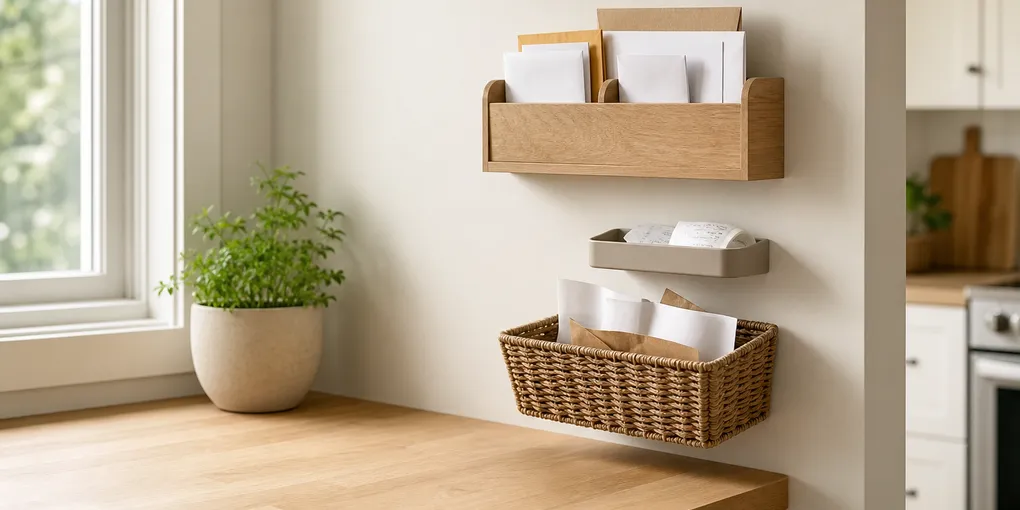
Kitchen Mail Command Center Protocol: Stop Paper From Settling in the Kitchen
ProtocolKitchen counters become paper stations because they are near traffic, never because the paper belongs there. The result is usually the same: bills, school forms, receipts, returns, and flyers become one mixed layer between meal prep, pets, and children.
The solution is not a bigger organizer or a prettier basket. It is a command center that has a strict size, strict job roles, and a strict exit path.
The 30-minute command setup
Start with only one visible paper surface and one recycle outlet. If you already have more than one tray, remove extras for 48 hours and run only this configuration.
Minute 0-5: Make the command path explicit
Create these three zones in order from left to right on your counter or hallway bench:
- Paper intake: a shallow tray or open basket for all new arrivals.
- Action/archive lane: one narrow tray or folder slot for items requiring action.
- Exit path: the recycle and shred bin should be one step away, not hidden in another room.
Do not place identity-sensitive papers beside wet or high-humidity areas. The goal is speed, not storage density.
Minute 5-10: Define two paper verbs, not five
Use exactly two active verbs on the paper surface. The cleanest pair for kitchen-entry flow is:
- Act now: bills, urgent school notices, legal or medical follow-up.
- Archive: items needed for the current filing window only.
Everything else goes to recycle, shred, or return bins on sight.
Minute 10-20: Add one outbound bin
Outbound and returns are a separate category because they do not belong in the same lane as in-home decisions. Put a dedicated return basket near the door or next to the kitchen prep zone. If the return item is not packed, it is not ready to become the center of your station.
Minute 20-30: Set the weekly window
Pick a fixed ten- to twenty-minute window in advance of meals and before bed. This window is where everything not solved in under one minute is assigned, moved, or explicitly deferred with a calendar reminder.
Why kitchen paper fails first in many homes
The kitchen is a high-traffic service surface: it gets hands, keys, phones, and packages more often than many other areas. If paper is not forced into a narrow decision loop, it accumulates as friction.
Federal policy guidance on personal-data protections repeatedly emphasizes separating sensitive paperwork from routine household clutter so identity-bearing documents are not accidentally left in open view. The practical implication is straightforward: action papers should not be “out of sight” clutter for long; they should be “in a correct place” for a short period, then moved into controlled storage.
This protocol does not create a filing office. It creates a short bridge between arrival and action.
What counts as a hard failure
If any one of these appears, the command center is overloaded:
- The tray fills more than halfway by 5:00 PM.
- At least two family members are unsure where the same category belongs.
- Recycle or returns are behind other papers for more than one day.
- Papers leave the kitchen but reappear later in the same space.
These are not behavior failures by themselves. They are a topology failure. Reduce categories or reposition the station before adding new tools.
Step-by-step daily routine
Use this flow every day:
- Empty all incoming paper from counter, mailbox shelf, backpack pockets, and floor.
- Apply one of three actions to each item: act now, archive this week, or exit.
- Remove exit items immediately (recycle/shred/return route).
- Keep only uncompleted action/this-week-archive items in the visible center.
- Close the station before cooking begins.
If an item takes longer than your planned weekly window, move only the category label into action and keep the paper in a temporary secure container, not in the command tray.
Choosing location without guessing
Use this sequence:
- Place station at first paper landing point.
- Keep station clear of the prep sink line.
- Keep walking path clear for carrying food and drinks.
- Keep sensitive papers visible to the household, but not on open public-facing counters.
In many homes, this is best as a narrow station in the corridor between entry and kitchen, not on the island or stove side.
Recovery for shared households
If more than one person handles mail, add two role rules:
- One person owns the daily reset.
- One person owns the weekly window.
Share the same station and same folder labels for the full household. Shared systems fail less often when labels are obvious and identical.
Five-minute weekly review
During your weekly paper window:
- Clear all junk mail.
- Pay or date-stamp all action papers.
- Assign one return deadline for every package packet.
- File only the minimum retention items.
- Refresh labels if category names became unclear.
If all files need a second label by the second week, shorten your categories before expanding storage.
Tradeoff notes
The command center works best when it is small and obvious. You can keep a larger filing system elsewhere, but the kitchen station should only capture immediate decisions. It is a handoff point, not your home archive.
Related reading
Sources
- Consumer Financial Protection Bureau and identity protection resources for safe mail handling and sensitive information practices.
- FTC privacy guidance on personal information handling and identity-theft prevention.
- U.S. Environmental Protection Agency and local recycling guidance on source separation where applicable.
Frequently Asked Questions
- Keep it to one tray width or one shallow rack: it must hold one arrival wave, not three days of paper. If it hides behind the sink or blocks a prep path, it is too large.
- Separate action papers from recycle and outbound mail, but keep both in the same short-horizon station until a weekly window. Mixed folders create delay because everyone starts with different priorities.
- Move only reviewed and still-active papers to a single archive folder in the home office, closet, or document shelf with a clear label. Don’t add additional new folders during the weekly window.
- Place the first-surface station at the first place paper usually lands. If that means a garage drop tray, move the command center there and keep one clear pass route to the kitchen.