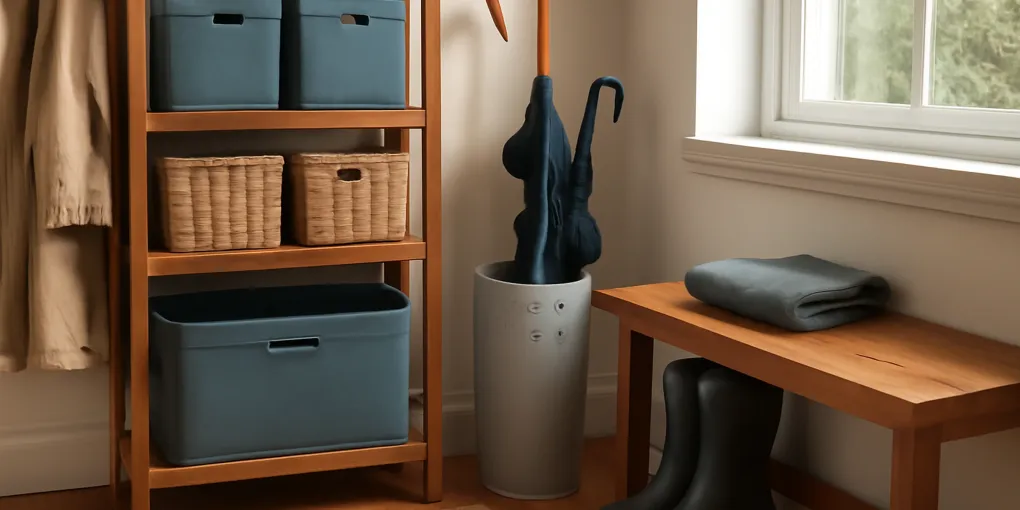
Rainy-Day Entryway Umbrella Station Protocol: Stop Wet Gear From Spreading
ProtocolQuick picks
Ventilated umbrella stand with drip tray
★ Top pick Best wet-umbrella home- Best For: Long umbrellas, compact umbrellas, and a contained drying spot near the door
- Caveat: Needs enough weight or wall support so it does not tip when full
Rubber boot tray
Best floor-protection layer- Best For: Wet shoes, dripping umbrellas, dog-walk gear, and muddy kids' boots
- Caveat: A tray still needs a pair limit or it becomes a wet pile
Wall hooks for rain jackets
Best vertical drying cue- Best For: Light jackets, kids' raincoats, tote umbrellas, and dog towels
- Caveat: Install into suitable backing and leave air space between wet items
A rainy-day entryway fails when wet gear has no first stop. Umbrellas drip on the floor, shoes spread into the walking path, jackets land on chair backs, and dog towels migrate to the nearest railing. The mess is not just visual. It is a moisture, path-clearance, and timing problem.
The protocol is simple: create one wet zone at the door, one vertical drying cue, and one reset time after items stop dripping. The goal is not to store every coat and shoe in the entryway. The goal is to interrupt the wet-gear spread before it reaches the hallway, kitchen, or living room.
Quick comparison: rainy-day storage pieces
- For umbrellas: ventilated umbrella stand with drip tray (Search Amazon for umbrella stands with drip trays).
- For shoes and temporary drips: rubber boot tray (Search Amazon for rubber boot trays).
- For jackets and dog towels: entryway wall hooks (Search Amazon for entryway rain jacket hooks).
Choose the piece that solves the first failure. If umbrellas are the problem, buy a stand before a bench. If wet shoes block the door, start with a tray. If jackets hit dining chairs, add hooks at shoulder height.
Step 1: Pick the wet zone
The wet zone should be inside the door but out of the swing path. Measure the deepest shoe, the door swing, and the walking lane before buying a tray or stand. A beautiful umbrella stand that forces people to sidestep will be moved or ignored.
Place the tray where wet shoes naturally land. If people enter through a side door, the front entryway may not matter. The best system follows the rainy-day route, not the formal door.
Step 2: Separate dripping from drying
Dripping and drying are different jobs. Umbrellas and wet shoe soles need a washable catch surface. Jackets need air space. If wet jackets sit in a heap on the tray, sleeves stay damp and the pile becomes harder to reset.
Use the umbrella stand for vertical drainage and the boot tray for shoes. Use hooks for jackets only when they can hang without touching the wall too tightly. For kids, install one low hook so the jacket can be hung before it becomes floor clutter.
Step 3: Cap the tray
A boot tray works only when it has a capacity limit. Two adult pairs, a child pair, and one umbrella may be all a small entry can handle. When the tray is full, dry or low-use shoes must move to the shoe rack, closet, or bedroom.
This is the same overflow rule described in why entryway shoe piles grow: the landing zone should hold active items, not become permanent storage for every shoe in the household.
Step 4: Add a reset time
Rain gear needs a second decision after it dries. Pick a reset time: after dinner, before bed, or the next morning. Empty water from the umbrella tray if needed, move dry shoes away, hang jackets in the closet, and leave the wet zone ready for the next storm.
Without this second decision, the station becomes a damp museum of the last three rainy days. The reset is what keeps the protocol from turning into another entryway pile.
Fit checks that matter
| Fit check | What to verify |
|---|---|
| Fit and safety | Strong when the station reduces slips, damp spread, and blocked walking paths at the actual entry used in bad weather. |
| Verifiable details | Best judged by measurements: tray depth, stand stability, hook spacing, door swing, and flooring tolerance. |
| Value and capacity | High for a small tray plus stand that prevents floor damage; low for oversized furniture that narrows the entry. |
| Daily friction | Common friction points are tipping umbrella stands, trays that overflow, hooks that crowd jackets, and hidden water under shoes. |
| Listing clarity | Product pages should show dimensions, material, drainage or tray details, weight, and mounting hardware. |
Safety and moisture notes
Wet entryways can create slip hazards, especially when the walking path is narrow or people enter carrying bags. The CDC’s home and recreation safety guidance emphasizes preventing falls by reducing environmental hazards. For rainy entries, that means keeping shoes and umbrellas out of the walking lane and wiping standing water quickly.
Moisture can also affect floors and walls. Use washable trays on wood or laminate, avoid trapping water under mats, and let wet fabric dry with air space. If a wall hook area repeatedly gets damp, move the drying location or add a washable backing.
Sources: CDC older adult fall prevention, https://www.cdc.gov/falls/.
Apartment version
If drilling is not allowed, use a freestanding umbrella stand and a low boot tray rather than wall hooks. A tension rack may work in some spaces, but check stability carefully; wet jackets are heavier than dry scarves. Over-door hooks can help when the door opens freely and the hooks do not scrape the frame.
Keep the apartment version smaller, not larger. One stand, one tray, and one over-door hook row are easier to maintain than a hallway full of temporary drying points.
FAQ
Should umbrellas dry open or closed?
If there is safe space, opening an umbrella briefly can speed drying. In a small entryway, a ventilated stand is usually safer because an open umbrella can block the path or poke into furniture.
What size boot tray works for rain gear?
Choose a tray based on the number of wet pairs that arrive at the same time. For many small entries, a tray that holds two adult pairs and one child pair is more realistic than a large tray that blocks the door.
Where should dog towels go on rainy days?
Put one washable dog towel on a hook or in a small open bin near the tray. Do not store a stack of clean towels in the wet zone; keep backups in a linen closet or laundry area.